Week - 2 - Explicit and Implicit Analysis
Week - 2 - Explicit and Implicit Analysis
As demonstrated in the PDF, F(u) = u3+9u2+4u use this equation and solve using both Explicit and Implicit Methods ( have a tolerence of 0.001).
F(u) = u3+9u2+4u
Stiffness k(u) = df/du=3u2+18u+4
F=k(u)
∆F=k(u)* ∆u
Here,
∆F=1;U0=0
U1=u0+ ∆u
∆u= ∆F/k(u)
|
U1=u0+ ∆u1 ∆u1= ∆F/k(u0) ∆u1=1/3u2+18u+4 ∆u1=1/3(0)2+18(0) +4 ∆u1=1/4=0.25 U1=u0+ ∆u1=0+0.25=0.25 |
U2=u1+ ∆u1 ∆u2= ∆F/k(u1) ∆u2=1/3u2+18u+4 ∆u2=1/3(0.25)2+18(0.25) +4 ∆u2=1/8.688=0.115 U2=u1+ ∆u2=0.25+0.115=0.365 |
U3=u2+ ∆u3 ∆u3= ∆F/k(u2) ∆u3=1/3u2+18u+4 ∆u3=1/3(0.365)2+18(0.365) +4 ∆u3=1/10.9696=0.0911 U3=u2+ ∆u3=0.365+0.0911=0.456 |
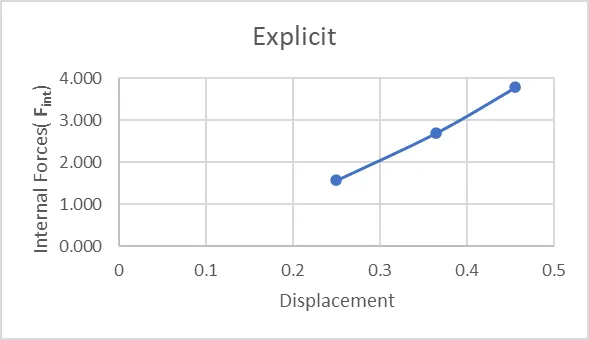
from the three steps the following results are obtained
External Forces Fext = ∆F + ∆F + ∆F = 1+1+1=3.0
Internal Forces Fint = u3+9u2+4u = (0.456)3+9(0.456)2+4(0.456) =3.79
It is evident from the results that external and internal forces are NOT in equilibrium because
Fext ≠Fint.
|
Step |
∆Fi |
∆ui |
ui |
(Fext)i |
(fint)i |
fint − Fext = R |
|
1 |
1 |
0.25 |
0.25 |
1 |
1.578 |
0.578 |
|
2 |
1 |
0.115 |
0.365 |
2 |
2.708 |
0.708 |
|
3 |
1 |
0.0911 |
0.456 |
3 |
3.790 |
0.790 |
Implicit Analysis
An implicit analysis is the same as the explicit analysis, except that at the end of each step Newton-Raphson iterations are used to enforce equilibrium before moving to the next step.
Basically, an incremental force is applied to advance the solution forward at the beginning of a step. However, internal forces and external forces will not be in equilibrium unless the stiffness is linear for the given step. Hence, in order to achieve equilibrium, corrections must be made to the displacement
This is accomplished by using Newton-Raphson iterations to minimize the residual,
R(u) = fint − Fext.
Expanding the residual as a Taylor series about the current displacement u j gives
R j+1 = R j (u j ) + dR(u j ) /du .δuj+1 + ... = R j + k(u j )δuj+1 + ...
By neglecting higher order terms in the series, setting Rj+1 = 0 and solving for δuj+1 the following correction is obtained
δuj+1 = −[k(u j )]−1R j .
Notice: that the iteration variable is j and it may take several iterations for the norm of the residual, |R|, to be reduced below the chosen tolerance criteria (for the below a tolerance of 10−2 is chosen).
Here,
∆F=1;U0=0
U1=u0+ ∆u
∆u= ∆F/k(u)
Find “U1”
U1=u0+ ∆u1,
∆u1= ∆F/k(u0)
∆u1=1/3u2+18u+4
∆u1=1/3(0)2+18(0) +4
∆u1=1/4=0.25
U1=u0+ ∆u1=0+0.25=0.25
After finding this u1, apply this Fext.
check the residual, Fext = ∆F = 1, fint = u3+9u2+4u = (0.25)3+9(0.25)2+4(0.25) =1.578
R(u) = fint − Fext.
R(u1) =1.578 -1=0.578
||R0|| > 10−2 ⇒ another Newton-Raphson iteration is necessary
Apply Taylor equation.
Δu11 = − [k(u10)]−1 .R j .
consider u1=u0
δu11 =-[3u2+18u+4]-1 *0.578=-[3(0.25)2+18(0.25)+4]-1 *0.578=-0.0665
u11 = u10 +δu11=0.25+(-0.0665) =0.1835
use this u11=0.1835 and find f int,
fint= u3+9u2+4u = (0.1835)3+9(0.1835)2+4(0.1835) = 1.0430
Fext=1
R(u1) = fint − Fext =1-1.0430=0.0430
(For the above more than a tolerance of 10−2 repeats this up to below the value)----------------1
consider u12=u11
δu12=-(k(u11))-1.R1
δu12 =-[3u2+18u+4]-1 *0.0430=-[3(0.1835)2+18(0.1835)+4]-1 *0.0430= -0.00581
u12= u11+ δu12=0.1835+(-0. 0.00581) = 0.17769
use this u12=0.1777and find f int,
fint= u3+9u2+4u = (0.1777)3+9(0.1777)2+4(0.1777) = 1.0003
Fext=1
R(u1) = fint − Fext =1-1.0003=0.0003
R=0.0003<0.001
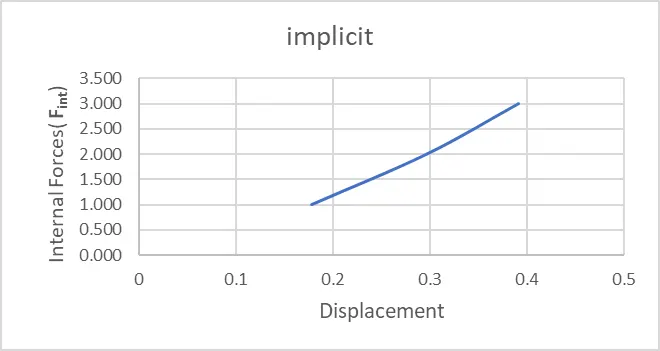
||R|| < 10−2 ⇒ no further iterations are necessary U1=0.1777
Find “U2”
U2=u1+ ∆u2
∆u2 = ∆F/k(u1)
=1/(3u2+18u+4)=1/(3*0.17772+18*0.1777+4)= 0.1371
U2 =0.1777+0.1371=0.3148
Apply u2 in fext F(u) = u3+9u2+4u
F(u2) = u23+9u22+4u2
= (0.3148)3+(9*0.3148)2+(4*0.3148)
Fext(u2) = 2.1824
R(u2) = fint − Fext =2-2.1824=0.1824
Apply Taylor equation. Δu21 = − [k(u0)]−1 .R j .
consider u21=u20
δu21 =-[3u2+18u+4]-1 *0.1824 =-[3(0.3148)2+18(0.3148)+4]-1 *0.1824 =-0.0183
u21= u20 +δu21=0.3148+(-0.0183) =0.2965
use this u11=0.2965and find f int,
fint= u3+9u2+4u = (0.2965)3+9(0.2965)2+4(0.2965) = 2.0032
Fext=2
R(u12) = fint − Fext =2-2.0032=0.0032
(For the above more than a tolerance of 10−2 repeats this up to below the value)----------------1
consider u22=u21
δu22 = − [k(u21)]−1 .R 1 .
δu22 =-[3u2+18u+4]-1 *0.0032=-[3(0.2965)2+18(0.2965)+4]-1 *0.0032 = -0.00033
u22= u21+ δu22=0.3148+(-0.00033) = 0.2962
use this u22=0.2962and find f int,
fint= u3+9u2+4u = (0.2962)3+9(0.2962)2+4(0.2962) = 2.000001
Fext=2
R(u22) = fint − Fext =2-2.000001=0.000001
R=0.000001<0.001
||R|| < 10−2 ⇒ no further iterations are necessary U2=0.2962
Find “U3”
U3=u2+ ∆u3
U2=0.2962
∆u3 = ∆F/k(u2)
=1/(3u2+18u+4)=1/(3*0.2962+18*0.2962+4)= 0.10422
U3 =0.2962+0.10422=0.4004
Apply u2 in fext F(u) = u3+9u2+4u
F(u3) = u33+9u32+4u3
= (0.4004)3+(9*0.4004)2+(4*0.4004)
Fext(u2) = 3.1089
R(u2) = fint − Fext =3-3.10894=-0.10894
Apply Taylor equation. Δu31 = − [k(u0)]−1 .R j .
consider u31=u20
δu31 =-[3u2+18u+4]-1 *0.10894 =-[3(0.4004)2+18(0.4004)+4]-1 *0.10894=-0.0093
u31= u30 +δu31=0.4004+(-0.0093) =0.3911
use this u31=0.3911and find f int,
fint= u3+9u2+4u = (0.3911)3+9(0.3911)2+4(0.3911) = 3.000855237
Fext=3
R(u3) = fint − Fext =3-3.000855237=0.000855237
R=0.000855237<0.001
||R|| < 10−2 ⇒ no further iterations are necessary U2=0.3911
|
Step |
∆F |
ui |
Fext)i |
(fint)i |
fint − Fext = R |
|
1 |
1 |
0.1777 |
1 |
1.001 |
0.001 |
|
2 |
1 |
0.2962 |
2 |
2.000 |
0.000 |
|
3 |
1 |
0.3911 |
3 |
3.001 |
0.001 |