Week - 2 - Explicit and Implicit Analysis
WEEK 2 -EXPLICIT AND IMPLICIT ANALYSIS
As demonstrated in the PDF, F(u) = u3+9u2+4u use this equation and solve using both Explicit and Implicit Methods ( have a tolerence of 0.001).
Deliverables :
1. Write a detailed report about Implicit and explicit methods.
2. Do the calculations in a spreadsheet, try to plot the graph and compare them (optional).
3. Calculations that are done in a piece of paper and uploaded as an image will not be taken into consideration for grading.
4. Equations can be typed using the insert equation option present in the toolbar. Equations are supposed to be typed and not copy-pasted as images.
5. plots can be uploaded as images, Don't use the google drive to upload the plots you can upload images directly and post it in the answer section.
Objective:
• To solve the given non-linear equation "F(u)- u3+9u2-4u" using both Explicit and Implicit Methods.
• To perform 3 steps for both explicit and implicit Methods & calculate the various parameters such as displacement, stiffness, internal & external forces. Then, To suggest the best method.
• To plot the obtained results for both explicit and implicit methods.
Theory required:
Explicit Analysis:
The explicit analysis is preferred for the following reasons:
- Acceleration is assumed to be constant over the time step.
- It will calculate the state of the system at different times by considering the current time, which results in finding out the solution faster.
- Each increment is founded fast, This results in less computation. • Explicit method is used for large strain deformation problems, Which includes the applications such as Automotive Crash analysis, Drop test & a few dynamic analyses.
- One of the cons in the explicit analysis is: More increments are needed to match up with the exact solution.
- Less accuracy in the obtained results when compared to the solution obtained by the implicit method.
Implicit Analysis:
The implicit analysis is preferred for the following reasons:
- In implicit analysis, Acceleration is assumed to vary linearly over the time step(Which could be either positive (or)Negative).
- It will calculate the solution by considering the current & further states of the system, which helps in attaining the equilibrium between the external & internal forces before moving into the next step with the help of Newton-Raphson iterations.
- An implicit method is used for small strain deformation problems.
- More accuracy in the obtained results when compared to the solution obtained by the explicit method.
- This method is used where the events to be performed are fewer.
Procedure:
Consider the case of a simple bar in tension as shown in Figure 1. Suppose that the force
in the bar is a nonlinear function of the displacement
`F(u)=u^3 + (9.u²) + 4u` ----eq(1)
From (1) it follows that the stiffness of the bar is
k(u) = dF / du = 3*u^2 + 18*u + 4
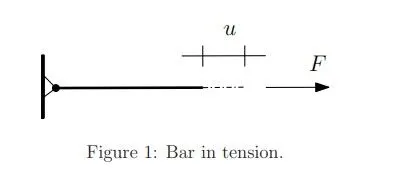
Where,
F = external force applied to the bar
u = Displacement
f = Internal force in the bar
k = Stiffness
`Delta` u = Incremental displacements
`Delta` F = Incremental externally applied forces
Explicit Method:
For the nonlinear analysis, the force Vs displacement relationship is not known, but the stiffness is known, it is possible to construct the graph of force Vs displacement numerically. One method is, To use an incremental explicit load control scheme. For this example, three equal load increments (or steps) of `Delta`F = 1 unit each are used to load the tension bar.
For finding the stiffness, The following relationship: `Delta`F = `Delta` u is used.
Then, k'(u) = dF/du ----- eq(2)
Therefore. The analysis proceeds as follows:
Step 1:
This step is performed by taking the initial conditions as follows:
u0 = 0.0,
⇒ k(u0) = (3.u0^2)+ (18.(0))+4
therefore k(u0)= 4,
∆F = 1,
then ∆u1 = ∆F/k(u0)=`1/4`=0.25
u1 = u0 + ∆u1 = 0+0.25=0.25 ----- eq(3)
then internal force (f) can be calculated by substituting the "u1" value in equation 1:
f1= (0.25)^3 + (9*(0.25)^2) + (4*0.25)
= 1.578125
therefore, the internal force for the first increment is 1.578125.
Step 2:
In this step. The externally applied load is incremented by one unit(`Delta`F=1).
From eq(3), The value for displacement for this iteration is u1= 0.25
Then, Stiffness for this step is calculated by:`k(u1)= (3.(u1)^2) + (18*u1) + 4`
k(u1)=(3*(0.25)^2)+18*(0.25)+4
k(u1) = 8.6875
Now the incremental displacement for this step is : `Delta u2`=`DeltaF`/K(u1)= 1/8.6875
`Delta u2`=0.11512
u2= u1 + `Deltau2` = 0.25 + 0.11512 = 0.36512
internal force f2 = (0.36512)^3 + (9*(0.36512)^2) + (4*0.36512)
=2.708
step 3 :
in this step also, the externally applied load is incremented by one unit ∆F = 1
u2= 0.36512
k(u2)=(3*u2^2) + (18*u1) + 4
= (3*(0.3652)^2) + (18*u1) + 4
k(u2)= 10.97
∆u3 = ∆F/K(u2) = 1/10.97
∆u3 =0.09115
u3 = u2 + ∆u3 = 0.36512 + 0.09115 = 0.45627
internal force f3 = (0.45627)^3 + (9*(0.45627)^2) + (4*0.45627)
=3.794
| step no. | incremental external force (∆F) |
incremental displacement (∆u) |
displacement (u) | external force (F) | internal force (f) | residual force = f-F |
|
1 |
1 | 0.25 | 0.25 | 1 | 1.578125 | 0.578125 |
| 2 | 1 | 0.11512 | 0.36512 | 2 | 2.708 | 0.708 |
| 3 | 1 | 0.09115 | 0.45627 | 3 | 3.794 | 0.794 |
Result:
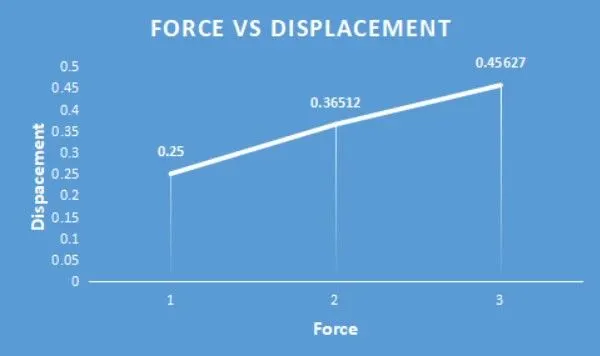
From the above table, The residual force(difference between internal & external forces are not equal) & more in magnitude. This depicts that, external and internal forces are NOT in equilibrium. To reduce the residual forces, more iterations should be performed. The only advantage of choosing an explicit method for performing the analysis is, The processing time is very less when compared to the implicit method.
The obtained result in explicit methods is plotted & it appears as shown in the below fig.
Implicite Analysis :
Step 1:
in this step , the initial condition are taken into consideration as follows :
u0= 0
∆F= 1
k(u0)= 4 ----> as funded in explicit analysis step 1.
∆u1 = ∆F / K(u0) = 1/4 =0.25
`f1^0`= (0.25)³+(9 *(0.25)²)+(4*0.25)
= 1.578125
Check the residual,
residual force (`R^0`)= internal force(`f1^0`)- external force (F)
=1.57812-1
=0.57821 , which is greater than 0.01
if (`R^0`) > (10^−2) ⇒ Newton-Raphson iterations are necessary.
Then Newton-Raphson iterations are necessary to get the forces in to equilibrium.
u1= u1⁰
`deltau1^1`= -[k(u1)]¹. `R^0`=-[8.6875]^(-1)*(0.57821)
= -0.066
Now update the value of u1
u1= `u1^0 + deltau1^1` =0.25 + (-0.066) =0.184
`f1^1=(0.184)^3 + (9*(0.184)^2) + (4*0.184 ) = 1.0469`
Now the residual is founded again , `R^1` = internal (`f1^1`) - external force (F)
= 1.0469-1 =0.0469 which is greater then 0.01
Newton-Raphson iterations are necessary.
u1= u1⁰
`deltau1^2`= `deltau1^1`-[k(u1)]¹. `R^1`=(-0.066)-[8.6875]^(-1)*(0.0469)
=-0.066-0.0054
=-0.0711
therefore , `deltau1^2`= -0.0711
Now the updated u1= `u1^0 + deltau1^2`
=0.25+(-0.0711) = 0.1789
`f1^2=(0.1789)^3 + (9*(0.1789)^2) + (4*0.1789 ) = 1.0093`
R² = internal force(ƒ1²)-external force (F) = 1.0093-1=0.0093 Which is <0.01.
Therefore, The final value of u1 = 0.1789
step 2:
u2= u1= 0.1789
`k(u2)= 3*(0.1789)^2 + (18*(0.1789)) + 4`
`Delta u2 = Delta F`/ K(u1) =0.1366
`u2^0 = u1 + Deltau2 = 0.1789 + 0.1366 = 0.3115`
`f2^0 = (u2^0)^3 + 9 (u2^0)^2 + 4(u2^0)`
`f2^0=(0.3115)^3 + (9*(0.3115)^2) + (4*0.3115 ) = 2.15`
Residual, R^O = f2-F = 2.15-2 =0.15 Which is >0.01. So, The Newton's Raphson iterations are used to find u2.
`k(u2^1) = (3*(u2^0)^2)+(18*(u2^0))+4 = (3*(0.3115)^2)+(18*(0.3115))+4= 9.898`
`deltau2^1=-[k(u2¹)]^(-1)*R^O` = -0.01515`
Therefore,`u2¹ = u2º+deltau2^1 = 0.3115-0.01515 = 0.296`
Now, `f2^1 = (u2¹)³+9 (u2¹)²+4(u2¹) = 2.0032`
Residual, `R¹ = f2¹-F = 2.0032-2 = 0.0032 <0.01.`
So, The updated u2 is u2^1 = 0.296
step 3:
u3= u2= 0.293
`k(u3)= 3*(0.293)^2 + (18*(0.293)) + 4`=9.53
`Delta u3 = Delta F`/ K(u3) =1/9.53 = 0.1049
`u3^0 = u2 + Deltau3 = 0.293 + 0.1049 = 0.3979`
`f3^0 = (u3^0)^3 + 9 (u3^0)^2 + 4(u3^0)`
`f3^0=(0.3979)^3 + (9*(0.3979)^2) + (4*0.3979 ) = 3.07951`
Residual, R^O = f3^0-F = 3.07951-3 = 0.07951 Which is >0.01. So, The Newton's Raphson iterations are used to find u3.
`k(u3^1) = (3*(u3^0)^2)+(18*(u3^0))+4 = (3*(0.3979)^2)+(18*(0.3979))+4= 11.64`
`deltau3^1=-[k(u3¹)]^(-1)*R^O` = -0.00683
Therefore,`u3¹ = u3º+deltau3^1 = 0.3979 - 0.00689 = 0.39107`
Now, `f3^1 = (u3¹)³+9 (u3¹)²+4(u3¹) = 3.0005`
Residual, `R¹ = f2¹-F = 3.0005-3 = 0.0005 <0.01.`
So, The updated u3 is u3^1 = 0.39107
| step no. | incremental external force (∆F) |
incremental displacement (∆u) |
displacement (u) | external force (F) | internal force (f) | residual force = f-F |
|
1 |
1 | 0.25 | 0.1789 | 1 | 1.0093 | 0.0093 |
| 2 | 1 | 0.1366 | 0.296 | 2 | 2.0032 | 0.0032 |
| 3 | 1 | 0.1049 | 0.39107 | 3 | 3.0005 | 0.0005 |
Result:
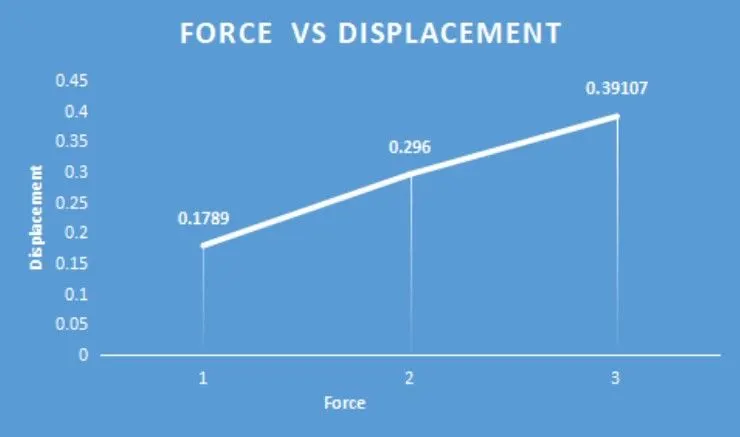
From the above table, The residual force(difference between internal & external forces are not equal) & less in magnitude & tries to attain the equilibrium m between the forces when compared to the results obtained in Explicit analysis. This depicts that, external and internal forces are almost brought to equilibrium by using the newton-Raphson iterations.
The obtained result in implicit methods is plotted & it appears as shown in the
below fig.
Conclusion:
Final comparison graph distinguishing the implicit, explicit & exact calculations with force Vs Displacement:
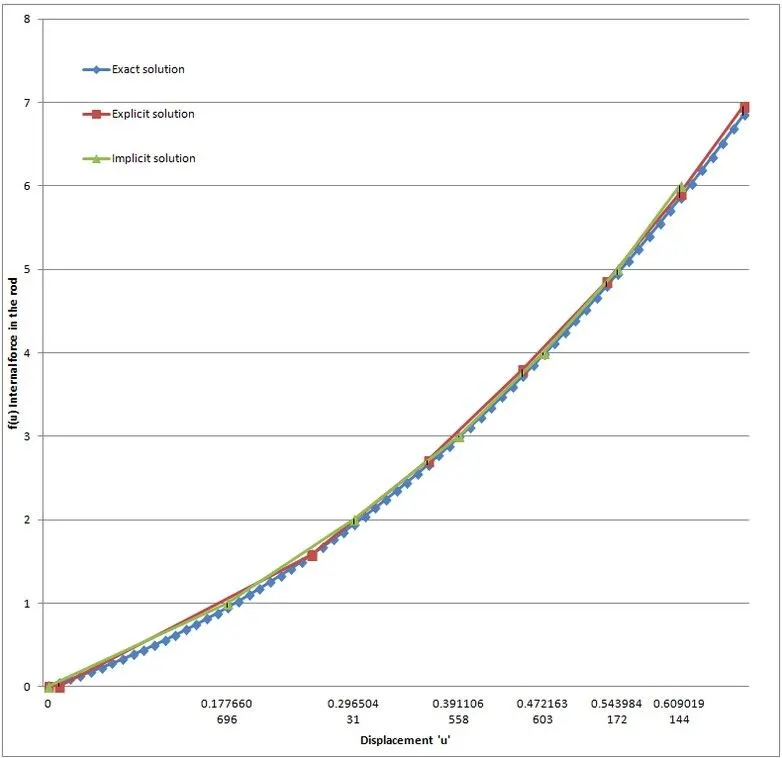
From the above fig, The following aspects are concluded:
. The explicit solution drifts a bit from the exact solution. This is due to the residual force (difference between internal & external forces are not equal) & more in magnitude. In order to attain equilibrium between forces, More iterations are needed.
. But the solution obtained by the implicit method with the newton-Raphson method iterations, Will help the solution to attain the equilibrium between the internal & external forces. Which results in getting the solution much closer to the exact solution.
• As the given equation F(u) = u3+9u2+4u is non-linear, The obtained result in terms of force Vs displacement will be in an
exponential form. As shown in above fig.