Week - 2 - Explicit and Implicit Analysis
AIM
To study about implicit and explicit method to solve a given polynomial equation
F(u) = u3+9u2+4u
EXPLICIT and IMPLICIT Method
Implicit and Explicit analysis differ in the approach to time incrementation.
Explicit methods calculate the state of a system at the next time step from the state of the system at the current time, Explicit analysis handles non linearities with relative ease compared to implicit analysis. In nonlinear implicit analysis, solution of each step requires a series of trial solutions (iterations) to establish equilibrium within a certain tolerance.
In explicit analysis, no iteration is required as the nodal accelerations are solved directly. However, each time increment has to converge, but you can set quite large time increments. Explicit analysis doesn’t need to have a convergence at each increment, but time increments must be super small for the accuracy of solution since the time step in explicit analysis must be less than the Courant time step for it to be valid. Implicit method checks for convergence after every time-step this is achieved by incorporating a correction scheme using newton Raphson iteration to minimize the residual This method is suitable for highly linear problems.
1.Explicit Method:
F(u) = u3+9u3+4u, to solve this equation an incremental explicit load control scheme is used.
Three equal load increment of ΔF = 1 unit are used,
u - displacement
f - internal force
F - external force applied
K – stiffness
Δu - Incremental displacement and
ΔF - Externally applied load
Force(F) = Stiffness (K)* displacement (u)
F(u) = u3+9u3+4u
K(u) = dF/du = 3u2+18u+4
Step 1,
Take u = 0
k(u0) = 3 x 0 + 18 x 0 + 4 = 4
Δu1 = ΔF/k(u0) = ¼ = 0.25
u1 = u0 + Δu1 = 0 + 0.25 = 0.25
Step 2,
Take u1= 0.25
k(u1)= 3 x 0.252 + 18 x 0.25 + 4 = 8.6875
Δu2 = ΔF/k(u1) = 1/8.6875 = 0.1151
u2 = u1+Δu2= 0.3651
Step 3,
Take u2= 0.3651
k(u2)= 3 x 0.36512 + 18 x 0.3651 + 4 = 10.9716
Δu2 = ΔF/k(u2) = 1/10.9716 = 0.09114
u3 = u2+Δu3 = 0.46
Finally,
F(ext) = ΔF+ΔF+ΔF = 3
f(int) = (0.463) + (9 x 0.462) + (4 x 0.46) = 3.841
Thus F(ext) and f(int) are not in equilibrium
|
Step |
ΔF |
Δui |
ui |
Fext |
Fint |
R = Fext - fint |
|
1 |
1 |
0.25 |
0.25 |
1 |
1.578 |
0.578 |
|
2 |
1 |
0.1151 |
0.3654 |
2 |
2.708 |
0.708 |
|
3 |
1 |
0.09114 |
0.46 |
3 |
3.841 |
0.841 |
2.Implicit Method:
F(u) = u3+9u3+4u
K(u) = dF/du = 3u2+18u+4
Step1,
Take u0 = 0
k(u0) = 3 x 0 + 18 x 0 + 4 = 4
Δu1 = ΔF/k(u0) = ¼ = 0.25
u1 = u0 + Δu1 = 0 + 0.25 = 0.25
Residual R0
F = (0.25) + 9 x (0.25) + 4 x 0.25 = 1.578
R0 = 1.578 – 1 = 0.578 > 10-2
Thus, Newton-Raphson iterations is necessary
u1(0) = u1(0) = 0.25
du(1) = -[k(u1(0)]-1 x R0
= - [(3 x 0.25 ) + (18 x 0.250) +4]-1 x 0.578
= - 0.0665
u1(1) = u1(0) + du(1)
= 0.25 – 0.0665 = 0.1835
Residual R1
F = (0.1835) + 9 x (0.1835) +4 x 0.1835 = 1.0432
R1 = 1.0432 – 1 = 0.0432 > 10-2
Thus, Newton-Raphson iterations is necessary
u1(1) = 0.1835
du(2)= du(1) - [k(u1(1))]-1 x R1
= (-0.0665) - (8.6875 )-1 x 0.0432
= -0.0714
u1(2) = u1(1) + du(2)
= 0.25 – 0.0714 = 0.1786
Residual R2
F = (0.1786) + 9 x (0.1786) +4 x 0.1786 = 1.0071
R0 = 1.0071 – 1 = 0.0071 < 10-2
Thus u1 = 0.1786
Step 2&3:
we get u2=0.2968 , u3=0.3913 following a similar approach
|
Step |
ΔF |
ui |
Fext |
Fint |
R = Fext - fint |
|
1 |
1 |
0.1786 |
1 |
1.004 |
0.004 |
|
2 |
1 |
0.2968 |
2 |
2.0038 |
0.0038 |
|
3 |
1 |
0.3911 |
3 |
3.0007 |
0.0007 |
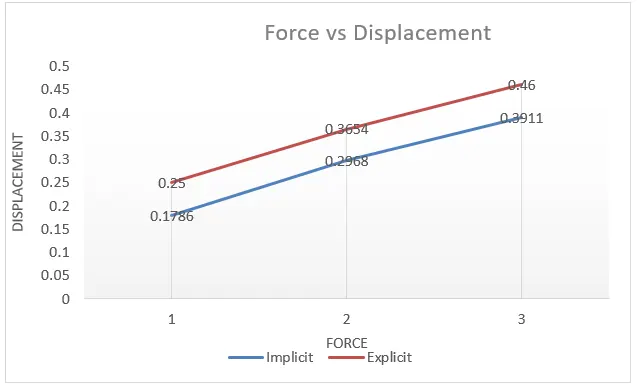
CONCLUSION:
The above equation was solved using both implicit and explicit approaches. The difference being the approach to time increment between the cases. The explicit method gives faster result where as the implicit is more computationally intensive. The results obtained from implicit method match the analytical results where as the explicit method results tends to deviate.