Week 2 Challenge
Q1)
| Type | Polymer electrolyte membrane fuel cell | Alkaline fuel cell | Phosphoric acid fuel cell | Solid oxide fuel cell |
| Type of electrolyte | H+ ions with anions bound in polymer membrane | OH- ions typhically aqueous KOH solution | H+ ions H3PO4 | O2- ions stabilized ceramix matrix with free oxide ions |
| Type of construction | Plastic, metal or corbon | Plastic, metal | carbon, porous ceramics | Ceramics and high temperature metals |
| Internal reforming | No | No | No | Yes, good temperature match |
| Oxidant | air to O2 | purified air to O2 | air to enriched air | air |
| operational temperature | 65-85C | 90 - 260C | 190 -210C | 600 - 1000C |
| power efficiency | 30 - 36 | 30 -40 | 35 - 42 | 40 - 60 |
| fuels used | H2, natural gas, methanol, LPG, naphta and kerosene | H2, methanol, ethanol, sodium boro hydride | H2, natural gas, methanol, lpg, naptha, kerosene | h2, natural gas, methanol, lpg, naptha, kerosene, coal, hydrocarbons |
| Applications | Cars, Trucks,Buses | Primary Generator,UPS ,Backup Power Supply | Buildings, Hotels, Utilities | Power Plants |
Q2)
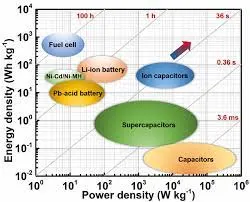
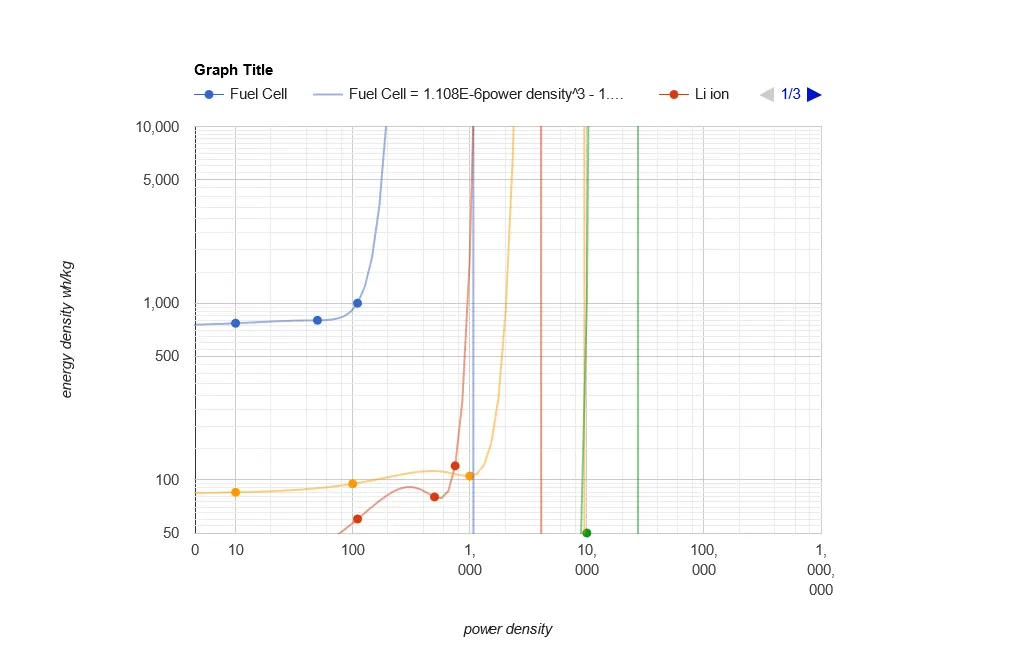
energy density and power density are compared and a graph was plotted. one sourced from online and one made