Week 2 Challenge
Question 1:
Compare four different types of fuel cells and state their applications.
Polymer electrolyte membrane (PEM) fuel cells
Polymer electrolyte membrane (PEM) fuel cells—also called proton exchange membrane fuel cells—deliver high power density and offer the advantages of low weight and volume compared with other fuel cells. PEM fuel cells use a solid polymer as an electrolyte and porous carbon electrodes containing a platinum or platinum alloy catalyst. They need only hydrogen, oxygen from the air, and water to operate. They are typically fueled with pure hydrogen supplied from storage tanks or reformers.
PEM fuel cells operate at relatively low temperatures, around 80°C (176°F). Low-temperature operation allows them to start quickly (less warm-up time) and results in less wear on system components, resulting in better durability. However, it requires that a noble-metal catalyst (typically platinum) be used to separate the hydrogen's electrons and protons, adding to system cost. The platinum catalyst is also extremely sensitive to carbon monoxide poisoning, making it necessary to employ an additional reactor to reduce carbon monoxide in the fuel gas if the hydrogen is derived from a hydrocarbon fuel. This reactor also adds cost.
application:
PEM fuel cells are used primarily for transportation applications and some stationary applications. PEM fuel cells are particularly suitable for use in vehicle applications, such as cars, buses, and heavy-duty trucks.
Solid oxide fuel cells (SOFCs)
Solid oxide fuel cells (SOFCs) use a hard, non-porous ceramic compound as the electrolyte. SOFCs are around 60% efficient at converting fuel to electricity. In applications designed to capture and utilize the system's waste heat (co-generation), overall fuel use efficiencies could top 85%.
SOFCs operate at very high temperatures—as high as 1,000°C (1,830°F). High-temperature operation removes the need for precious-metal catalyst, thereby reducing cost. It also allows SOFCs to reform fuels internally, which enables the use of a variety of fuels and reduces the cost associated with adding a reformer to the system.
SOFCs are also the most sulfur-resistant fuel cell type; they can tolerate several orders of magnitude more sulfur than other cell types can. In addition, they are not poisoned by carbon monoxide, which can even be used as fuel. This property allows SOFCs to use natural gas, biogas, and gases made from coal. High-temperature operation has disadvantages. It results in a slow startup and requires significant thermal shielding to retain heat and protect personnel, which may be acceptable for utility applications but not for transportation. The high operating temperatures also place stringent durability requirements on materials. The development of low-cost materials with high durability at cell operating temperatures is the key technical challenge facing this technology.
Scientists are currently exploring the potential for developing lower-temperature SOFCs operating at or below 700°C that have fewer durability problems and cost less. Lower-temperature SOFCs have not yet matched the performance of the higher temperature systems, however, and stack materials that will function in this lower temperature range are still under development.
Alkaline fuel cells
Alkaline fuel cells (AFCs) were one of the first fuel cell technologies developed, and they were the first type widely used in the U.S. space program to produce electrical energy and water on-board spacecraft. These fuel cells use a solution of potassium hydroxide in water as the electrolyte and can use a variety of non-precious metals as a catalyst at the anode and cathode. In recent years, novel AFCs that use a polymer membrane as the electrolyte have been developed. These fuel cells are closely related to conventional PEM fuel cells, except that they use an alkaline membrane instead of an acid membrane. The high performance of AFCs is due to the rate at which electro-chemical reactions take place in the cell. They have also demonstrated efficiencies above 60% in space applications.
A key challenge for this fuel cell type is that it is susceptible to poisoning by carbon dioxide (CO2). In fact, even the small amount of CO2 in the air can dramatically affect cell performance and durability due to carbonate formation. Alkaline cells with liquid electrolytes can be run in a recirculating mode, which allows for electrolyte regeneration to help reduce the effects of carbonate formation in the electrolyte, but the recirculating mode introduces issues with shunt currents. The liquid electrolyte systems also suffer from additional concerns including wettability, increased corrosion, and difficulties handling differential pressures. Alkaline membrane fuel cells (AMFCs) address these concerns and have lower susceptibility to CO2 poisoning than liquid-electrolyte AFCs do. However, CO2 still affects performance, and performance and durability of the AMFCs still lag that of PEMFCs. AMFCs are being considered for applications in the W to kW scale. Challenges for AMFCs include tolerance to carbon dioxide, membrane conductivity and durability, higher temperature operation, water management, power density, and anode electrocatalysis.
application:
On the world-wide automobile market technical developments are increasingly determined by the dramatic restriction on emissions as well as the regimentation of fuel consumption by legislation. Therefore there is an increasing chance of a completely new technology breakthrough if it offers new opportunities, meeting the requirements of resource preservation and emission restrictions. Fuel cell technology offers the possibility to excel in today's motive power techniques in terms of environmental compatibility, consumer's profit, costs of maintenance and efficiency. The key question is economy. This will be decided by the costs of fuel cell systems if they are to be used as power generators for future electric vehicles. The alkaline hydrogen-air fuel cell system with circulating KOH electrolyte and low-cost catalysed carbon electrodes could be a promising alternative.
Direct methanol fuel cells
Most fuel cells are powered by hydrogen, which can be fed to the fuel cell system directly or can be generated within the fuel cell system by reforming hydrogen-rich fuels such as methanol, ethanol, and hydrocarbon fuels. Direct methanol fuel cells (DMFCs), however, are powered by pure methanol, which is usually mixed with water and fed directly to the fuel cell anode.
Direct methanol fuel cells do not have many of the fuel storage problems typical of some fuel cell systems because methanol has a higher energy density than hydrogen—though less than gasoline or diesel fuel. Methanol is also easier to transport and supply to the public using our current infrastructure because it is a liquid, like gasoline.
applications:
DMFCs are often used to provide power for portable fuel cell applications such as cell phones or laptop computers.
Question 2:
Using a plot with energy density and power density on the X and Y axis, arrange various battery types like lithium ion, lead acid, Nickel Cadmium, Ultracapacitor, fuel cell.
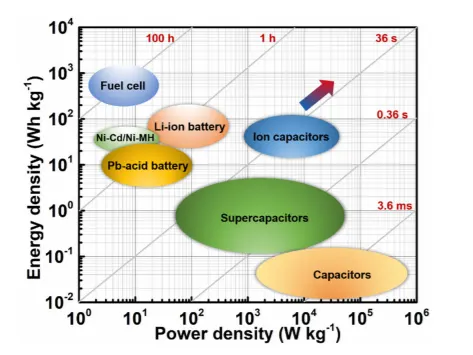
thus from graph we found that, the lithium ion, lead acid, Nickel Cadmium batteries have low power density and moderate energy density.
ultra capacitor or super capacitor have moderate power density and moderate energy density.
the fuel cell have low power density and high energy density.
CONCLUSION:
thus all the objectives are achieved.