Week 2 Challenge
1)
Ans1).Compare four different types of fuel cells and state their applications.
| Fuel cell | Operating temperature(°C) | Power(kw) | Efficiency(%) | Application |
| PEM(polymer electrolyte membrane) | 60°C - 110°C | 0.01-250 | 40%-55% | portables,mobile,low power generation |
| PAFC(phosphoric acid fuel cell) | 70°C - 130°C | 0.1-50 | 50%-70% | mobile ,space, military |
| MCFC(molten carbonate fuel cell) | 175°C - 210°C | 200-100,000 | 40%-45% | medium to large scale power generation and chp(combined heat and power) |
| SOFC(solid oxide fuel cell) | 550°C - 650°C | 0.5-2000 | 50%-60% | large scale power generation |
Ans2).Using a plot with energy density on the X axis and power density on the Y axis, arrange various battery types like lithium ion, lead acid, Nickel Cadmium, Ultracapacitor,fuel cell.
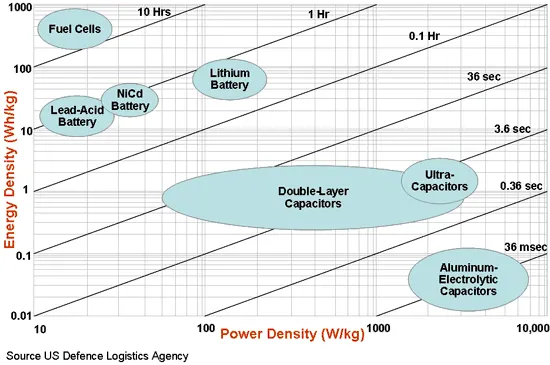
Fuel cell:
Fuel cells work like batteries, but they do not run down or need recharging. They produce electricity and heat as long as fuel is supplied. A fuel cell consists of two electrodes—a negative electrode (or anode) and a positive electrode (or cathode)—sandwiched around an electrolyte. A fuel, such as hydrogen, is fed to the anode, and air is fed to the cathode. In a hydrogen fuel cell, a catalyst at the anode separates hydrogen molecules into protons and electrons, which take different paths to the cathode. The electrons go through an external circuit, creating a flow of electricity. The protons migrate through the electrolyte to the cathode, where they unite with oxygen and the electrons to produce water and heat. Learn more about:
Observation:In this graph we can see that fuel cell has highest energy density which means we can travel long with a fuelcell equipped electric vehicle but it consist of lowest power density which result in slower acceleration and vehicle runs under a speed limit.
ultra capacitors:
Like a battery, a single ultracapacitor cell consists of a positive and negative electrode, separated by an electrolyte. However, ultracapacitors store energy electrostatically, like a regular capacitor, not chemically like a battery - there is a dielectric separator dividing the electrolyte, also like a capacitor.
Observation:completly opposite to the fuel cell ultra capacitors have highest power density but lowest energy density and can not be used as standalone fuel source . it is either used with fuel cell or li-ion batteries.
Lead Acid:
A lead acid battery consists of a negative electrode made of spongy or porous lead. The lead is porous to facilitate the formation and dissolution of lead. The positive electrode consists of lead oxide. Both electrodes are immersed in a electrolytic solution of sulfuric acid and water. In case the electrodes come into contact with each other through physical movement of the battery or through changes in thickness of the electrodes, an electrically insulating, but chemically permeable membrane separates the two electrodes. This membrane also prevents electrical shorting through the electrolyte
Observation:
in comparision to ultra capacitor lead acid battery has higher energy density but low power density which means it has capacity to run a vehicle upto a distance bus has less power
Li-ion battery:
A battery is made up of an anode, cathode, separator, electrolyte, and two current collectors (positive and negative). The anode and cathode store the lithium. The electrolyte carries positively charged lithium ions from the anode to the cathode and vice versa through the separator. The movement of the lithium ions creates free electrons in the anode which creates a charge at the positive current collector. The electrical current then flows from the current collector through a device being powered (cell phone, computer, etc.) to the negative current collector. The separator blocks the flow of electrons inside the battery.
Observation:
the revolunationary invention that changed the energy storage issue and space required to storge high capacity of energy with in a limited space
li-ion battery has a sweet spot between the graph of energy and power compared to other storage option already available in the market li-ion is most suitable and more economical for every pupose and every voltage rating it is used in combination of series and parallel to carry out the required voltage rating .
Li-ion battery:
A battery is made up of an anode, cathode, separator, electrolyte, and two current collectors (positive and negative). The anode and cathode store the lithium. The electrolyte carries positively charged lithium ions from the anode to the cathode and vice versa through the separator. The movement of the lithium ions creates free electrons in the anode which creates a charge at the positive current collector. The electrical current then flows from the current collector through a device being powered (cell phone, computer, etc.) to the negative current collector. The separator blocks the flow of electrons inside the battery.
Observation:
the revolunationary invention that changed the energy storage issue and space required to storge high capacity of energy with in a limited space
li-ion battery has a sweet spot between the graph of energy and power compared to other storage option already available in the market li-ion is most suitable and more economical for every pupose and every voltage rating it is used in combination of series and parallel to carry out the required voltage rating .
Nickel Cadmium:
The chemical reaction that occurs between the layers is what makes the nickel-cadmium battery work. The battery, which is a DC voltage source, is made up of two ports: anode and cathode. The cadmium coating is kept on the redox first when producing the battery. The cathode terminal is the cadmium layer. Cadmium is a heavy metal of excellent electrical conductivity Separator layers are held above the cadmium layer. The separator layer's job is to provide the required OH ions for the chemical reaction. The reaction between the cathode layer mckel and the separator requires OH ions. It produces Nickel oxide OH ions as an output As previously stated, the separator layer is used to provide the OH Ions needed for the chemical reactiom For the initial reaction, the separator layer is soaked in water to provide H20 As a result, one of the byproducts is H20 The cadmium layer is also mixed with OH ions derived from the separator layer on the anode side. Cadmium oxide and electrons are generated as a result of this process. It's worth noting that the electrons in both equations balance out OH ions are also canceled. The third equation, in which nickel is mixed with cadmium and water, is the reminder equation. Nickel oxide and cadmium oxide are the end A surge of electrons follows the chemical reaction, causing a potential difference benveen the two terminals.
Observation:
Nickel Cadmium are better than lead acid battery but in comparision to the li-ion batteries they are similar or we can say as near as lead acid batteries rather than that this batteries are used for following things:portable power tools, photography equipment, flashlights, emergency lighting, hobby R/C, and portable electronic devices