Week 2 Challenge
Given Data:
For the I Girder bridge to be designed for the following data,
- The width of the bridge deck=7m
- The span of the bridge =24m,
- The Pier size (diameter)= 2m
- The seismic zone is Zone III
- Wind speed= 42 km/hr
- The unit weight of soil is 18 kN/m3
Aim: We have to apply the IRC live loads and model in Staad pro and perform the structural analysis.
Solution:
- Calculation of dead load
Let's calculate the self-weight of the bridge, for that, we have to find out the Gross volume of the bridge's superstructure for the entire span and convert it into the dead load by multiplying with the unit weight of Reinforced cement concrete as follows:
Step 1. Calculation of gross volume: (V)
i) RCC railing,25 no. railing posts @ 1000mm c/c
a)Post's rectangular portion=2x25x0.200x0.200x0.865=1.73
b)Post's circular portion (Crown/head)=2x{(25x0.15x0.15x0.15)+(4/3x3.14x0.20^3)}=0.202
ii) Longitudinal members of Railing(assuming dia of member is 1/3 of 0.200)=2x3x24.5x3.14x0.06^2=1.66
iii) 50mm wearing cource= 24.50x7.00x0.05=8.575
iii) Deck slab= 24.50x7.70x0.20=37.73
iv) Kerb Beam= 2x24.50x0.350x0.350=6.00
v)Main girders= 4x24.50x0.50x1.70= 83.30
vi) Cross-girders= 4x0.30x{5.70-(3x0.5)}x1.50=7.56
Total volume "V" is the sum of the above values i.e. (i)+(ii)+(iii)+(iv)+(v)+(vi)=(1.73+0.202)+1.66+8.575+37.73+6.00+83.3+7.56=146.76
Step 2. Calculation of dead load(Self-weight)
We have calculated the total volume of RCC used in the superstructure, So calculate the dead load of the superstructure as follows:
Dead Load = Unit weight of RCC x Volume= 25.00x146.76=3669 KN
- Structural analysis on STAAD Pro
We are directed to apply the IRC live loads and model in STAAD Pro and perform the structural analysis.
Steps of Model generation:
Step 1: Let's first open the STAAD Pro software and create a new file using the name "Challenge 2"
Step 2: As per the above calculations, The Total dead load is 3669 KN for the whole span of 24m, or else we can say that this load is uniformly distributed on this span as UDL of 3669/24=152.875 KN/m as shown in the following figure.
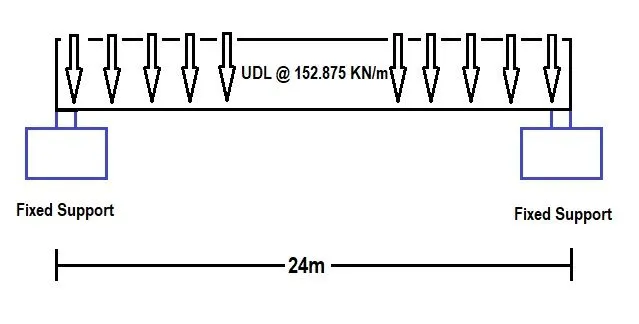
Now, assign the geometrical properties to the model in the software i.e.
1. Draw two columns or piers of diameter 2m each.
2. Join these two piers by a girder for a distance of 24m making it the effective span of the bridge.
Step 3: Assign properties to the members of the structure. Assign a Cross-sectional area of 146.76 cubic meters/24=6.115 square meters, let's assume the x-section of the bridge girder is a rectangular one having dimensions, B=6m & D=1.02 m which has required x-sectional area.
Step 4: Assign material properties to the members of the structure. In this case, we take concrete as a material for analysis.
Step 5: Let's assign the supports to the piers, Use Fixed supports as the piers will be fixed on the foundation.
Step 6: Let's assign loading conditions to the structure, firstly assign a Dead load as UDL of 152.875 KN/m, then assign IRC Live loads and a wind load of 42km/hr or 11.67m/s.
Step 7: For assigning the Live loads, we refer to the code IRC 006-2017. Let's assign the live load of class loading from clause no. 204.1 and page no. 12. Let's assign the axle loads as per the provisions of the aforesaid code as shown in the following picture.
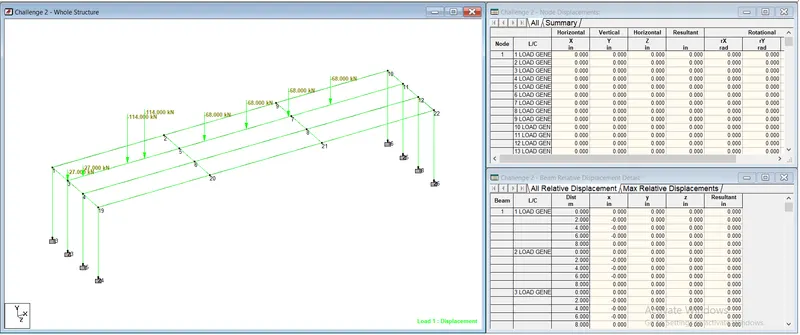
Step 8:Results:
In the challenge, we had to assign IRC live loads for the given conditions, apply it to the STAAD-Pro and Analyse the structure.
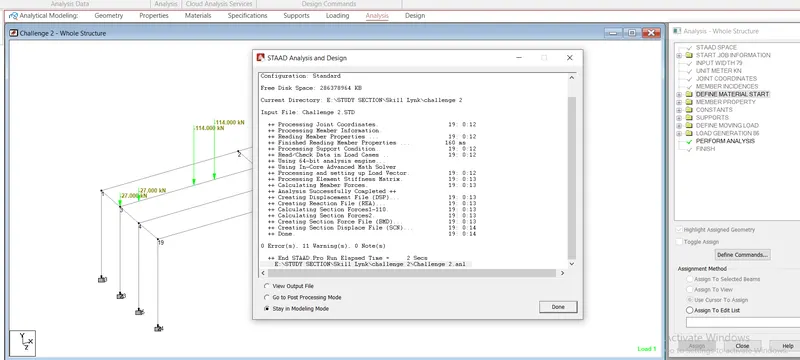
So after performing the above steps, model analysis was done and as shown in the following picture, there are no errors.