Week 2 - EV Challenge
Aim : To study the test conditions for comparing the losses of EV against the ICE vehicles.
Introduction:
- Electric Vehicles (EVs) are a promising technology for drastically reducing the environmental burden of road transport. More than a decade ago and also more recently, they were advocated by various factors as an important element in reducing CO2 emissions of particularly passenger cars and light commercial vehicles as well as emissions of pollutants and noise.
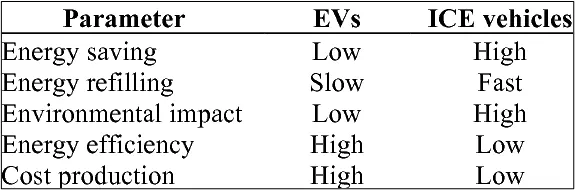
- EVs have various advantages over ICE vehicles (ICEVs), including cheaper fuel, lower maintenance costs, and less air pollution.
Theory & Concept-
- Comparisons between electric vehicles and conventional vehicles are complex. They depend on the size of the vehicles, the accuracy of the fuel-economy estimates used, how electricity emissions are calculated, what driving patterns are assumed, and even the weather in regions where the vehicles are used.
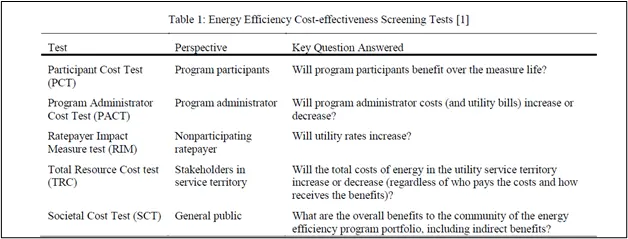
- As shown in Table 1, there are currently five main cost-effectiveness screening tests used to evaluate energy efficiency programs. Each test values certain criteria. The test states utility commission selects for cost-effectiveness screening is a reflection of the jurisdiction’s policy priorities.
- The EV main characteristic is the high efficiency, ranging from 59 to 62%, far exceeding ICE’s, which ranges from 17 to 21%. Moreover, unlike the internal combustion engine, it does not emit greenhouse gases. Another advantage is the small number of moving parts compared to combustion engines, which significantly reduces vehicle maintenance.
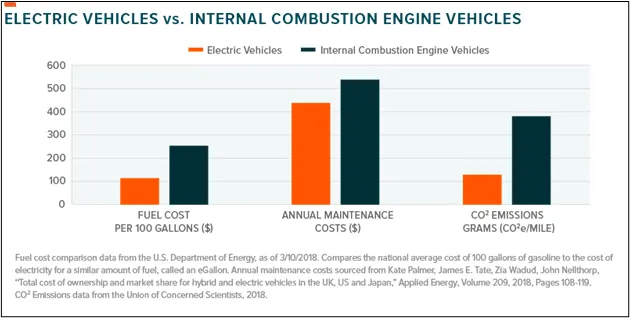
- The above image shows the comparison for EV vs ICEV for parameters such as Fuel cost, annual maintenance, and CO2 emissions. The data clearly indicates that the EV is more efficient in terms of fuel cost by saving approx. 150 $ as compare to ICE vehicle and also EV has lower annual maintenance cost with very low CO2 emissions against the ICE vehicle.
- For an EV in very cold conditions, auxiliary electrical losses can account for more than 25% of energy use in highway driving. Unlike a conventional gasoline or diesel vehicle, which uses heat from the engine to help warm the cabin, all heat must be provided by electricity.
- When compared the losses for power to wheels in an EV and ICE vehicles it tells us about the braking losses, aerodynamic drag & rolling resistance for which the conditions may be the different driving scenarios like the vehicle going uphill or downhill, driving in highways, etc.
- Conditions under which the test was performed for comparing the losses of EVs against ICEV could be in terms of performance, efficiency, Emissions, Fuel consumption rate, Annual Maintenance Costs, etc.
Conclusion:
- Thus, we had understood the test conditions for comparing the losses and can say that EV is less efficient in terms of fuel refilling i.e. charging & might has low range in some EV models as compared to ICE vehicles.
References
- Apostolaki-Iosifidou, E., Codani, P., & Kempton, W. (2017). Measurement of power loss during electric vehicle charging and discharging. Energy, 127, 730-742.
- https://www.fueleconomy.gov/feg/label/learn-more-electric-label.shtml
- https://www.energysage.com/electric-vehicles/101/pros-and-cons-electric-cars/#:~:text=Con%3A%20Electric%20cars%20take%20longer,charge%20to%2080%20percent%20capacity.
- https://ec.europa.eu/clima/sites/clima/files/transport/vehicles/docs/d5_en.pdf