Week 2:- BiW Fixture Basics Challenge
1.What is the process of project execution activity?
Project execution is about actualizing the already designed plan. It involves putting into action all the activities that were set in the previous processes of the project cycle. The project activities are done according to the set plans, sequence and procedures to satisfy the requirements of the project. The purpose of implementing or executing a project is to deliver the expected results. Concerning the span of the project processes, this project execution is the longest and is the one that utilizes a lot of the resources. This process is based on the PMBOK framework and this affirms that it is a proven practice that is applied widely in project management.
During this stage, all the prepared schedules, procedures, and templates are used. Unexpected and unplanned events and situations are usually taken care of in advance. However, unanticipated happenings are likely to occur in the execution of the project. Such happenings need to be mitigated early by the project manager and other important stakeholders
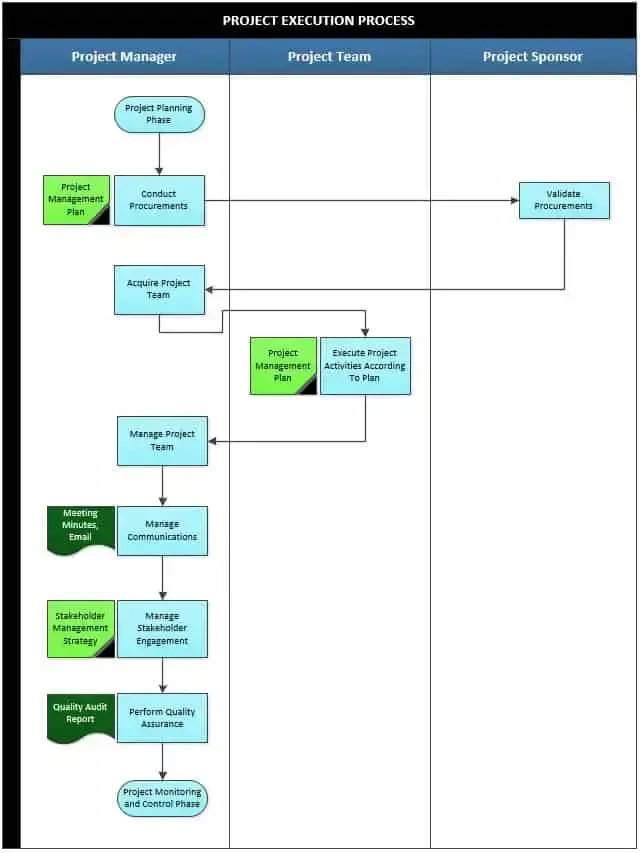
The project execution process consists of the following activities.
1.CONDUCT PROCURMENTS
The objective of this activity is to analyze different sellers in order to identify the most suitable vendor. Timely execution of the project requires timely delivery of different raw materials. This implies that the project manager needs to select vendors carefully to avoid working with individuals or companies that will not deliver materials on time.
2. VALIDATE PROCUREMENTS
This activity involves the validation of the procurement process. The purpose of validating the procurements is to provide the assurance that the equipment and resources needed for the completion of the project will be provided
This is essential because the projects sponsor gets to approve the chosen bidder and the items to be purchased.in relation to the project. Validation also guarantees that the bidder will be paid for delivering his or her supplies.
3.AQUIRE PROJECT TEAM
The objective of this activity is to select individuals who will constitute the project team. Members of the project team perform different project tasks with some requiring specialized skills. This requires determining the skills of different individuals to allocate each task to the most qualified individual.
This activity also seeks to ascertain availability of individuals who can perform various project activities. Thus, the project manager gathers information pertaining to the experience and competence of all team members. The skills of the project team members are evaluated in consideration of the level of experience required and how project execution will be performed.
4.EXECUTE PROJECT ACTIVATES ACCORDING TO THE PLAN
The objective of this activity is to make sure that actual work on the project has started. Members of the project team implement the tasks and activities they have been assigned. In other words, the project plan is translated into action. The project manager oversees project works and ensures that all activities are executed according to plan to guarantee project success.
5. MANAGE PROJECT TEAM
The objective of this activity is to follow up on the performance of project team members to ensure the project performance is optimized. Besides, this activity concerns resolving issues, providing feedback, and managing team changes. This activity is vital to the project because it helps to appraise the performance of team members, resolve issues, manage conflict, and influence team behavior.
6.MANAGE COMMUNICATION
This activity is concerned with facilitating effective and efficient communication between the stakeholders. The activity is vital because it facilitates communication between stakeholders who communicate often on project implementation matters. Different communication tools, measures, and techniques are utilized to suit the intended purpose. The output documents in this activity are Meeting Minutes and Emails.
7.MANAGE STAKE HOLDER ENGAGMENT
This activity is absolutely necessary for every project because it boosts the support of the project by stakeholders and significantly reduces their resistance to the project. A great way to raise the possibility of achieving project success is to ensure that stakeholders are engaged and managed effectively.
8.PERFORM QUALITY ASSURANCE
This activity is carried out as the project work is being carried out. The purpose of performing quality assurance is to enhance quality processes in the project. It involves performing an audit on the quality requirements and findings of quality control assessment to make sure that appropriate operational definitions and quality standards are used.
2.What are the types of joining processes?
Joining processes include welding, brazing, soldering, mechanical fastening, and adhesive bonding . Mechanical fastening can be used to provide either temporary or permanent joints, while adhesive bonding,welding, brazing, and soldering processes are mainly used to provide permanent joints. Mechanical fastening and adhesive bonding usually do not cause metallurgical reactions. Consequently, these methods are often preferred when joining dissimilar combinations of materials and for joining
polymer-matrix composites that are sensitive to extreme heat. Welding processes are divided into two broad classes: fusion welding and solidstate welding
1.FUSSION WELDING
fussion welding processs are involve localized melting and solidification and are normally used when joining similar material combinations or materials belonging to the same family (e.g., joining one type of stainless steel with another type). In fusion welding, the weld can be made by simply melting the edges of the two workpieces and allowing them to fuse together on cooling.
EXAMPLES OF FUSSION WELDING PROCECESS
There exist a large number of fusion welding processes and the same can be further grouped on the basis of source of heat. Such processes where heat is applied by means of electric arc are termed as arc welding process. Similarly, all gas welding processes, resistant welding processes, and intense energy welding processes are basically examples of fusion welding. A list of such processes is provided below.
- Arc welding processes
- Shielded Metal Arc Welding (SMAW)
- Gas Metal Arc Welding (GMAW)
- Tungsten Inert Gas (TIG) welding
- Submerged Arc Welding (SAW)
- Flux Cored Arc Welding (FCAW)
- Electro-Slag Welding (ESW)
- Electro-Gas Welding (EGW)
- Arc Stud Welding (SW)
- Carbon Arc Welding (CAW)
- Atomic Hydrogen Welding (AHW)
- Gas welding processes
- Air-Acetylene Welding (AAW)
- Oxy-Acetylene Welding (OAW)
- Oxy-Hydrogen Welding (OHW)
- Pressure Gas Welding (PGW)
- Resistance welding processes (many consider this as solid-state welding)
- Resistance Spot Welding (RSW)
- Resistance Seam Welding (RSEW)
- Projection Welding (PW)
- Percussion Welding (PEW)
- Flash Welding (FW)
- Upset Welding (UW)
- Intense energy welding processes
- Plasma Arc Welding (PAW)
- Electron Beam Welding (EBW)
- Laser Beam Welding (LBW)
2.SOLID STATE WELDING
In all those welding processes where melting of faying surfaces of parent materials don’t take place are called solid-state welding. Unlike fusion welding, here application of heat is not necessary. However, application of pressure is required for getting a sound joint and thus it is also termed as Pressure welding. It is worth nothing that sometime base materials are heated to an elevated temperature while joining by sold-state welding process; however, temperature always remains below melting point.
EXAMPLES OF SOLID STATE WELDING
Any welding process where no melting takes place comes under this group. Although fusion welding processes are many, there exist quite a few solid-state welding processes also. Some examples are provided below. Note that many people consider resistance welding group as solid-state welding; here the same is kept under fusion welding as nugget is formed due to melting of faying surfaces by resistance heating.
- Cold Welding (CW)
- Roll Welding (ROW)
- Pressure Welding (PW)
- Diffusion Welding (DFW)
- Forge Welding (FOW)
- Friction Welding (FRW)
- Friction Stir Welding (FSW)
- Explosion Welding (EXW)
- Ultrasonic Welding (USW)
3.What is Resistance Welding & its application in the automotive sector?
Resistance welding is the joining of metals by applying pressure and passing current for a length of time through the metal area which is to be joined. The key advantage of resistance welding is that no other materials are needed to create the bond, which makes this process extremely cost effective.
There are several different forms of resistance welding (e.g. spot and seam, projection, flash, and upset welding) which differ primarily by the types and shapes of weld electrodes that are used to apply the pressure and conduct the current. The electrodes, typically manufactured from copper based alloys due to superior conductive properties, are cooled by water flowing through cavities inside the electrode and the other conductive tooling of the resistance welding machine.
Resistance welding machines are designed and built for a wide range of automotive, aerospace and industrial applications. Through automation, the action of these machines is highly controlled and repeatable allowing manufacturers to staff production readily.
APPLICATIONS USED IN AUTOMOTIVE INDUSTRY:An economical joining process in sheet metal processing
Resistance Spot Welding (often just called spot welding) is a cost-effective joining technology that continues to be very popular in the automotive industry where high reproducibility and automation are essential criteria. An additional advantage is that, with a suitable choice of parameters, a high quality of joints can be obtained without being dependent on a welder’s ability.
Resistance Spot Welding is a pressure welding process. The sheets are pressed together locally with the help of fitted copper electrode welding guns that then have a current applied to them. As a result, Joule heating locally melts the joining partners at the junction resulting in a cohesive composite once the joint has solidified.
RSW TECHNOLOGY:Widely spread
RSW technology is employed in manifold industries, such as:
- Transportation industries
- Automotive construction (body parts, frames, add-on parts such as doors & tailgates etc.)
- Commercial vehicles
- Rail vehicles
- Sheet metal forming industries
Major trends and developments in resistance spot welding are:
- The optimization of welding processes. Also if it comes to welding of aluminum alloys, high strength materials and new coatings
- Usage of new high-performance robotic welding guns
- New self-regulating process control, which can also cover an increased range of material thickness combinations
- The use of control devices for quality assurance and a reduction in the resources needed to inspect parts and processes.
- Investigations of hybrid welding processes, such as spot-weld bonding
- Achieving consistent quality by using spot welding systems on a circulating process belt
- Investigations of spot welding of CF components by the use of local metal structures
4.What is fusion welding & types of fusion welding with its application in the automotive sector?
Fusion welding processes are all those welding processes where faying surfaces of parent part as well as filler material melt down during welding for weld bead formation. So heat is always associated with these processes. External application of pressure is not required for these processes, except for resistance welding group where substantial contact pressure needs to be maintained during welding for sound joining. Filler material may or may not be applied.
APPLICATIONS
The most commonly used welding methods for automotive applications include resistance spot welding (RSW), resistance seam welding (RSEW), metal inert gas (MIG) welding, tungsten inert gas (TIG) welding, laser beam welding (LBW), friction welding (FW) and plasma arc welding (PAW).
5.What is the 3-2-1 principle?
Locating a part to be machined involves mainly three steps: Supporting, Positioning, and Clamping.
Two main intentions when placing a job on a jig/fixture are:
- Precisely positioning the part at the desired coordinates.
- Curbing all six degrees of movement so that the part cannot budge.
An extensively used method for obtaining these objectives is the 3-2-1 principle or six degrees of freedom for part location.
The 3-2-1 method is a work-holding principle where three pins are located on the 1st principle plane, i.e., either XY, YZ, ZX. And two pins are located on the 2nd plane perpendicular to the 1st plane, and at last, one pin on the plane is mutually perpendicular to the 1st and 2nd planes. The aim is to constrain the movement of the workpiece along all three axes.
6.Define Body coordinate system?
The noninertial body coordinate system is fixed in both origin and orientation to the moving craft. The craft is assumed to be rigid.
The orientation of the body coordinate axes is fixed in the shape of body.
-
The x-axis points through the nose of the craft.
-
The y-axis points to the right of the x-axis (facing in the pilot's direction of view), perpendicular to the x-axis.
-
The z-axis points down through the bottom the craft, perpendicular to the xy plane and satisfying the RH rule.
Translational Degrees of Freedom
Translations are defined by moving along these axes by distances x, y, and z from the origin.
Rotational Degrees of Freedom
Rotations are defined by the Euler angles P, Q, R or Φ, Θ, Ψ. They are:
Unless otherwise specified, by default the software uses ZYX rotation order for Euler angles.
7.Elaborate Body plane system & its essentials.
Body planes are hypothetical geometric planes used to divide the body into sections. They are commonly used in both human and zoological anatomy to describe the location or direction of bodily structures. Reference planes are the standard planes used in anatomical terminology and include:
- The sagittal plane (lateral or Y-Z plane) divides the body into sinister and dexter (left and right) sides. The midsagittal (median) plane is in the midline through the center of the body, and all other sagittal planes are parallel to it.
- The coronal plane (frontal or Y-X plane) divides the body into dorsal and ventral (back and front) portions. It also separates the anterior and posterior portions.
- The transverse plane (axial or X-Z plane) divides the body into superior and inferior (head and tail) portions. It is typically a horizontal plane through the center of the body and is parallel to the ground.
While these are the major reference planes of the body, other planes are commonly used in relation to these three. A longitudinal plane is any plane perpendicular to the transverse plane, while parasaggital planes are parallel to the saggital plane. The coronal plane, the sagittal plane, and the parasaggital planes are examples of longitudinal
planes.
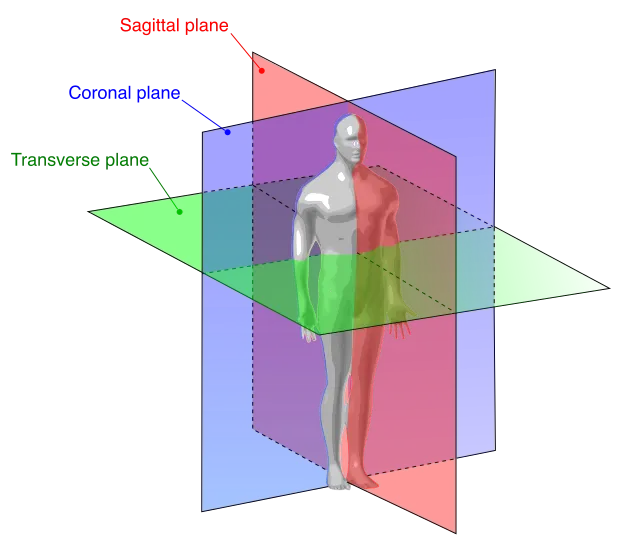
Anatomical Planes in a Human: There are three basic planes in zoological anatomy: sagittal, coronal, and transverse. A human in the anatomical position, can be described using a coordinate system with the Z-axis going from front to back, the X-axis going from left to right, and the Y-axis going from up to down.
APPLICATIONS
Medical imaging techniques such as sonography, CT scans, MRI scans, or PET scans are one of the primary applications of body planes. By imaging a patient in standard anatomical position, a radiologist can build an X-Y-Z axis around the patient to apply body planes to the images. The planes can then be used to identify and locate the positions of the patient’s internal organs. Individual organs can also be divided by planes to help identify smaller structures within that organ.
Body planes are used to describe anatomical motion in the X-Y-Z coordinate system that the body moves through. An anatomist could model a limb’s range of motion by measuring which planes the limb can move through and how far it is able to travel.
Anatomical change during embryological development is also described and measured with body planes. For example, during human embryonic development the coronal plane is horizontal, but becomes vertical as the embryo develops into a fetus. In comparative embryology, body planes provide a basis for comparing the ways in which different types of organisms develop anatomically within the womb.