Week 2 Air standard Cycle
AIM: To Plot the PV Diagram of the Otto cycle and derive the thermal efficiency of the Otto cycle of an Air standard Cycle
OBJECTIVES:-
- To create a PV diagram
- Get the thermal efficiency of the engine of the given values.
Introduction:
2.1 Ideal Otto Cycle:-
Air standard Otto cycle is used for the SI Engines (Spark Ignition Engine). The cycle Contains Mainly four main Processes. In the overall cycle, suction and Exhaust are neglected, also power consumption is not considered.
The Ideal Otto cycle consists of four processes which are as below.
1-2 Reversible Adiabatic compression (Or) Isentropic Compression.
2-3 Constant Volume Heat Addition.
3-4 Reversible Adiabatic Expansion (Or) Isentropic Expansion.
4-1 Constant Volume Heat Rejection.
When the piston in the cylinder of the Internal Combustion Engine (SI Engine) moves from BDC (i.e Bottom Dead Centre) to TDC (i.e. Top Dead Centre) the Pressure and volume Relatively change, which is represented on the Diagram known as the PV-Diagram. The ideal PV-Diagram can be seen below
formula:
Swept volume:
Vs = n*(pi/4)*(bore)^2*stroke
where,
n= no of cylinder
Vc= cylinder swept volume [cm3 (cc)]
BDC = Bottom Dead Center TDC = Top Dead Center
Clearance volume:
Vc= Vs/(Cr-1)
V1 = Vs+ Vc
V2 = Vc
where,
Cr=compression ratio
Compression ratio:
Cr=(Vs+ Vc)/ Vc
Isentropic proccess:
P*V^γ= constant
Ideal gas equation:
PV=mRT
Efficiency:
η=(Cr-1)/Cr
PROGRAM:
#otto cycle program for Air standard Cycle
import math
import matplotlib.pyplot as plt
def engine_kinematics(bore,stroke,con_rod,cr,start_angle,end_angle):
#otto cycle program for Air standard Cycle
import math import matplotlib.pyplot as plt
def engine_kinematics(bore,stroke,con_rod,cr,start_angle,end_angle):
#engine parameters
a = stroke/2
R = con_rod/a
v_s = (math.pi/4) * pow(bore,2) * stroke
v_c = v_s/(cr -1)
sc = math.radians(start_angle)
ec = math.radians(end_angle)
num_values = 75
dtheta = (ec-sc)/(num_values - 1)
v = []
for i in range (0,num_values):
theta = sc + i * dtheta
term1 = 0.5*(cr-1)
term2 = R+1-math.cos(theta)
term3 = pow(R,2) - pow(math.sin(theta),2)
term3 = pow(term3,0.5)
v.append((1+term1*(term2-term3))*v_c)
return v
#inputs for calculations
p1 = 102325
t1 = 500
gamma = 1.4
t3 = 2300
#Geomentric parameter
bore = 0.13
stroke = 0.142
con_rod = 0.15
cr = 7
#volume computation
v_s = (math.pi/4) * pow(bore,2)*stroke
v_c = v_s/(cr-1)
v1 = v_s+v_c
#state point 2
v2 = v_c
#p2v2^gama = p1v1^gama
p2 = p1*pow(v1,gamma)/pow(v2,gamma)
#p2v2/t2 = p1v1/t1 | rhs = p1v1/t1 | p2v2/t2 = rhs
#t2 = p2v2/rhs
rhs = p1*v1/t1
t2 = p2*v2/rhs
v_compression = engine_kinematics(bore,stroke,con_rod,cr,180,0)
constant = p1*pow(v1,gamma)
p_compression = []
for V in v_compression:
p_compression.append(constant/pow(V,gamma))
#state point 3
v3 = v2
#p3v3/t3 = p2v2/t2 | rhs = p2v2/t2 | p3 = rhs *t3/v3
rhs = p2*v2/t2
p3 = rhs*t3/v3
v_expansion = engine_kinematics(bore,stroke,con_rod,cr,0,180)
constant = p3*pow(v3,gamma)
p_expansion = []
for V in v_expansion:
p_expansion.append(constant/pow(V,gamma))
# state point 4
v4 = v1
#p4v4^gama = p3v3^gamma
p4 = p3*pow(v3,gamma)/pow(v4,gamma)
#p4v4/t4 = rhs
t4 = p4*v4/rhs
plt.plot([v2,v3],[p2,p3])
plt.plot(v_compression,p_compression)
plt.plot(v_expansion,p_expansion)
plt.plot([v4,v1],[p4,p1])
plt.xlabel('volume')
plt.ylabel('pressure')
plt.title('pressure vs volume')
plt.show()
#thermal efficiency for Air standard Cycle
thermal_efficiency = 1-(1/(pow(cr,(gamma-1))))
print ('Thermal efficiency is : ',thermal_efficiency)
PLOT:
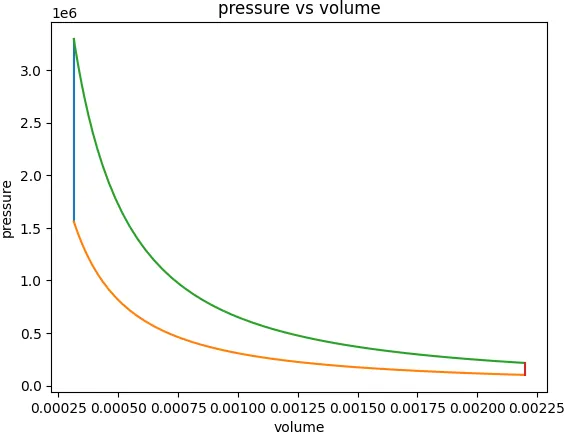
Thermal efficiency is: 0.5408434500405659
CONCLUSION:
Hence we plotted the PV Diagram of the Otto cycle and derived the thermal efficiency of the Otto cycle of an Air standard Cycle i.e., 0.5408434500405659.
https://lms.skill-lync.com/projects/177422/content