Week 2 Air standard Cycle
“AIR STANDARD CYCLE PROGRAM USING PYTHON.”
AIM:-
Based on the concepts you have learnt during the forward kinematics routine, go ahead and write code that can solve an otto cycle and make plots for it.
OBJECTIVES:-
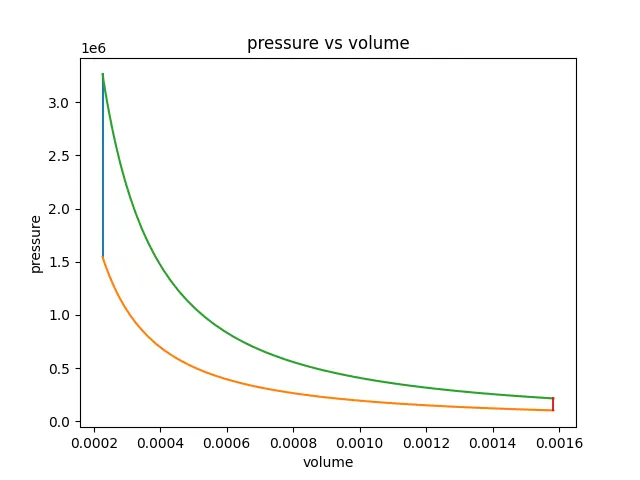
1. Your code should create a PV diagram
2. You should output the thermal efficiency of the engine.
FORMULAS FOR VOLUME:-
Compression ratio (cr) = Volume before compression/volume after compression also,
Compression ratio (cr) = (Vs+Vc)/Vc
Where:-
V1= volume before compression = V_swept + V_clearance
V2 = volume after compression = V_clearance
Vs = V_swept , Vc = V_clearance
Therefore, Compression ratio (cr) = V1/V2
The Formula for the Engine kinematics is as follows.
V/Vc=1+0.5(cr−1)⋅[R+1−cos(θ)—(R²−sin²(θ))⁰.5]
PROGRAM:-
#otto cycle program
import math
import matplotlib.pyplot as plt
def engine_kinematics(bore,stroke,con_rod,cr,start_angle,end_angle):

	#engine parameters


	a = stroke/2

	R = con_rod/a

	v_s = (math.pi/4) * pow(bore,2) * stroke
	v_c = v_s/(cr -1)
	sc = math.radians(start_angle)
	ec = math.radians(end_angle)

	num_values = 75
	dtheta = (ec-sc)/(num_values - 1)
	v = []
	for i in range (0,num_values):
		theta = sc + i * dtheta
		term1 = 0.5*(cr-1)
		term2 = R+1-math.cos(theta)
		term3 = pow(R,2) - pow(math.sin(theta),2)
		term3 = pow(term3,0.5)
		v.append((1+term1*(term2-term3))*v_c)
	return v
#inputs
p1 = 101325

t1 = 500

gamma = 1.4

t3 = 2300

#Geomentric parameter
bore = 0.12
stroke = 0.12
con_rod = 0.15
cr = 7

#volume computation
v_s = (math.pi/4) * pow(bore,2)*stroke
v_c = v_s/(cr-1)
v1 = v_s+v_c

#state point 2
v2 = v_c

#p2v2^gama = p1v1^gama
p2 = p1*pow(v1,gamma)/pow(v2,gamma)

#p2v2/t2 = p1v1/t1 | rhs = p1v1/t1 | p2v2/t2 = rhs
#t2 = p2v2/rhs
rhs = p1*v1/t1
t2 = p2*v2/rhs

v_compression  = engine_kinematics(bore,stroke,con_rod,cr,180,0)
constant = p1*pow(v1,gamma)
p_compression = []
for V in v_compression:
	p_compression.append(constant/pow(V,gamma))

#state point 3
v3 = v2

#p3v3/t3 = p2v2/t2 | rhs = p2v2/t2 | p3 = rhs *t3/v3
rhs = p2*v2/t2
p3 = rhs*t3/v3
v_expansion  = engine_kinematics(bore,stroke,con_rod,cr,0,180)
constant = p3*pow(v3,gamma)
p_expansion = []
for V in v_expansion:
	p_expansion.append(constant/pow(V,gamma))


# state point 4
v4 = v1

#p4v4^gama = p3v3^gamma
p4 = p3*pow(v3,gamma)/pow(v4,gamma)

#p4v4/t4 = rhs
t4 = p4*v4/rhs

plt.plot([v2,v3],[p2,p3])
plt.plot(v_compression,p_compression)
plt.plot(v_expansion,p_expansion)
plt.plot([v4,v1],[p4,p1])
plt.xlabel('volume')
plt.ylabel('pressure')
plt.title('pressure vs volume')
plt.show()

#thermal efficiency
thermal_efficiency = 1-(1/(pow(cr,(gamma-1))))
print ('Thermal efficiency is : ',thermal_efficiency)
P-V DIGRAM:-
THERMAL EFFICIENCY:-
formula for thermal efficiency:-
thermal_efficiency = 1-(1/(pow(cr,(gamma-1))))
CODE FOR THERMAL EFFICIENCY CALCULATION:-
#thermal efficiency
thermal_efficiency = 1-(1/(pow(cr,(gamma-1))))
print ('Thermal efficiency is : ',thermal_efficiency)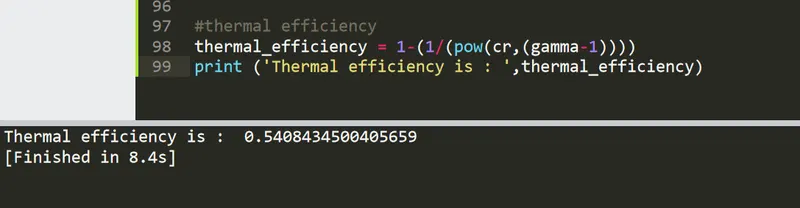
Thermal efficiency is : 0.5408434500405659