Week -2
AIM :
To Make a Simulink model of Doorbell using solenoid block with the following details:
when the switch is closed the electromagnet receives electrical power from the battery and pulls the metal arm to hit the bell producing sound.
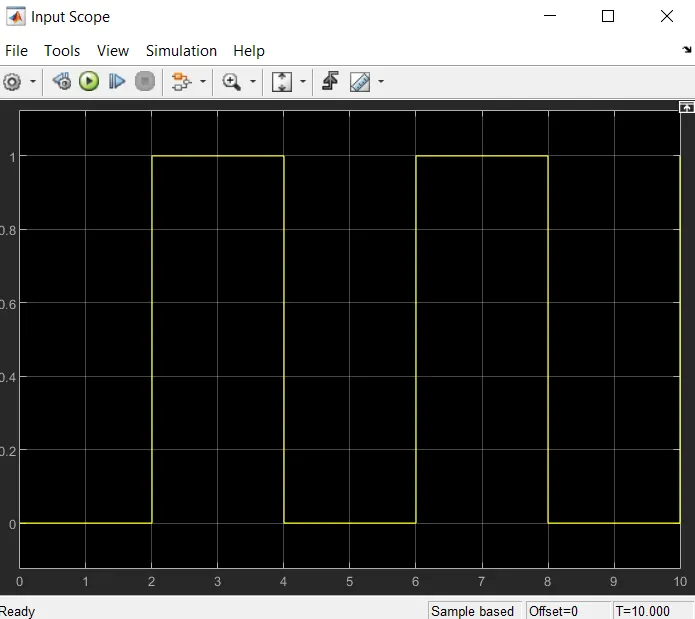
Create a situation where the switch is closed for 2 seconds and then released. Observe the physical movement of the plunger.
Sol:
Theory of Door bell:
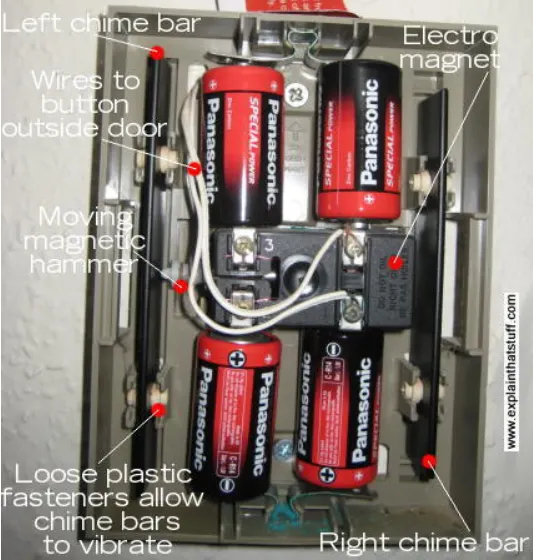
Ding-dong chime doorbells are slightly more sophisticated. They have two metal bars at either side that make the two different musical notes when something hits them. In between are mounted batteries and an electromagnet with a freely moving "hammer" inside it—essentially just a cylinder of magnetic metal that slides back and forth inside a slightly bigger cylindrical plastic tube. When you press the doorbell, the electromagnet magnetizes the metal hammer and pulls it way to the right, compressing it against a spring and striking the metal chime bar on the right: ding! At this point, the circuit is interrupted and the electromagnet switches off, so the spring makes the hammer shoot back the other way, striking the metal chime bar on the left: dong! The chime bars are very lightly mounted on plastic fasteners so they vibrate for a few seconds before the sound dissipates.
Blocks involved:
PS-simulink and simulink-PS converter:
The Simulink-PS Converter block converts the input simulink signal into a physical signal.
Scopes:
Simulink scopes provide several methods for displaying simulation data and capturing the data for later analysis.
Pulse Generator:
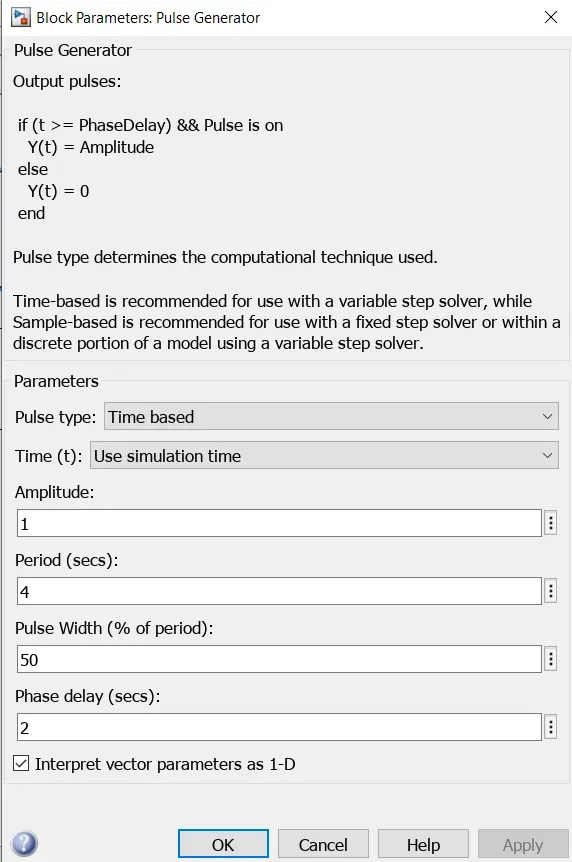
The Pulse Generator block generates square wave pulses at regular intervals. The block waveform parameters, Amplitude, Pulse Width, Period, and Phase delay, determine the shape of the output waveform.
Input parameter should be 2 secs delay with amplitude 1 and pulse time should 4secs to make it in half with 50% pulse width.
Electrical and Mechanical Refrences:
The Electrical Reference block represents an electrical ground. Electrical conserving ports of all the blocks that are directly connected to ground must be connected to an Electrical Reference block.
The Mechanical Translational Reference block represents a reference point, or frame, for all mechanical translational ports. All translational ports that are rigidly clamped to the frame (ground) must be connected to a Mechanical Translational Reference block.
Solenoid :
The Solenoid block represents the electrical characteristics and generated force for the solenoid in this figure: Both positive and negative currents generate a force that pulls the plunger towards the winding.
Battery:
Battery is a device that has a negative and positive terminal for the electric circuit to be completed for an electric flow.
The switch:
The Switch block passes through the first input or the third input based on the value of the second input. The first and third inputs are called data inputs. The second input is called the control input.
Ideal translated motion sensor:
The Ideal Translational Motion Sensor block represents a device that converts an across variable measured between two mechanical translational nodes into a control signal proportional to acceleration, velocity, or position.
Solver Configuration:
The Solver Configuration block specifies the solver parameters that your model needs before you can begin simulation. Each topologically distinct Simscape block diagram requires exactly one Solver Configuration block to be connected to it.
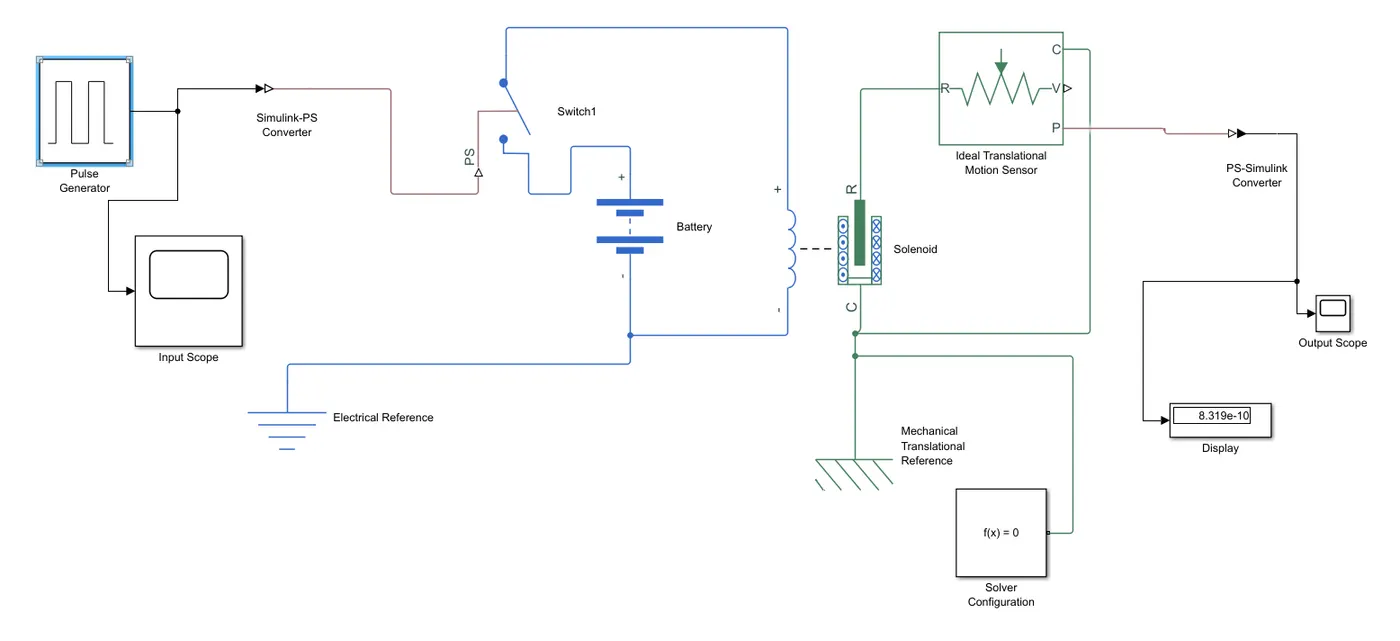
Simulink Model:
Input Signal:
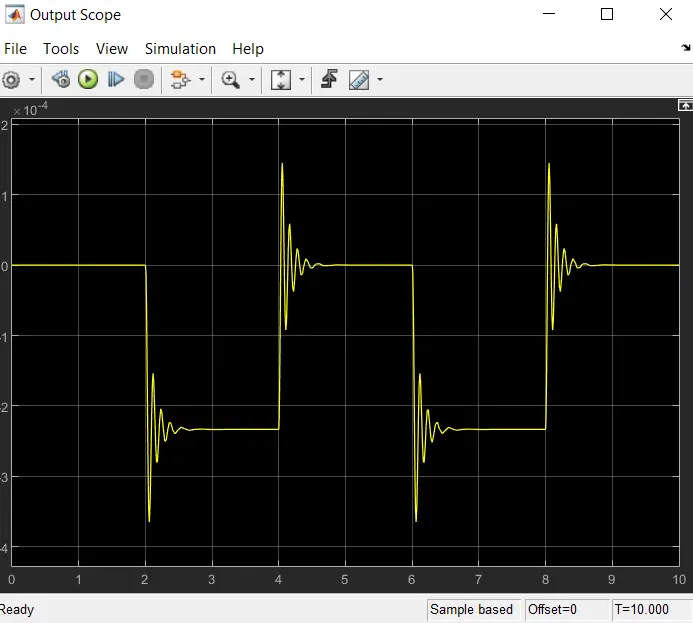
Output Graph: