Week -2
- Make a Simulink model of Doorbell using solenoid block with the following details:
Doorbell:
A doorbell is a signaling device typically placed near a door to a building's entrance. When a visitor presses a button the bell rings inside the building, alerting the occupant to the presence of the visitor. The heart of a doorbell is an electromagnet. Electromagnets are coils of wire wrapped around a small piece of magnetic metal. When electricity passes through the wire, it creates a magnetic field around the wire. When you press a doorbell button, you complete an electrical circuit that allows household electricity to flow through the doorbell's internal electromagnet. The magnetic field generated by the electromagnet is then used to power a mechanism that creates the doorbell sound.
Doorbells are low-voltage devices. This means they require relatively little energy to operate. An important part of a doorbell mechanism is the transformer. The transformer converts regular 120-volt household current to the lower voltage (usually somewhere between 6-16 volts) required by the doorbell.
Solenoid:
A solenoid is a 3-dimensional structure of wire. When this wire is wrapped around a metallic block in a coil and electricity is passed through it, it has some special magnetic properties. Electromagnetic induction makes it an electromagnet that can be switched on or off. The side in which the current appears to be passing clockwise is the South Pole, and the side in which the current seems to be passing anticlockwise is the Northern Pole. The solenoid works just like a bar magnet and therefore has many uses. This principle is used to create valves, among other things. Where the solenoid operates an electric switch, it is a relay.
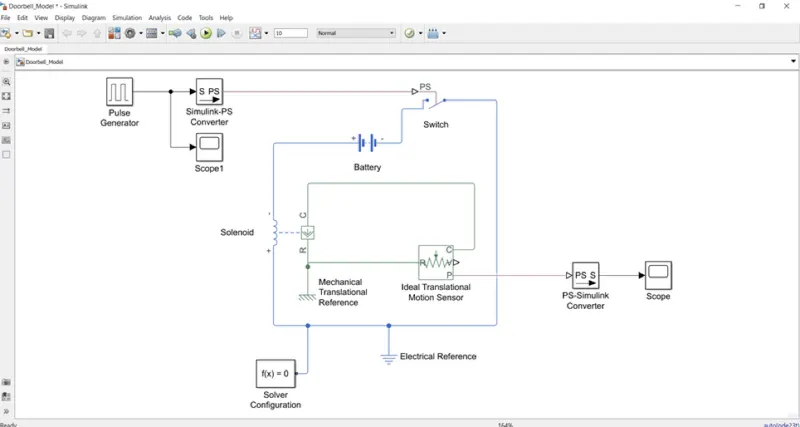 .
.
2. Use a thermistor to sense the temperature of a heater & turn on or turn off the fan as per the below conditions:
The Controlled PWM Voltage and H-Bridge blocks have two modes of operation, namely Averaged and PWM. As this is a system-level model, and the thermal time constants are measured in seconds, the Averaged mode of operation is used. The PWM mode replicates the PWM control signal which would typically operate at a few kilohertz.
Model
Simulation Results
The plot below shows the electrical, mechanical, and thermal behavior of the thermistor controlled motor. As the temperature of the thermistor changes, the voltage applied to the motor changes, which alters the speed of the motor and the convective heat transfer from the case. The system reaches steady state after a short period of time.