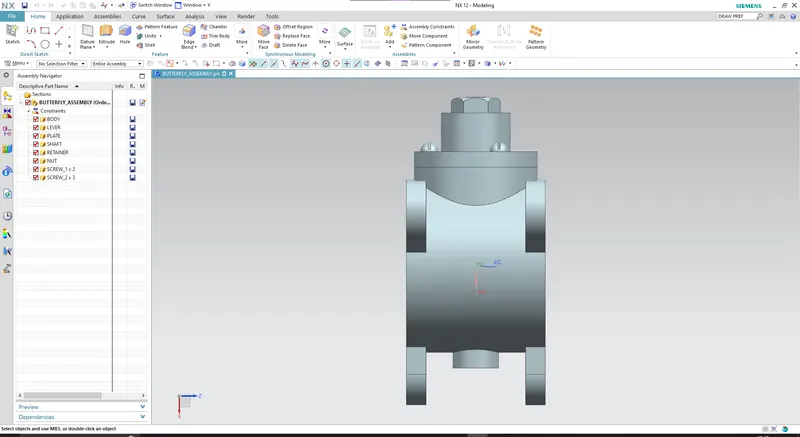
Week 14 challenge
A butterfly valve is an efficient flow control device used to regulate or completely halt the flow within pipes. It consists of a disc that can be rotated to control the flow. When the disc is aligned parallel to the connecting pipe(s), it enables the flow to pass through. Conversely, when the disc is positioned perpendicular to the pipe, it effectively isolates the flow.
To manipulate the disc, a sealed stem is employed, linking it to the turning mechanism. This turning mechanism can take various forms: it may be manually operated using a lever or gearbox, providing human control over the valve position, or it can be an automated system known as an actuator, which adjusts the valve position automatically based on predetermined parameters or commands.
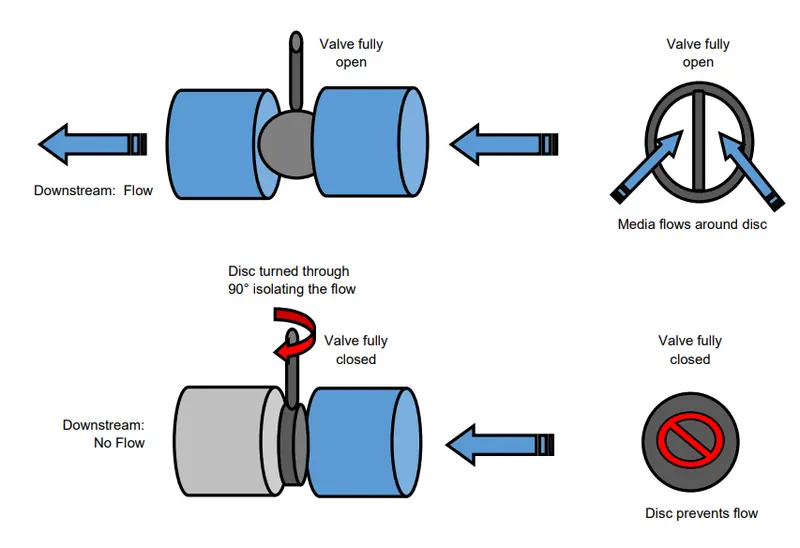
From this, it is easy to determine the necessary features and surfaces for defining datums and FOS.
The primary datum A1, A2, A3 are defined as shown below with a flatness tolerance of 0.25 as that will become the mating part on the correspondent flange of a pipe.
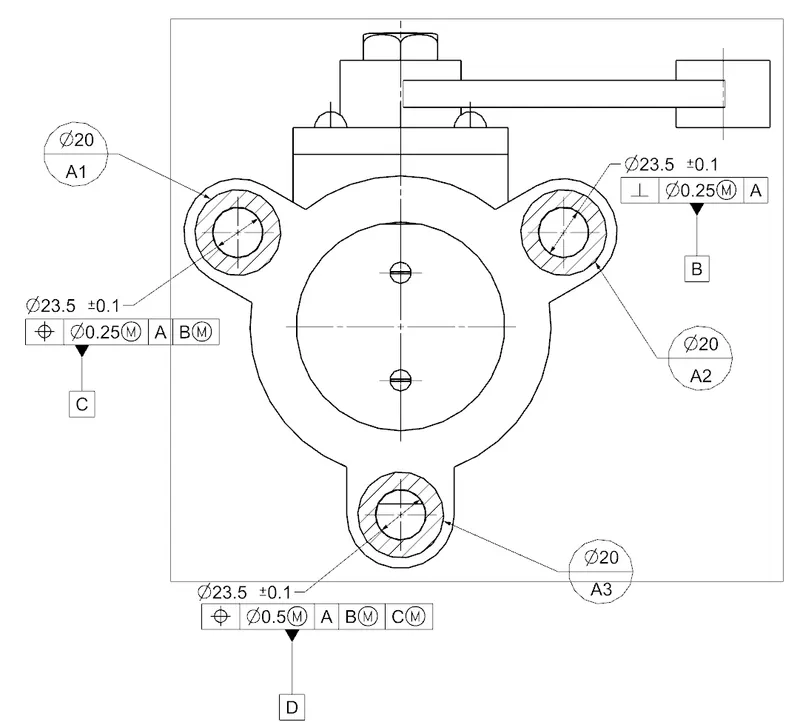
The secondary datum B is defined using perpendicularity tolerance of 0.25 @ MMC w.r.t A
The tertiary datum C is defined using position tolerance of 0.25 @ MMC w.r.t A and B (MMB)
Another thing to note here is the definition of a 'quarternary' datum D which helps in positioning the correspondent co-axial hole on the opposite flange of the body as with the case for datums B and C
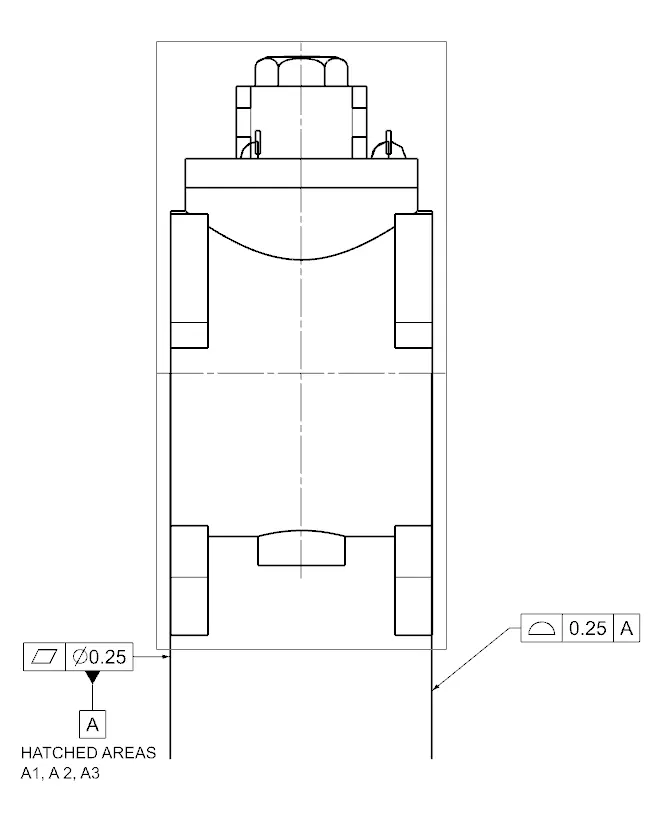
The surface opposite to the datum is given a profile of surface tolerance of 0.25 w.r.t A (controls the surface variation and size)
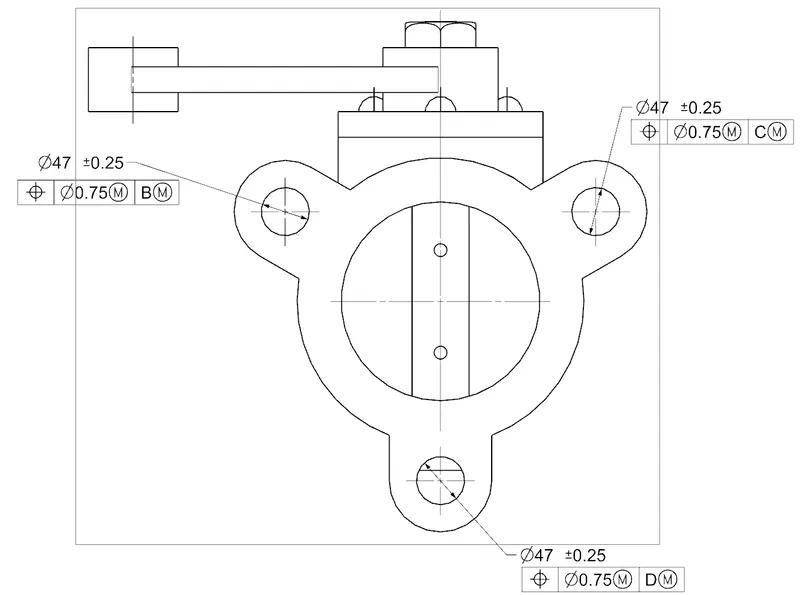
Here, the 3 coaxial holes are positioned w.r.t their correspondent datums (it becomes clear here why datum D was defined) for a tolerance of 0.75
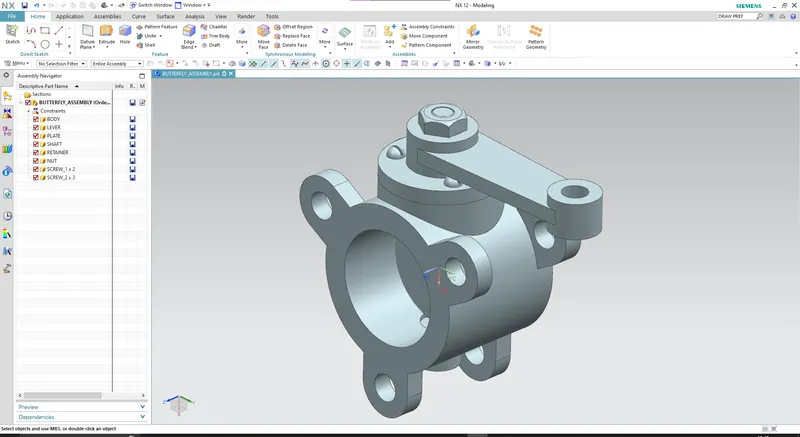
ISOMETRIC
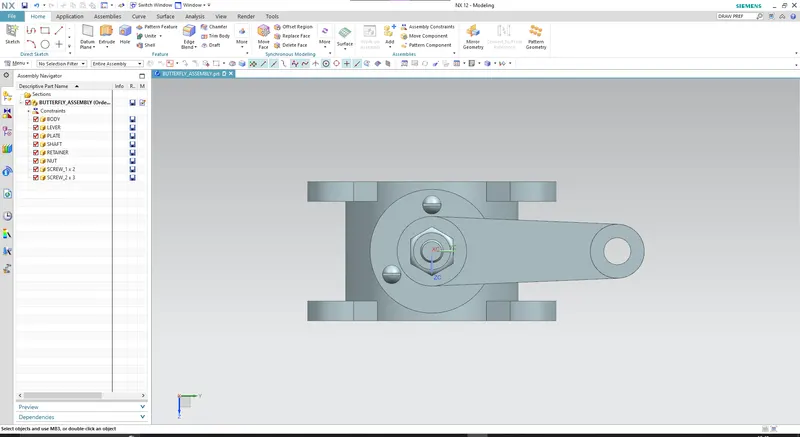
TOP
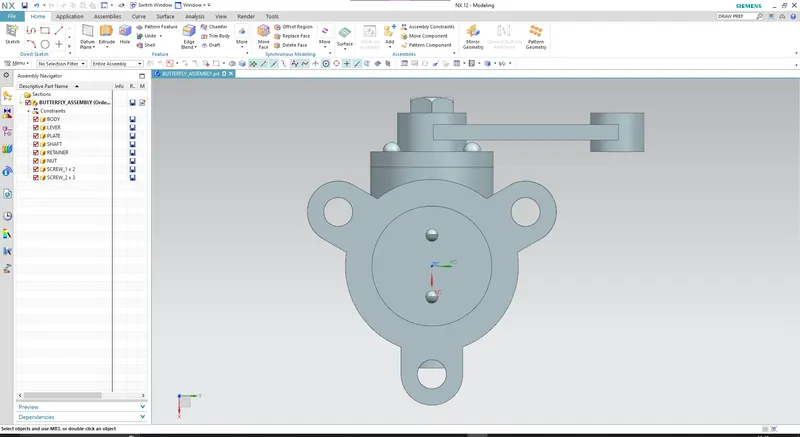
FRONT
LEFT