Week 12 - Validation studies of Symmetry BC vs Wedge BC in OpenFOAM vs Analytical H.P equation
OBJECTIVE:
To study the effect of the wedge angle and the Boundary Conditions on the simulation of an axisymmetric laminar flow in a cylindrical pipe.
- To simulate an axis-symmetric laminar flow through the constant cross-sectional of the pipe by applying the symmetry boundary condition.
- To simulate for the mentioned angles i.e for 10, 25, 45 degrees using both symmetry and wedge boundary conditions and validate them with HP equations.
THEORY:
Axi-symmetric flow:
A flow pattern is axisymmetric when it is identical in every plane that passes through a certain straight-line. The straight-line in question is referred to as the symmetry axis.
Every longitudinal plane through the axis would exhibit the same streamline pattern.
Laminar Flow:
In fluid dynamics, laminar flow is characterized by fluid particles following smooth paths in layers, with each layer moving smoothly past the adjacent layers with little or no mixing. At low velocities, the fluid tends to flow without lateral mixing, and adjacent layers slide past one another like playing cards. There are no cross-currents perpendicular to the direction of flow, nor eddies or swirls of fluids. In laminar flow, the fluid particles' motion is very orderly, with particles close to a solid surface moving in straight lines parallel to that surface.
Laminar flow is a flow regime characterized by high momentum diffusion and low momentum convection.
When a fluid flows through a closed channel such as a pipe or between two flat plates, either of two types of flow may occur depending on the fluid's velocity and viscosity: laminar flow or turbulent flow. Laminar flow occurs at lower velocities, below a threshold at which the flow becomes turbulent. The velocity is determined by a dimensionless parameter characterizing the flow called the Reynolds number, which also depends on the viscosity and density of the fluid and dimensions of the channel.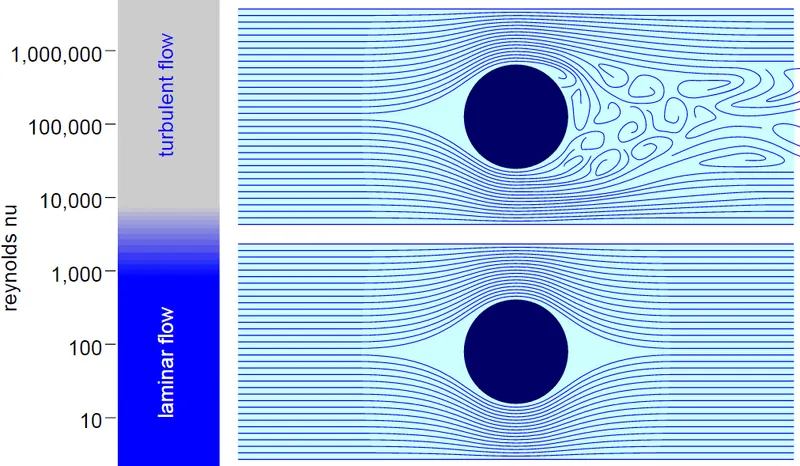
Comparison between Turbulent and Laminar Flow.
Reynolds Number: The Reynolds number (Re) helps predict flow patterns in different fluid flow situations. At low Reynolds numbers, flows tend to be dominated by laminar (sheet-like) flow, while at high Reynolds numbers, flows tend to be turbulent. The turbulence results from differences in the fluid's speed and direction, which may sometimes intersect or even move counter to the flow's overall direction (eddy currents). These eddy currents begin to churn the flow, using up energy in the process, which for liquids increases the chances of cavitation. Reynolds numbers are an important dimensionless quantity in fluid mechanics.
The Reynolds number has wide applications, ranging from liquid flow in a pipe to the passage of air over an aircraft wing. It is used to predict the transition from laminar to turbulent flow and is used in the scaling of similar but different-sized flow situations, such as between an aircraft model in a wind tunnel and the full-size version. The predictions of the onset of turbulence and the ability to calculate scaling effects can be used to help predict fluid behaviour on a larger scale, such as in local or global air or water movement and thereby the associated meteorological and climatological effects.
PROCEDURE:
- Will start with copying the cavity file from the tutorial to the FOAM_RUN folder.
- In the run folder only we are going to simulate and whatever we want to do the changes in the blockMeshDict file and pressure and velocity files and controlDict files we will be doing here.
- creating the block in the OpenFoam here we are creating the wedge after making the required changes in the blockMeshDict file to check the geometry run the blockMesh command.
- After creating the wedge assign the boundary conditions, and also sitting the simulation end time and time-step in such a way that the courant number should be less than 0.5 and also in the transportProperties enter the kinematic viscosity.
- Run the simulation using the icoFoam solver after calculating the time needed for the fluid to travel from inlet to outlet.
- After the simulation, use paraFoam to view the flow inside the wedge and use plot over line command to plot the velocity and shear stress changes at a point after the hydrodynamical entry region so that we analyse the fully developed region of the fluid.
- Use Matlab to parse the blockMeshDict so that the same file can be used for any wedge values.
CODE:
Wedge Boundary Condition:
clear all
close all
clc

%  inputs
% assumptions made the fluid is assumed as water
Re=2100; % given reynolds number
rho=997; % density of the water
D=0.02; % diiameter of the pipe
r=D/2; % radius of the pipe
mu=0.89*10^-3; % dynamic viscosity of the water at 25 degree celcius
v=0.88927*10^-6; % kinematic viscosity of the water at 25 degree celcius
theta=input('Enter the value of the wedge angle= ')
L_h=0.06*Re*D; % hydrodynamic lenght

L=L_h+0.5;
% Analytical solutions
V_avg=(Re*mu)/(rho*D);  % average velocity
V_max=2*V_avg;   % maximum velocity
P_drop=(32*mu*L*V_avg)/D^2;  % pressure drop
P_kinematic=(P_drop)/rho;  % kinematic pressure drop

% vertices
v0=[0 0 0]
v1=[0 r*cosd(theta/2) r*sind(theta/2)]
v2=[0 r*cosd(theta/2) -r*sind(theta/2)]
v3=[L 0 0]
v4=[L r*cosd(theta/2) r*sind(theta/2)]
v5=[L r*cosd(theta/2) -r*sind(theta/2)]


% PRINTING THE blockMeshDict FILE

H1='/*--------------------------------*- C++ -*----------------------------------*\';
H2='  =========                 |';
H3='  \\      /  F ield         | OpenFOAM: The Open Source CFD Toolbox';
H4='   \\    /   O peration     | Website:  https://openfoam.org';
H5='    \\  /    A nd           | Version:  10;
H6='     \\/     M anipulation  |';
H7='\*---------------------------------------------------------------------------*/';
H8='FoamFile';
H9='{'
H10='    version     2.0;';
H11='    format      ascii;';
H12='    class       dictionary;';
H13='    object      blockMeshDict;';
H14='}'
H15='// * * * * * * * * * * * * * * * * * * * * * * * * * * * * * * * * * * * * * //';

% opening the file
f1=fopen('blockMeshDict_parsedNEW.txt','wt');

fprintf(f1,'%s \n',H1);
fprintf(f1,'%s \n',H2);
fprintf(f1,'%s \n',H3);
fprintf(f1,'%s \n',H4);
fprintf(f1,'%s \n',H5);
fprintf(f1,'%s \n',H6);
fprintf(f1,'%s \n',H7);
fprintf(f1,'%s \n',H8);
fprintf(f1,'%s \n',H9);
fprintf(f1,'%s \n',H10);
fprintf(f1,'%s \n',H11);
fprintf(f1,'%s \n',H12);
fprintf(f1,'%s \n',H13);
fprintf(f1,'%s \n',H14);
fprintf(f1,'%s \n',H15);
fprintf(f1,'\n');

fprintf(f1,'%s \n','convertToMeters 1;');

fprintf(f1,'%s \n','vertices');
fprintf(f1,'%s \n','(');
fprintf(f1,'%s (%f %f %f) \n',blanks(5),v0(1),v0(2),v0(3));
fprintf(f1,'%s (%f %f %f) \n',blanks(5),v1(1),v1(2),v1(3));
fprintf(f1,'%s (%f %f %f) \n',blanks(5),v2(1),v2(2),v2(3));
fprintf(f1,'%s (%f %f %f) \n',blanks(5),v3(1),v3(2),v3(3));
fprintf(f1,'%s (%f %f %f) \n',blanks(5),v4(1),v4(2),v4(3));
fprintf(f1,'%s (%f %f %f) \n',blanks(5),v5(1),v5(2),v5(3));

fprintf(f1,'%s \n',');');

fprintf(f1,'%s \n','blocks');
fprintf(f1,'%s \n','(');
fprintf(f1,'%s %s \n',blanks(5),'hex (0 2 1 0 3 5 4 3) (20 1 200) simpleGrading (1 1 1)');
fprintf(f1,'%s \n',');');

fprintf(f1,'%s \n','edges');
fprintf(f1,'%s \n','(');
fprintf(f1,'arc 1 2 (%f %f %f) \n',0,r,0);
fprintf(f1,'arc 4 5 (%f %f %f) \n',L,r,0);
fprintf(f1,'%s \n',');');

fprintf(f1,'%s \n','boundary');
fprintf(f1,'( \n');
fprintf(f1,'%s %s \n',blanks(5),'inlet');
fprintf(f1,'%s %s \n',blanks(5),'{');
fprintf(f1,'%s %s \n',blanks(10),'type patch;');
fprintf(f1,'           %s \n','faces');
fprintf(f1,'          %s \n','(');
fprintf(f1,'           (%d %d %d %d)\n',0, 1, 2, 0);
fprintf(f1,'          );\n');
fprintf(f1,'      }\n');
fprintf(f1,'      %s\n','outlet');
fprintf(f1,'      {\n');
fprintf(f1,'        %s\n','type patch;');
fprintf(f1,'         %s\n','faces');
fprintf(f1,'         (\n');
fprintf(f1,'            (%d %d %d %d)\n',3, 4, 5, 3);
fprintf(f1,'          );\n');
fprintf(f1,'     }\n');
fprintf(f1,'     %s\n','wedge_front');
fprintf(f1,'     {\n');
fprintf(f1,'         %s\n','type wedge;');
fprintf(f1,'         %s\n','faces');
fprintf(f1,'         (\n');
fprintf(f1,'             (%d %d %d %d)\n',2, 5, 3, 0);
fprintf(f1,'\n');
fprintf(f1,'          );\n');
fprintf(f1,'     }\n');
fprintf(f1,'     %s\n','wedge_Back');
fprintf(f1,'     {\n');
fprintf(f1,'%s\n','         type wedge;');
fprintf(f1,'%s\n','         faces');
fprintf(f1,'         (\n');
fprintf(f1,'\n');
fprintf(f1,'             (%d %d %d %d)\n',0, 3, 4, 1);
fprintf(f1,'          );\n');
fprintf(f1,'     }\n');
fprintf(f1,'     %s\n','top');
fprintf(f1,'     {\n');
fprintf(f1,'         %s\n','type wall;');
fprintf(f1,'         %s\n','faces');
fprintf(f1,'         (\n');
fprintf(f1,'             (%d %d %d %d)\n',1, 4, 5, 2);
fprintf(f1,'          );\n');
fprintf(f1,'     }\n');
fprintf(f1,'     %s\n','axis');
fprintf(f1,'     {\n');
fprintf(f1,'         %s\n','type empty;');
fprintf(f1,'         %s\n','faces');
fprintf(f1,'         (\n');
fprintf(f1,'             (%d %d %d %d)\n',0, 3, 3, 0);
fprintf(f1,'          );\n');
fprintf(f1,'     }\n');
fprintf(f1,' );\n');
fprintf(f1,'\n');
fprintf(f1,' %s\n','mergePatchPairs');
fprintf(f1,'(\n');
fprintf(f1,' );\n');
fprintf(f1,'\n');
fprintf(f1,' // ************************************************************************* //\n');
fclose(f1);
Symmetry Boundary Condition:
clear all
close all
clc

%  inputs
% assumptions made the fluid is assumed as water
Re=2100; % given reynolds number
rho=997; % density of the water
D=0.02; % diiameter of the pipe
r=D/2; % radius of the pipe
mu=0.89*10^-3; % dynamic viscosity of the water at 25 degree celcius
v=0.88927*10^-6; % kinematic viscosity of the water at 25 degree celcius
theta=input('Enter the value of the wedge angle= ')
L_h=0.06*Re*D; % hydrodynamic lenght

L=L_h+0.5;
% Analytical solutions
V_avg=(Re*mu)/(rho*D);  % average velocity
V_max=2*V_avg;   % maximum velocity
P_drop=(32*mu*L*V_avg)/D^2;  % pressure drop
P_kinematic=(P_drop)/rho;  % kinematic pressure drop

% vertices
v0=[0 0 0]
v1=[0 r*cosd(theta/2) r*sind(theta/2)]
v2=[0 r*cosd(theta/2) -r*sind(theta/2)]
v3=[L 0 0]
v4=[L r*cosd(theta/2) r*sind(theta/2)]
v5=[L r*cosd(theta/2) -r*sind(theta/2)]


% PRINTING THE blockMeshDict FILE

H1='/*--------------------------------*- C++ -*----------------------------------*\';
H2='  =========                 |';
H3='  \\      /  F ield         | OpenFOAM: The Open Source CFD Toolbox';
H4='   \\    /   O peration     | Website:  https://openfoam.org';
H5='    \\  /    A nd           | Version: 10;
H6='     \\/     M anipulation  |';
H7='\*---------------------------------------------------------------------------*/';
H8='FoamFile';
H9='{'
H10='    version     2.0;';
H11='    format      ascii;';
H12='    class       dictionary;';
H13='    object      blockMeshDict;';
H14='}'
H15='// * * * * * * * * * * * * * * * * * * * * * * * * * * * * * * * * * * * * * //';

% opening the file
f1=fopen('blockMeshDict_parsedNEW.txt','wt');

fprintf(f1,'%s \n',H1);
fprintf(f1,'%s \n',H2);
fprintf(f1,'%s \n',H3);
fprintf(f1,'%s \n',H4);
fprintf(f1,'%s \n',H5);
fprintf(f1,'%s \n',H6);
fprintf(f1,'%s \n',H7);
fprintf(f1,'%s \n',H8);
fprintf(f1,'%s \n',H9);
fprintf(f1,'%s \n',H10);
fprintf(f1,'%s \n',H11);
fprintf(f1,'%s \n',H12);
fprintf(f1,'%s \n',H13);
fprintf(f1,'%s \n',H14);
fprintf(f1,'%s \n',H15);
fprintf(f1,'\n');

fprintf(f1,'%s \n','convertToMeters 1;');

fprintf(f1,'%s \n','vertices');
fprintf(f1,'%s \n','(');
fprintf(f1,'%s (%f %f %f) \n',blanks(5),v0(1),v0(2),v0(3));
fprintf(f1,'%s (%f %f %f) \n',blanks(5),v1(1),v1(2),v1(3));
fprintf(f1,'%s (%f %f %f) \n',blanks(5),v2(1),v2(2),v2(3));
fprintf(f1,'%s (%f %f %f) \n',blanks(5),v3(1),v3(2),v3(3));
fprintf(f1,'%s (%f %f %f) \n',blanks(5),v4(1),v4(2),v4(3));
fprintf(f1,'%s (%f %f %f) \n',blanks(5),v5(1),v5(2),v5(3));

fprintf(f1,'%s \n',');');

fprintf(f1,'%s \n','blocks');
fprintf(f1,'%s \n','(');
fprintf(f1,'%s %s \n',blanks(5),'hex (0 2 1 0 3 5 4 3) (40 1 500) simpleGrading (1 1 1)');
fprintf(f1,'%s \n',');');

fprintf(f1,'%s \n','edges');
fprintf(f1,'%s \n','(');
fprintf(f1,'arc 1 2 (%f %f %f) \n',0,r,0);
fprintf(f1,'arc 4 5 (%f %f %f) \n',L,r,0);
fprintf(f1,'%s \n',');');

fprintf(f1,'%s \n','boundary');
fprintf(f1,'( \n');
fprintf(f1,'%s %s \n',blanks(5),'inlet');
fprintf(f1,'%s %s \n',blanks(5),'{');
fprintf(f1,'%s %s \n',blanks(10),'type patch;');
fprintf(f1,'           %s \n','faces');
fprintf(f1,'          %s \n','(');
fprintf(f1,'           (%d %d %d %d)\n',0, 1, 2, 0);
fprintf(f1,'          );\n');
fprintf(f1,'      }\n');
fprintf(f1,'      %s\n','outlet');
fprintf(f1,'      {\n');
fprintf(f1,'        %s\n','type patch;');
fprintf(f1,'         %s\n','faces');
fprintf(f1,'         (\n');
fprintf(f1,'            (%d %d %d %d)\n',3, 4, 5, 3);
fprintf(f1,'          );\n');
fprintf(f1,'     }\n');
fprintf(f1,'     %s\n','wedge_front');
fprintf(f1,'     {\n');
fprintf(f1,'         %s\n','type symmetry;');
fprintf(f1,'         %s\n','faces');
fprintf(f1,'         (\n');
fprintf(f1,'             (%d %d %d %d)\n',2, 5, 3, 0);
fprintf(f1,'\n');
fprintf(f1,'          );\n');
fprintf(f1,'     }\n');
fprintf(f1,'     %s\n','wedge_back');
fprintf(f1,'     {\n');
fprintf(f1,'%s\n','         type symmetry;');
fprintf(f1,'%s\n','         faces');
fprintf(f1,'         (\n');
fprintf(f1,'\n');
fprintf(f1,'             (%d %d %d %d)\n',0, 3, 4, 1);
fprintf(f1,'          );\n');
fprintf(f1,'     }\n');
fprintf(f1,'     %s\n','top');
fprintf(f1,'     {\n');
fprintf(f1,'         %s\n','type wall;');
fprintf(f1,'         %s\n','faces');
fprintf(f1,'         (\n');
fprintf(f1,'             (%d %d %d %d)\n',1, 4, 5, 2);
fprintf(f1,'          );\n');
fprintf(f1,'     }\n');
fprintf(f1,'     %s\n','axis');
fprintf(f1,'     {\n');
fprintf(f1,'         %s\n','type empty;');
fprintf(f1,'         %s\n','faces');
fprintf(f1,'         (\n');
fprintf(f1,'             (%d %d %d %d)\n',0, 3, 3, 0);
fprintf(f1,'          );\n');
fprintf(f1,'     }\n');
fprintf(f1,' );\n');
fprintf(f1,'\n');
fprintf(f1,' %s\n','mergePatchPairs');
fprintf(f1,'(\n');
fprintf(f1,' );\n');
fprintf(f1,'\n');
fprintf(f1,' // ************************************************************************* //\n');
fclose(f1);
Controldict File:
/*--------------------------------*- C++ -*----------------------------------*\
| =========                 |                                                 |
| \\      /  F ield         | OpenFOAM: The Open Source CFD Toolbox           |
|  \\    /   O peration     | Website:  www.openfoam.com                      |
|   \\  /    A nd           | Version:  10                                    |
|    \\/     M anipulation  |                                                 |
\*---------------------------------------------------------------------------*/
FoamFile
{
    version     2.0;
    format      ascii;
    class       dictionary;
    location    "system";
    object      controlDict;
}
// * * * * * * * * * * * * * * * * * * * * * * * * * * * * * * * * * * * * * //

application     icoFoam;

startFrom       latestTime;

startTime       0;

stopAt          endTime;

endTime         30;

deltaT          0.005;

writeControl    timeStep;

writeInterval   20;

purgeWrite      0;

writeFormat     ascii;

writePrecision  6;

writeCompression off;

timeFormat      general;

timePrecision   6;

runTimeModifiable true;

// ************************************************************************* //
Velocity File:
/*--------------------------------*- C++ -*----------------------------------*\
| =========                 |                                                 |
| \\      /  F ield         | OpenFOAM: The Open Source CFD Toolbox           |
|  \\    /   O peration     | Website:  www.openfoam.com                      |
|   \\  /    A nd           | Version:  10.                                   |
|    \\/     M anipulation  |                                                 |
\*---------------------------------------------------------------------------*/
FoamFile
{
    version     2.0;
    format      ascii;
    class       volVectorField;
    object      U;
}
// * * * * * * * * * * * * * * * * * * * * * * * * * * * * * * * * * * * * * //

dimensions      [0 1 -1 0 0 0 0];

internalField   uniform (0 0 0);

boundaryField
{
    inlet
    {
        type            fixedValue;
        value           uniform (0.09373 0 0);
    }

    outlet
    {
        type            zeroGradient;
    }

    top
    {
        type            noSlip;
    }

    wedge_front
    {
        type            symmetry;
    }

    wedge_back
    {
        type            symmetry;
    }

    axis
    {
        type            empty;
    }
}

// ************************************************************************* //
Pressure File:
/*--------------------------------*- C++ -*----------------------------------*\
| =========                 |                                                 |
| \\      /  F ield         | OpenFOAM: The Open Source CFD Toolbox           |
|  \\    /   O peration     | Website:  www.openfoam.com                      |
|   \\  /    A nd           | Version:  10                                    |
|    \\/     M anipulation  |                                                 |
\*---------------------------------------------------------------------------*/
FoamFile
{
    version     2.0;
    format      ascii;
    class       volScalarField;
    object      p;
}
// * * * * * * * * * * * * * * * * * * * * * * * * * * * * * * * * * * * * * //

dimensions      [0 2 -2 0 0 0 0];

internalField   uniform 0;

boundaryField
{
    inlet
    {
        type            zeroGradient;
    }

    outlet
    {
        type            fixedValue;
        value           uniform 0;
    }

    wedge_front
    {
        type            symmetry;
    }

    wedge_back
    {
        type            symmetry;
    }

    top
    {
        type            zeroGradient;
    }

    axis
    {
        type            empty;
    }
}

// ************************************************************************* //
Wedge BC Wedge angle = 10 deg
/*--------------------------------*- C++ -*----------------------------------*\
  =========                 |
  \\      /  F ield         | OpenFOAM: The Open Source CFD Toolbox
   \\    /   O peration     | Website:  https://openfoam.org
    \\  /    A nd           | Version:  10
     \\/     M anipulation  |
\*---------------------------------------------------------------------------*/
FoamFile
{
    version     2.0;
    format      ascii;
    class       dictionary;
    object      blockMeshDict;
}
// * * * * * * * * * * * * * * * * * * * * * * * * * * * * * * * * * * * * * //

convertToMeters 1;
vertices
(
      (0.000000 0.000000 0.000000)
      (0.000000 0.009962 0.000872)
      (0.000000 0.009962 -0.000872)
      (3.020000 0.000000 0.000000)
      (3.020000 0.009962 0.000872)
      (3.020000 0.009962 -0.000872)
);
blocks
(
      hex (0 2 1 0 3 5 4 3) (40 1 500) simpleGrading (1 1 1)
);
edges
(
arc 1 2 (0.000000 0.010000 0.000000)
arc 4 5 (3.020000 0.010000 0.000000)
);
boundary
(
      inlet
      {
           type patch;
           faces
          (
           (0 1 2 0)
          );
      }
      outlet
      {
        type patch;
         faces
         (
            (3 4 5 3)
          );
     }
     wedge_front
     {
         type wedge;
         faces
         (
             (2 5 3 0)

          );
     }
     wedge_back
     {
         type wedge;
         faces
         (

             (0 3 4 1)
          );
     }
     top
     {
         type wall;
         faces
         (
             (1 4 5 2)
          );
     }
     axis
     {
         type empty;
         faces
         (
             (0 3 3 0)
          );
     }
 );

 mergePatchPairs
(
 );

 // ************************************************************************* //
Wedge BC Wedge angle = 25 deg
/*--------------------------------*- C++ -*----------------------------------*\
  =========                 |
  \\      /  F ield         | OpenFOAM: The Open Source CFD Toolbox
   \\    /   O peration     | Website:  https://openfoam.org
    \\  /    A nd           | Version:  10
     \\/     M anipulation  |
\*---------------------------------------------------------------------------*/
FoamFile
{
    version     2.0;
    format      ascii;
    class       dictionary;
    object      blockMeshDict;
}
// * * * * * * * * * * * * * * * * * * * * * * * * * * * * * * * * * * * * * //

convertToMeters 1;
vertices
(
      (0.000000 0.000000 0.000000)
      (0.000000 0.009763 0.002164)
      (0.000000 0.009763 -0.002164)
      (3.020000 0.000000 0.000000)
      (3.020000 0.009763 0.002164)
      (3.020000 0.009763 -0.002164)
);
blocks
(
      hex (0 2 1 0 3 5 4 3) (40 1 500) simpleGrading (1 1 1)
);
edges
(
arc 1 2 (0.000000 0.010000 0.000000)
arc 4 5 (3.020000 0.010000 0.000000)
);
boundary
(
      inlet
      {
           type patch;
           faces
          (
           (0 1 2 0)
          );
      }
      outlet
      {
        type patch;
         faces
         (
            (3 4 5 3)
          );
     }
     wedge_front
     {
         type wedge;
         faces
         (
             (2 5 3 0)

          );
     }
     wedge_back
     {
         type wedge;
         faces
         (

             (0 3 4 1)
          );
     }
     top
     {
         type wall;
         faces
         (
             (1 4 5 2)
          );
     }
     axis
     {
         type empty;
         faces
         (
             (0 3 3 0)
          );
     }
 );

 mergePatchPairs
(
 );

 // ************************************************************************* //
Wedge BC Wedge angle = 45 deg
/*--------------------------------*- C++ -*----------------------------------*\
  =========                 |
  \\      /  F ield         | OpenFOAM: The Open Source CFD Toolbox
   \\    /   O peration     | Website:  https://openfoam.org
    \\  /    A nd           | Version:  10
     \\/     M anipulation  |
\*---------------------------------------------------------------------------*/
FoamFile
{
    version     2.0;
    format      ascii;
    class       dictionary;
    object      blockMeshDict;
}
// * * * * * * * * * * * * * * * * * * * * * * * * * * * * * * * * * * * * * //

convertToMeters 1;
vertices
(
      (0.000000 0.000000 0.000000)
      (0.000000 0.009239 0.003827)
      (0.000000 0.009239 -0.003827)
      (3.020000 0.000000 0.000000)
      (3.020000 0.009239 0.003827)
      (3.020000 0.009239 -0.003827)
);
blocks
(
      hex (0 2 1 0 3 5 4 3) (40 1 500) simpleGrading (1 1 1)
);
edges
(
arc 1 2 (0.000000 0.010000 0.000000)
arc 4 5 (3.020000 0.010000 0.000000)
);
boundary
(
      inlet
      {
           type patch;
           faces
          (
           (0 1 2 0)
          );
      }
      outlet
      {
        type patch;
         faces
         (
            (3 4 5 3)
          );
     }
     wedge_front
     {
         type wedge;
         faces
         (
             (2 5 3 0)

          );
     }
     wedge_back
     {
         type wedge;
         faces
         (

             (0 3 4 1)
          );
     }
     top
     {
         type wall;
         faces
         (
             (1 4 5 2)
          );
     }
     axis
     {
         type empty;
         faces
         (
             (0 3 3 0)
          );
     }
 );

 mergePatchPairs
(
 );

 // ************************************************************************* //
Symmetry BC Wedge angle = 10 deg
/*--------------------------------*- C++ -*----------------------------------*\
  =========                 |
  \\      /  F ield         | OpenFOAM: The Open Source CFD Toolbox
   \\    /   O peration     | Website:  https://openfoam.org
    \\  /    A nd           | Version:  10
     \\/     M anipulation  |
\*---------------------------------------------------------------------------*/
FoamFile
{
    version     2.0;
    format      ascii;
    class       dictionary;
    object      blockMeshDict;
}
// * * * * * * * * * * * * * * * * * * * * * * * * * * * * * * * * * * * * * //

convertToMeters 1;
vertices
(
      (0.000000 0.000000 0.000000)
      (0.000000 0.009962 0.000872)
      (0.000000 0.009962 -0.000872)
      (3.020000 0.000000 0.000000)
      (3.020000 0.009962 0.000872)
      (3.020000 0.009962 -0.000872)
);
blocks
(
      hex (0 2 1 0 3 5 4 3) (40 1 500) simpleGrading (1 1 1)
);
edges
(
arc 1 2 (0.000000 0.010000 0.000000)
arc 4 5 (3.020000 0.010000 0.000000)
);
boundary
(
      inlet
      {
           type patch;
           faces
          (
           (0 1 2 0)
          );
      }
      outlet
      {
        type patch;
         faces
         (
            (3 4 5 3)
          );
     }
     wedge_front
     {
         type symmetry;
         faces
         (
             (2 5 3 0)

          );
     }
     wedge_back
     {
         type symmetry;
         faces
         (

             (0 3 4 1)
          );
     }
     top
     {
         type wall;
         faces
         (
             (1 4 5 2)
          );
     }
     axis
     {
         type empty;
         faces
         (
             (0 3 3 0)
          );
     }
 );

 mergePatchPairs
(
 );

 // ************************************************************************* //
Symmetry BC Wedge angle = 25 deg
/*--------------------------------*- C++ -*----------------------------------*\
  =========                 |
  \\      /  F ield         | OpenFOAM: The Open Source CFD Toolbox
   \\    /   O peration     | Website:  https://openfoam.org
    \\  /    A nd           | Version:  10
     \\/     M anipulation  |
\*---------------------------------------------------------------------------*/
FoamFile
{
    version     2.0;
    format      ascii;
    class       dictionary;
    object      blockMeshDict;
}
// * * * * * * * * * * * * * * * * * * * * * * * * * * * * * * * * * * * * * //

convertToMeters 1;
vertices
(
      (0.000000 0.000000 0.000000)
      (0.000000 0.009763 0.002164)
      (0.000000 0.009763 -0.002164)
      (3.020000 0.000000 0.000000)
      (3.020000 0.009763 0.002164)
      (3.020000 0.009763 -0.002164)
);
blocks
(
      hex (0 2 1 0 3 5 4 3) (40 1 500) simpleGrading (1 1 1)
);
edges
(
arc 1 2 (0.000000 0.010000 0.000000)
arc 4 5 (3.020000 0.010000 0.000000)
);
boundary
(
      inlet
      {
           type patch;
           faces
          (
           (0 1 2 0)
          );
      }
      outlet
      {
        type patch;
         faces
         (
            (3 4 5 3)
          );
     }
     wedge_front
     {
         type symmetry;
         faces
         (
             (2 5 3 0)

          );
     }
     wedge_back
     {
         type symmetry;
         faces
         (

             (0 3 4 1)
          );
     }
     top
     {
         type wall;
         faces
         (
             (1 4 5 2)
          );
     }
     axis
     {
         type empty;
         faces
         (
             (0 3 3 0)
          );
     }
 );

 mergePatchPairs
(
 );

 // ************************************************************************* //
Symmetry BC Wedge angle = 45 deg
/*--------------------------------*- C++ -*----------------------------------*\
  =========                 |
  \\      /  F ield         | OpenFOAM: The Open Source CFD Toolbox
   \\    /   O peration     | Website:  https://openfoam.org
    \\  /    A nd           | Version:  10
     \\/     M anipulation  |
\*---------------------------------------------------------------------------*/
FoamFile
{
    version     2.0;
    format      ascii;
    class       dictionary;
    object      blockMeshDict;
}
// * * * * * * * * * * * * * * * * * * * * * * * * * * * * * * * * * * * * * //

convertToMeters 1;
vertices
(
      (0.000000 0.000000 0.000000)
      (0.000000 0.009239 0.003827)
      (0.000000 0.009239 -0.003827)
      (3.020000 0.000000 0.000000)
      (3.020000 0.009239 0.003827)
      (3.020000 0.009239 -0.003827)
);
blocks
(
      hex (0 2 1 0 3 5 4 3) (40 1 500) simpleGrading (1 1 1)
);
edges
(
arc 1 2 (0.000000 0.010000 0.000000)
arc 4 5 (3.020000 0.010000 0.000000)
);
boundary
(
      inlet
      {
           type patch;
           faces
          (
           (0 1 2 0)
          );
      }
      outlet
      {
        type patch;
         faces
         (
            (3 4 5 3)
          );
     }
     wedge_front
     {
         type symmetry;
         faces
         (
             (2 5 3 0)

          );
     }
     wedge_back
     {
         type symmetry;
         faces
         (

             (0 3 4 1)
          );
     }
     top
     {
         type wall;
         faces
         (
             (1 4 5 2)
          );
     }
     axis
     {
         type empty;
         faces
         (
             (0 3 3 0)
          );
     }
 );

 mergePatchPairs
(
 );

 // ************************************************************************* //
RESULTS:
SHEAR STRESS VARIATION:
Shear Stress at 45 Deg for both the Boundary conditions.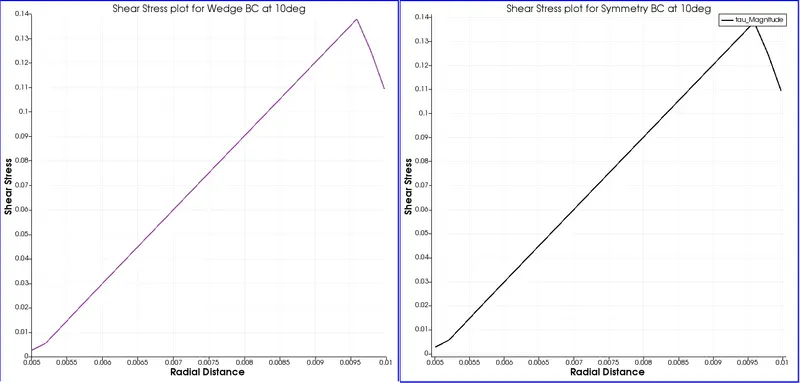
Shear Stress at 25 Deg for both the Boundary conditions.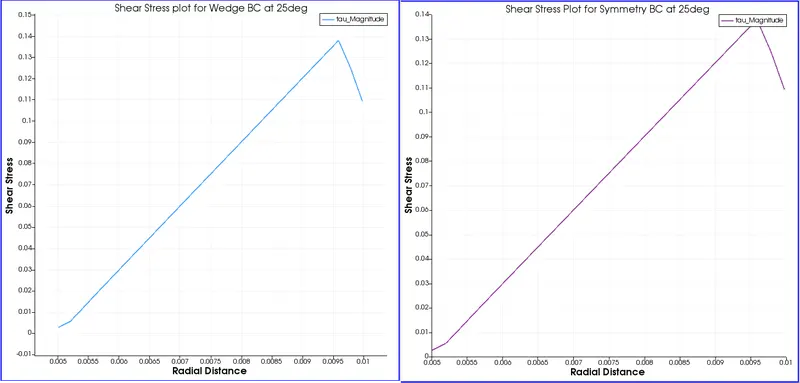
Shear Stress at 45 Deg for both the Boundary conditions.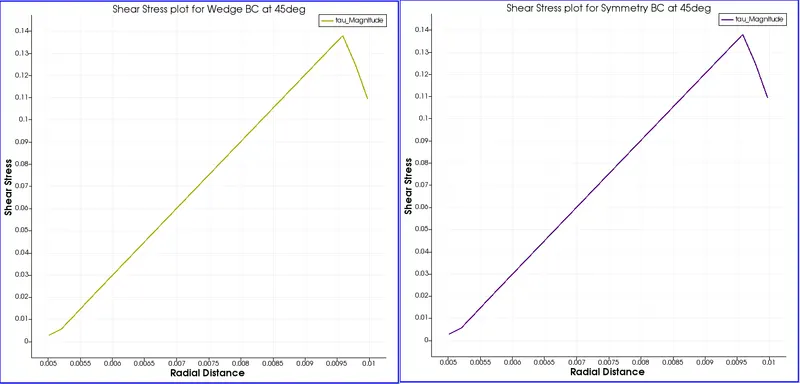
VELOCITY VARIATION:
Velocity variation at 10degrees for the two Boundary Conditions.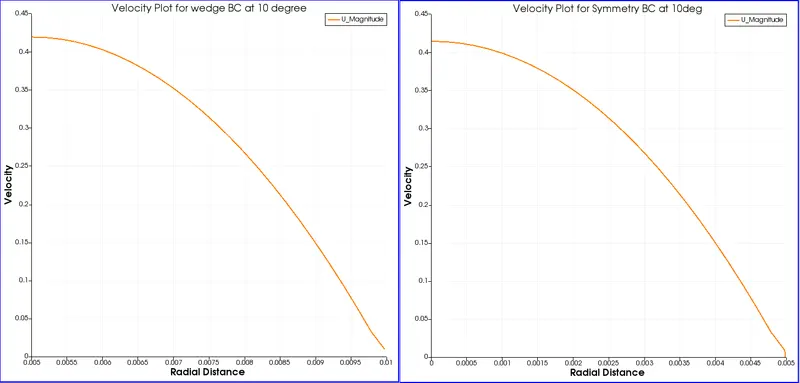
Velocity variation at 25 degrees for the two Boundary Conditions. 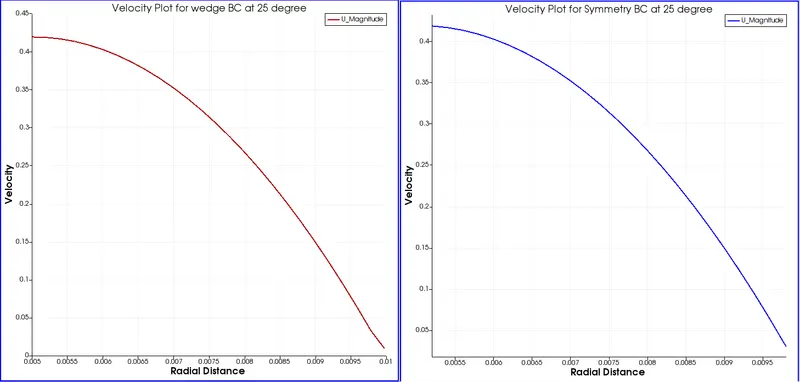
Velocity variation at 45 degrees for the two Boundary Conditions.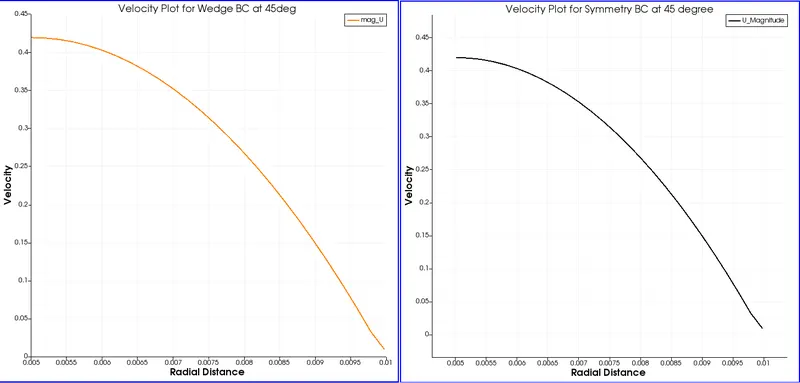
PRESSURE DROP:
Pressure drop at 10 degrees across the Axial Distance.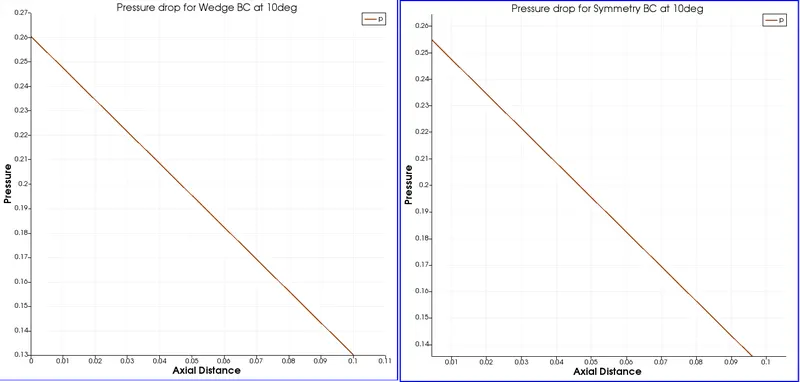
Pressure drop at 25 degrees across the Axial Distance.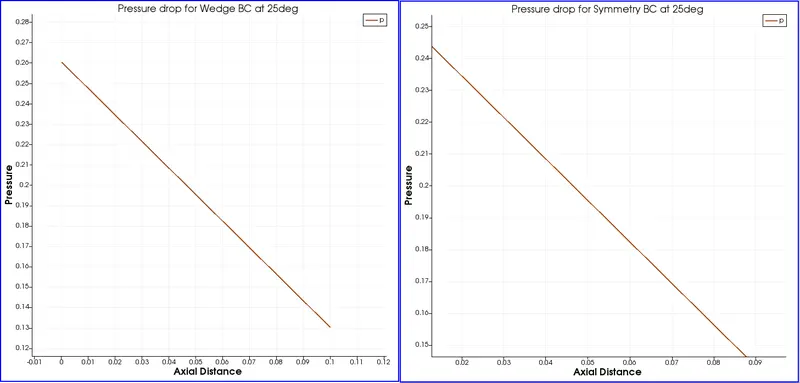
Pressure drop at 45 degrees across the Axial Distance.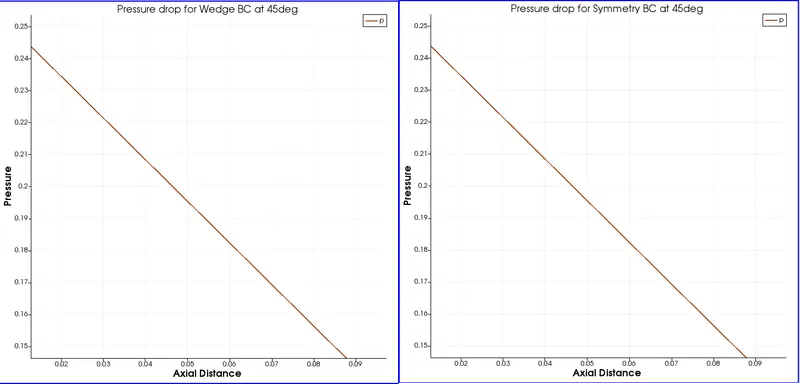
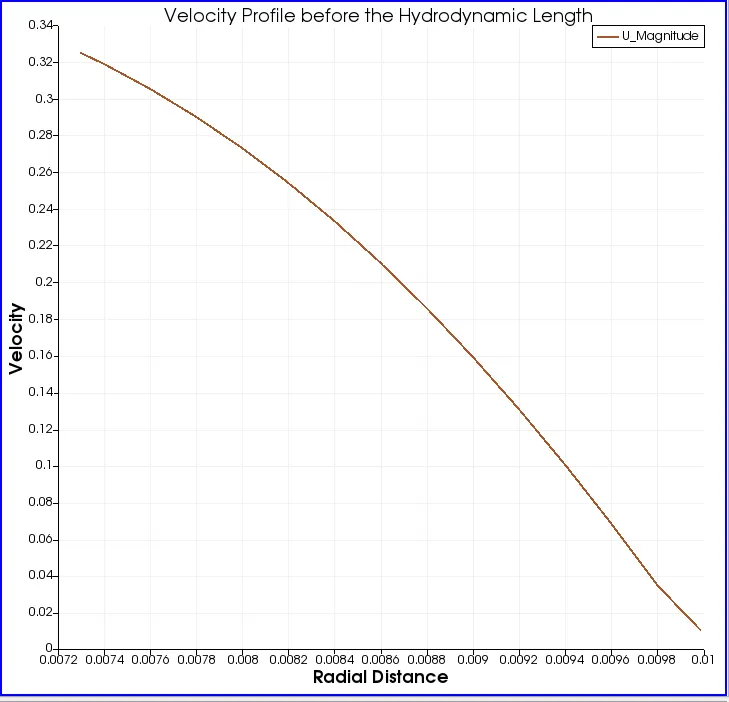
HYDRODYNAMIC LENGTH:
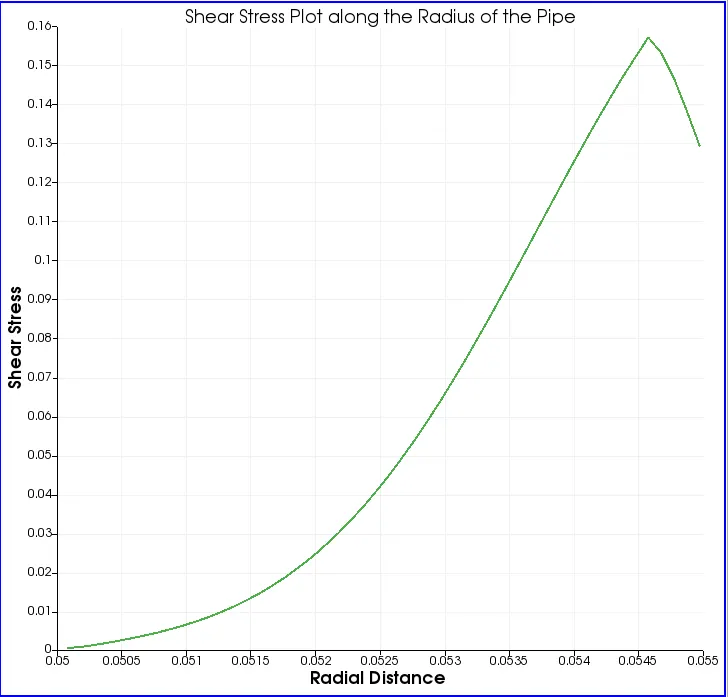
SHEAR STRESS along RADIUS of pipe:
CONCLUSION:
There is no much change in the maximum velocities. The only difference observed is execution time a little high than type-wedge. While the angle increases the error in the maximum velocity is decreased. Though there is not much difference between analytical and numerical results and also with increasing the angle of the wedge, The Courant number is slightly increasing. we can say that the symmetric boundary condition plays an important role in terms of accuracy in the result.