Week 12 - Validation studies of Symmetry BC vs Wedge BC in OpenFOAM vs Analytical H.P equation
Unlike in the previous assignment, where the simulation is performed using a transient solver icoFoam, the simulation is carried out using a steady-state solver simpleFoam since the emphasis is on the steady-state flow field.
This assignment aims to compare the boundary conditions of Wedge and Symmetry for different angles.
First, a tutorial on simpleFoam is copied to the run folder. The blockMeshDict file is edited as per the geometry. The simulation is carried for 5000 iterations until it reaches convergence. The simulation type and RAS model are both set as laminar in the turbulenceProperties file. The flow boundary conditions are as follows.
The Reynolds number of the flow is chosen as 2100 for the laminar flow. The diameter of the pipe is fixed as 20 mm. The density and viscosity are 996.59 `(kg)/m^3` and 0.000852 `(kg)/(m-s)` respectively.
The required uniform inlet velocity for the above flow conditions becomes 0.089766102 `m/s.`
The outlet condition is a fixed pressure boundary condition (of some value). Note that the inlet pressure is unknown and is determined from the simulation for the given inlet velocity and outlet pressure.
Thus, the boundary conditions are velocity-inlet and pressure-outlet.
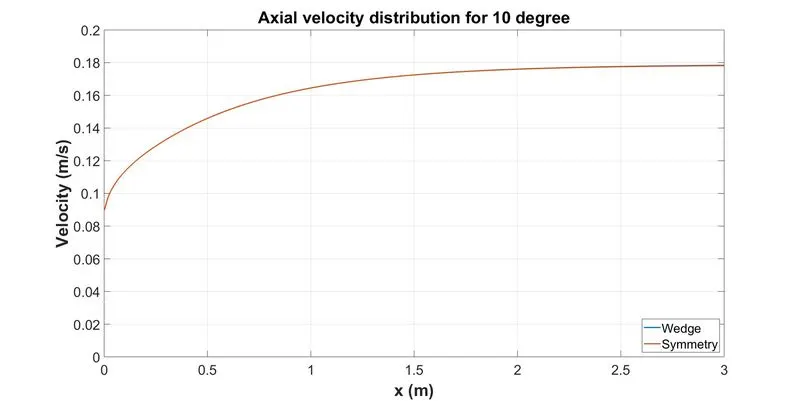
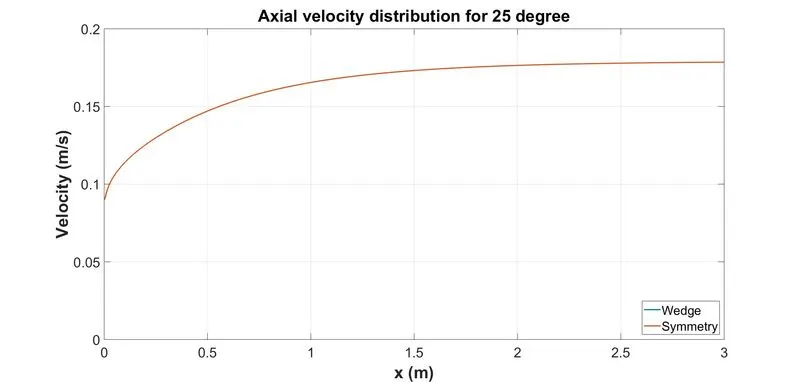
The hydrodynamic length for the given case is, `L_h` = `0.06*Re*D` = 2.52 `m.`
The difference in using the wedge and symmetry boundary condition at the front and back planes in simulation is just the syntax, i.e., for the wedge boundary condition, the term wedge is used. In contrast, for symmetry, the term symmetry is used.
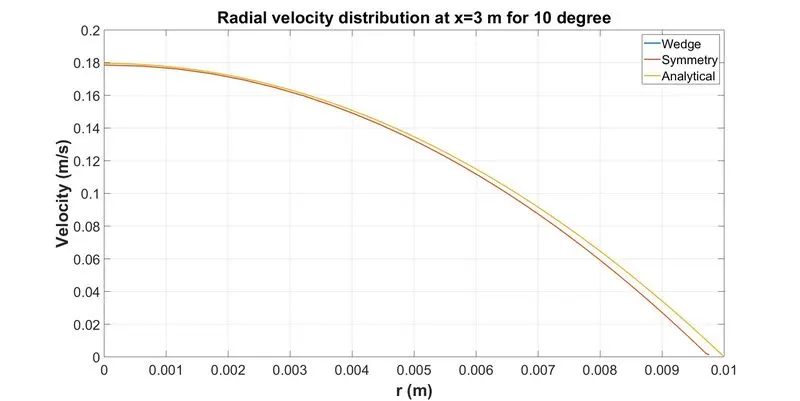
Wedge Vs Symmetry for `10^0` angle:
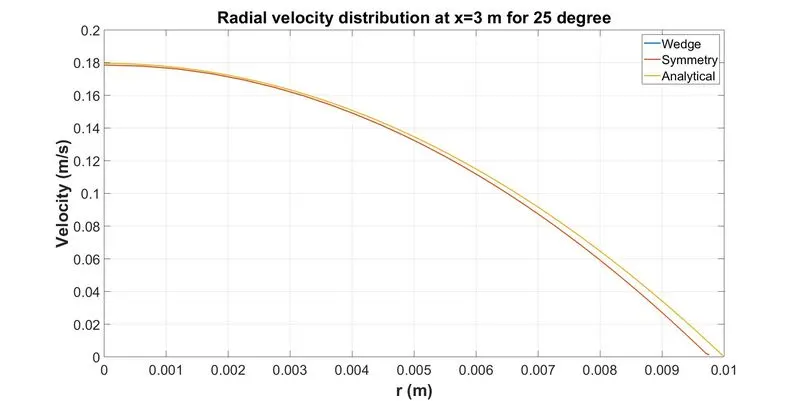
Wedge Vs Symmetry for `25^0` angle`
Wedge Vs Symmetry for `45^0` angle`
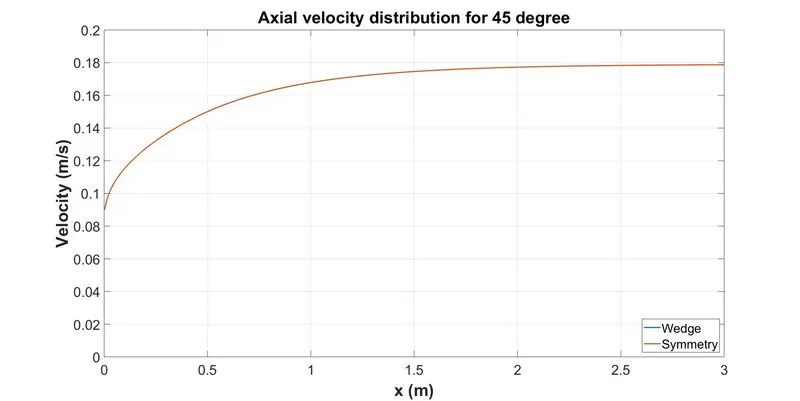
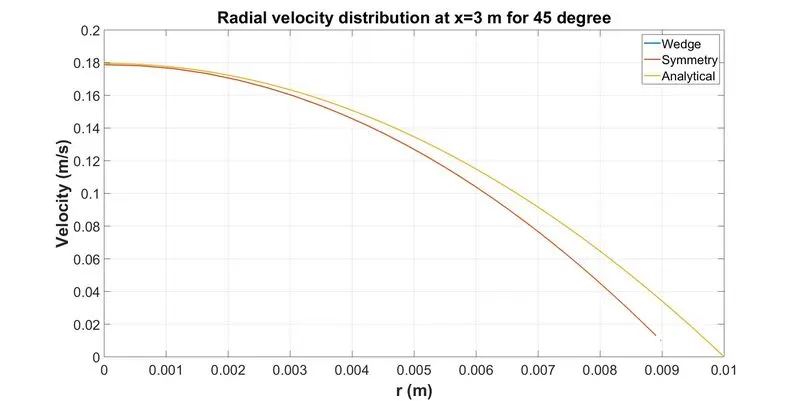
From the above graphs, the variation in results of simulation using wedge and symmetry conditions are negligible at least for the steady-state carried out using simpleFoam. The variation in the radial velocity distribution seems to differ a lot from the analytical at higher angles.
The hydrodynamic length from the simulation is approximately 2.5 m close to the analytical result.
The following is a table containing a list of maximum velocities obtained at different angles.
| Angle | Wedge condition (`m/s`) | Symmetry condition (`m/s`) | Analytical value (`m/s`) |
| 10 | 0.178404 | 0.178159 | 0.1795322 |
| 25 | 0.178516 | 0.178512 | 0.1795322 |
| 45 | 0.178735 | 0.17835 | 0.1795322 |
The blockMeshDict, controlDict, p, and U files remain the same as in icoFoam solver. The difference is the presence of turbulenceProperties file for simpleFoam solver.