Week 12:Project 2-Meshing of Rear Wheel Holder challenge
Target Element Length = 5 Units
| S.N | Quality Criteria | Value |
| 1 | Aspect Ratio | 5 |
| 2 | Skewness | 45 |
| 3 | Warping | 15 |
| 4 | Taper | 0.5 |
| 5 | Min. Length | 2 Units |
| 6 | Max. Length | 8 Units |
| 7 | Min angle Quad | 45 |
| 8 | Max angle Quad | 135 |
| 9 | Min angle Tria | 20 |
| 10 | Max angle Tria | 120 |
| 10 | Tria % | 10 |
ANSWER -:
Process -:
1. First thing to do is to make sense of all the collectors, which this component has several of. We can combine all the collectors into one by moving all of them to the first collector and then deleting the empty ones. This will help prevent any prospective confusion. This is done using the 'organize' tool (Tool > Organize). We need to select the surface that needs to be moved and the destination surface and we can go ahead and click move.
2. Since the entire component has almost the same thickness, we can go ahead and generate the midsurface manually from the bottom. This is due to the complexity of the geometry in certain regions. For this, we will need to measure its thickness. Which is 0.75 mm. (Thickness tool can be accessed by pressing F4). We need this for the manual creation of the midsurface. And this is done using the offset tool under surface edit.
3. Before carrying out the next step, we need to ensure that the newly created midsurface component is our current component. (We can make a component the current one by right-clicking the particular collector and selecting the 'make current' option).
4. The offset tool requires a measurement half of the thickness. The offset tool can be accessed through Geometry > Surface Edit > Offset. We can select any one face from any one of the faces. And then, right-click surfaces and select 'by face'. When this is done, the entire face is selected (which would be the entire bottom surface of the floor panel). Not the entire component.
Conclusion -:
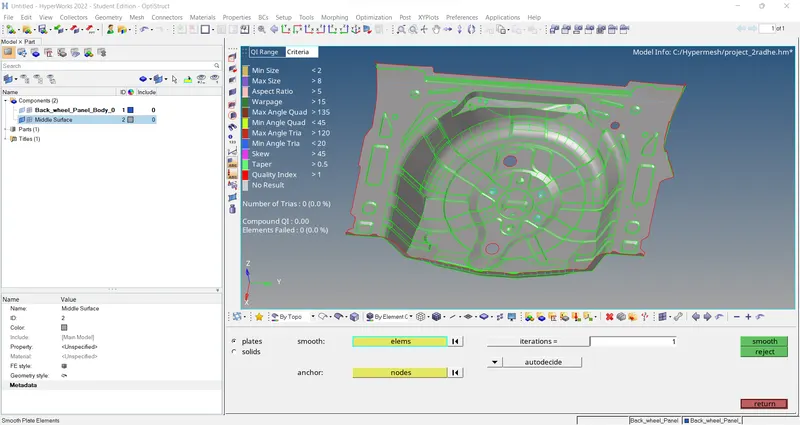
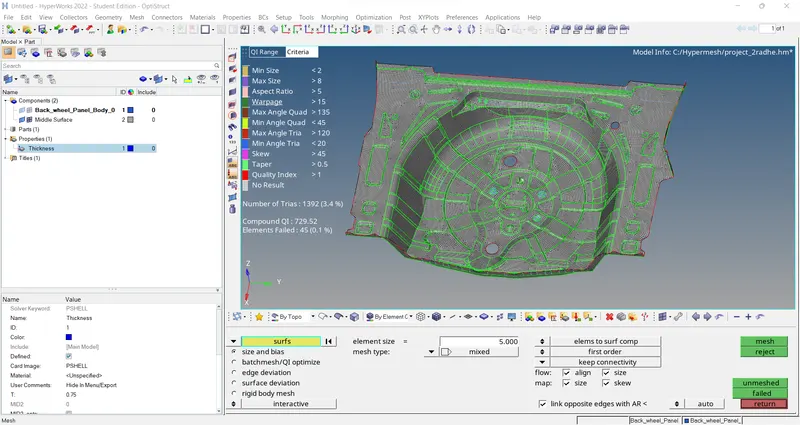
Therefore, the given floor panel was meshed after its midsurface was extracted. Meshing was carried out as per required quality criteria and it was ensured that the mesh flow was as smooth as possible. There were failed elements due to having to ensure proper surface capture.
Thickness and material were also assigned to the midsurface. 0.1% element are failed.