Week 12:Project-1-Meshing of Door Inner Panel Challenge
AIM :
To mesh the front door inner panel of Hyundai i10 according to the given quality criteria and assign thickness to the mesh.
Target Element Length = 4 Units
| S.N | Quality Criteria | Value |
| 1 | Aspect Ratio | 5 |
| 2 | Skewness | 45 |
| 3 | Warping | 15 |
| 4 | Taper | 0.5 |
| 5 | Min. Length | 2 Units |
| 6 | Max. Length | 6 Units |
| 7 | Min angle Quad | 45 |
| 8 | Max angle Quad | 135 |
| 9 | Min angle Tria | 20 |
| 10 | Max angle Tria | 120 |
| 10 | Tria % | 10 |
TOOLS REQUIRED :
- HyperMesh
THEORY :
Door Panels
Door panels serve as an interface between the interior of the car and the inner workings of the door, and between vehicle occupants and the door. They are expected to meet a variety of design specifications regarding safety, aesthetics, and functionality. In addition, they are expected to continue the material theme of the dashboard and pillars while concealing intricate electrical and mechanical components for operating locks, windows, and other features. The door panel has evolved from a simple two-part system of latch and simple winding mechanism to a more sophisticated enclosure. Doors currently have an inner full-width panel consisting of electronic windows, central locking system, and speakers. These panels typically consist of a foamed core covered with either textiles or plastics.
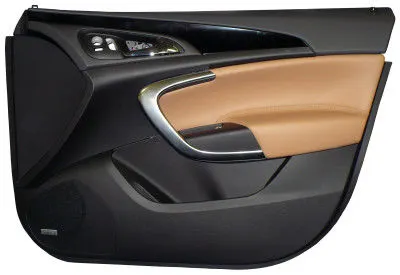
Door Inner Panel
Door panels are expected to meet one of the toughest sets of requirements among interior car components. These panels should be designed to withstand and channel loads into the body of the car while being thin (<2 mm). These loads could be horizontal and vertical in nature, like the force applied on opening or closing doors while leaning/resting on them or when stepping on the armrest to access the roof. An additional consideration is their ability to protect occupants from injury during a side collision, where most injuries are inflicted on the chest and pelvis as a result of crushing force of the door. Federal Motor Vehicle Safety Standard No. 214 therefore sets forth directives to manufacturers in order to limit this injury. It states that the Thoracic Trauma Index (TTI) should not exceed 85 g for a four-door or 90 g for a two-door passenger car. This test is performed at impact velocity of 53 km/h, which accounts for 90% of side impacts in North America.
PROCEDURE :
- Import the given model Side_door_final.hm to HyperMesh using Import option.
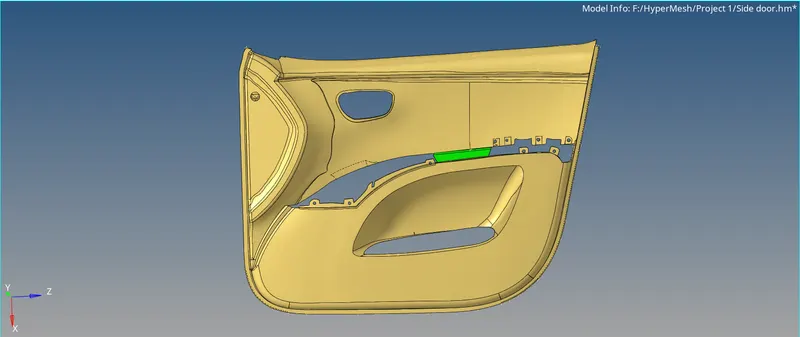
- First step is to organize different parts of the inner panel. The parts to be meshed are organized in a separate component.
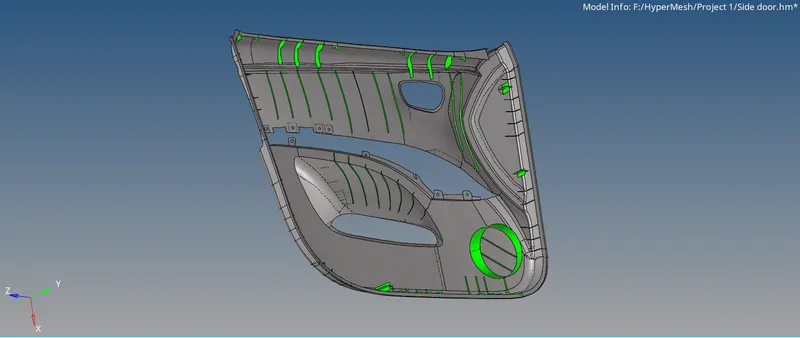
- Next step is to extract the midsurface of the inner panel. As this is a complex plastic component, thickness will not be uniform throughout the component. Also, there will be ribs and doghouses whose midsurface cannot be extracted using the conventional auto midsurface tool.
- To extract the base midsurface, we can use the Geom -> midsurface -> auto midsurface tool.
- Ribs and Doghouses should be manually extracted by offseting the surface to the midway using Geom -> surface edit -> offset tool.
- For the ribs with varying thickness, midline is created using Geom -> lines -> Midline tool and a surface is created with this line and its projection on the base surface. The extracted midsurface is shown below.
- The midsurface is then used for meshing according to the quality criteria set in the criteria file settings.
- Proper connection of elements of the ribs and doghouses to the elements of the base surface should be ensured while meshing. If connection is not present, we need to manually connect by adjusting the mesh and using replace node tool.
- After meshing, thickness is assigned to the model. Since thickness is different for different surfaces, separate properties have to be created according to the thickness values as shown below.
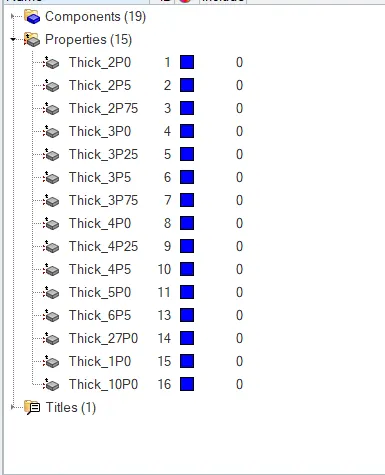
Model Browser
- Appropriate thickness is given to each rib and the properties are assigned to the corresponding components. Average thickness is given to the ribs with varying thickness.
RESULTS :
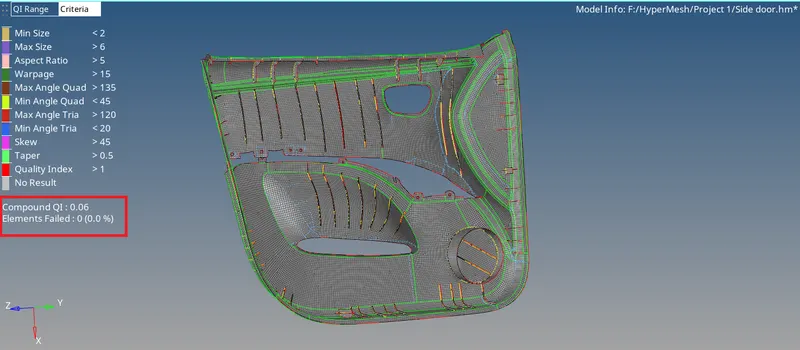
- The Door Inner panel is meshed according to the quality criteria and is shown below.
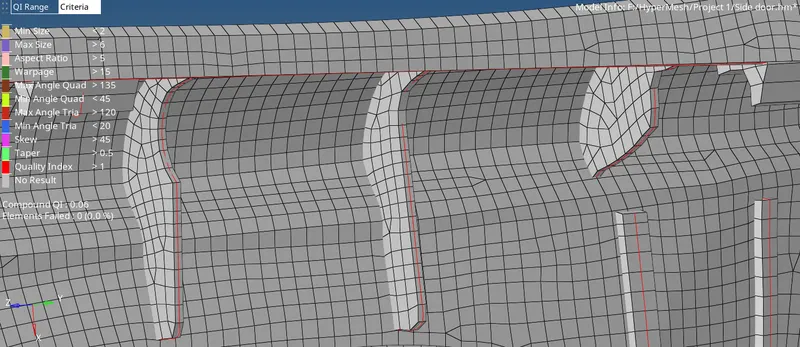
- Thickness is assigned to the whole model and its 2D Detailed Element Representation is shown below.
CONCLUSION :
The front door inner panel of Hyundai i10 is meshed according to the quality criteria as shown in the result above. The meshed model file is attached with this report.