Week 11: Project 2 - Emission characterization on a CAT3410 engine
Objective
We should simulate 2 types of piston heads: open-W and Omega shape. Our objective is to see how the design of a piston head affects engine performance and emission characteristics.
Creating `60^0` section of the combustion cylinder
To create a section of the combustion we are using the tool "Make engine sector surface".
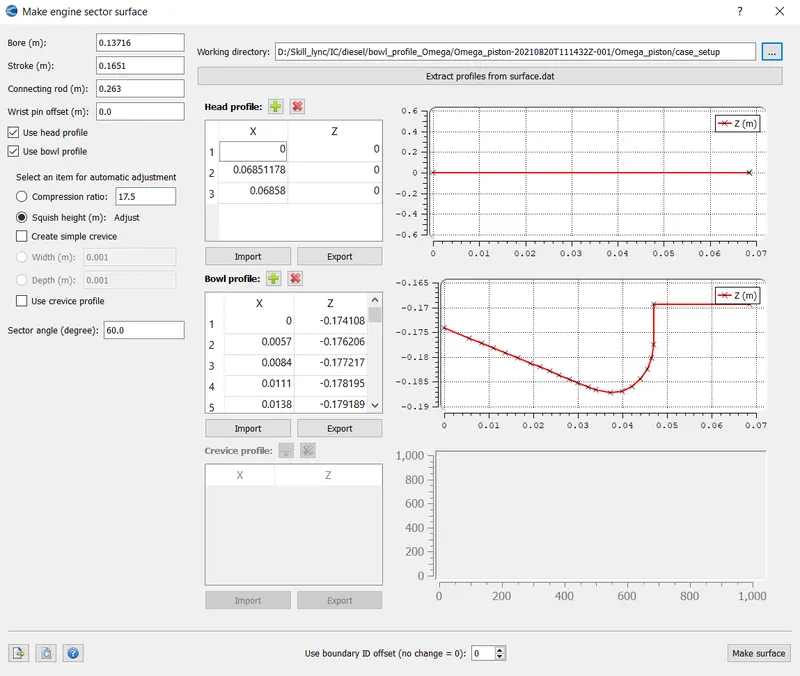
Figure 1
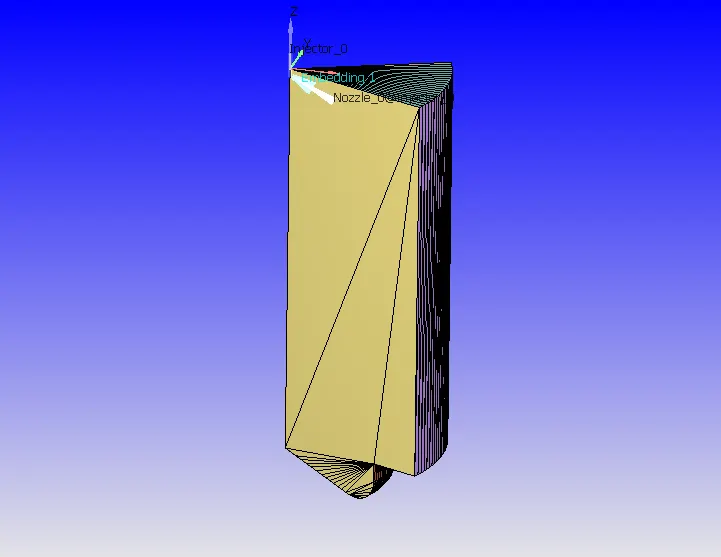
Figure 2
As you see in Figure 2 the Geometry only consists of a combustion cylinder, there is no intake, exhaust or valves. This is done for the problem simplification and the engine type, as we are simulating a Diesel engine the fuel injection will be direct injection, therefore we only need initial conditions for the cylinder and what's left is to simulate the half-cycle: compression and power stroke.
Note: As we have already simulated the PFI engine case in the challenge "Week 10: Project 1 - FULL HYDRO case set up (PFI)" and covered the complete set-up of the case. In this report, the case set-up discussion won't be included as it's similar to the PFI case and the input files were provided.
Post Processing
Our goal is to identify the pros and cons of the given 2 types of piston heads. Therefore, we provide plots showing the characteristics of the pistons. As we already mentioned we have Open-W and Omega profile pistons.
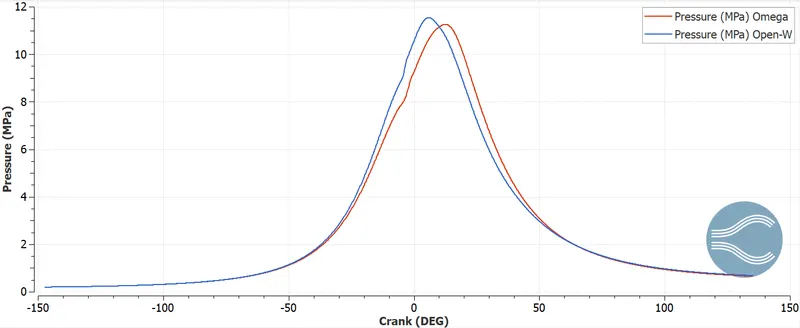
Figure 3
In Figure 3 crank angle corresponding pressure plots are shown, As you see Peak pressure of the Omega profile piston is slightly lower than the pressure of the Open-W profile one.
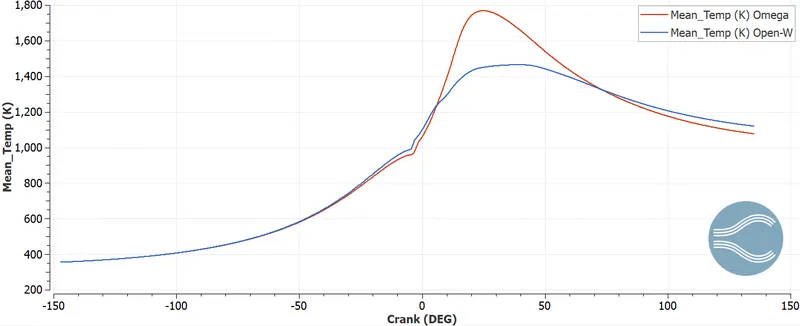
Figure 4
In Figure 4 we see that the mean temperature in the Omega profile piston case is significantly higher, therefore in that case we will have a higher `NO_x` generation, thus we may say that the Open-W profile piston will be more eco-friendly, however, low temperature may be caused due to inappropriate fuel burning, which can be examined by looking at CO generation plots.
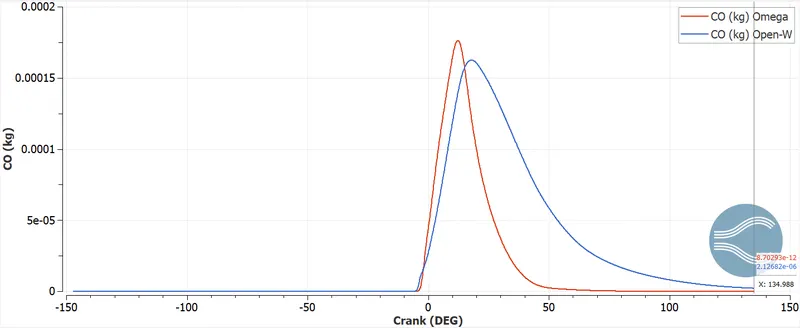
Figure 5
As shown in Figure 5 the Open-W profile generates more CO products during the combustion, therefore combustion efficiency is less than in the Omega profile case, however, we can not say that this is only one reason for lower temperatures in the Open-W profile case.
We should also see gaseous phase plots of the fuel `C_7H_16` to determine in which case the fuel-burning occurred faster.
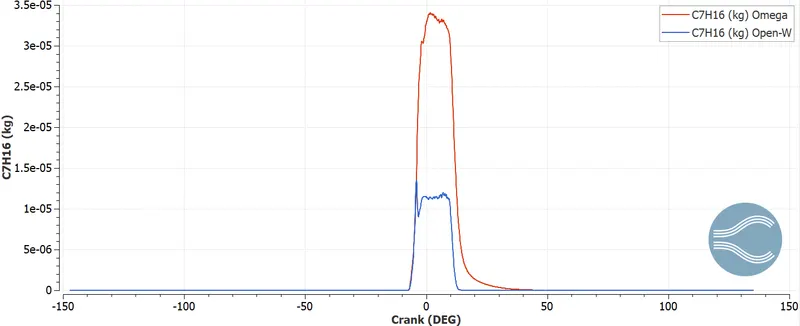
Figure 6
As you see according to Figure 6 in the Omega profile case we have multiple times more gaseous fuel during the process, meaning that fuel break-up after injection and evaporation occurred more efficiently than in the Open-W profile case. This phenomenon is due to the shape of the pistons, Omega profile piston shape transaction is much more aggressive than the Open-W profile, therefore fuel break-up and atomization happens much more quickly leading to a more efficient combustion process. Furthermore, the heat released during the combustion is slightly higher in the Omega profile case (Shown in Figure 7).
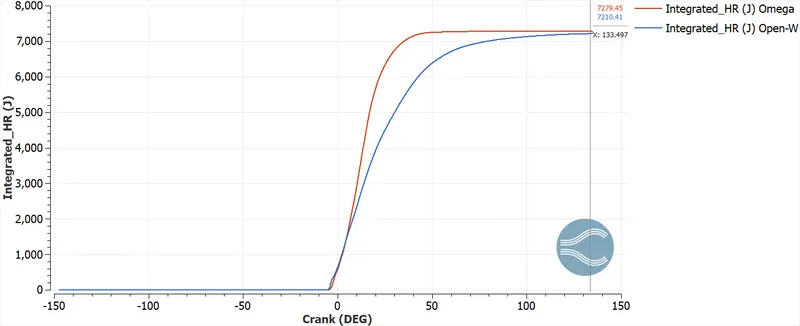
Figure 7
The difference in the integrated heat release is approximately 70jouls, you may think, it's not a big deal, however, we should take into account that we are looking at the one cycle results, therefore in real life this little difference will lead us to significant loses after a few thousand cycles which will happen within several minutes.
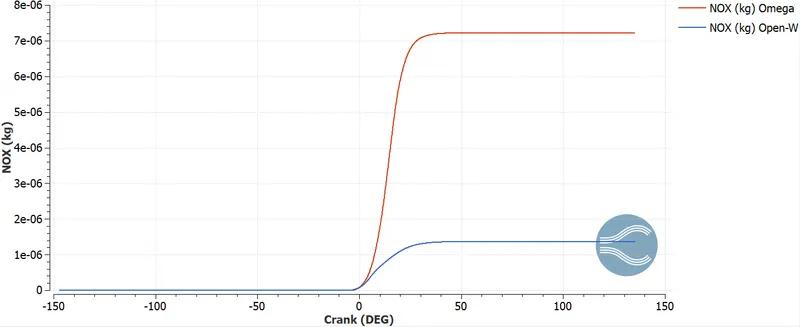
Figure 8
As we already discussed `NO_x` generation should have been higher in the Omega profile case due to significantly higher combustion mean temperature, Figure 8 shows nothing but the same.
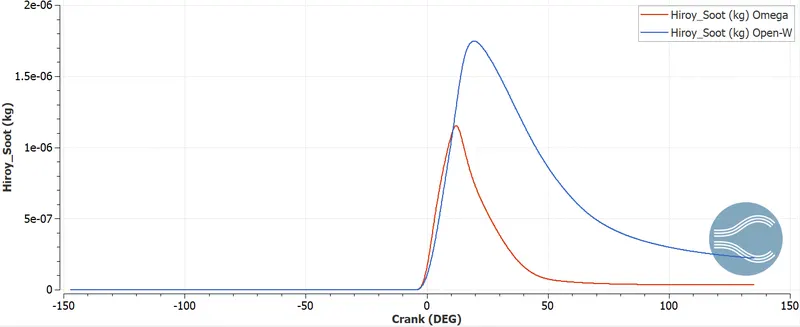
Figure 9
Soot is a mass of impure carbon particles resulting from the incomplete combustion of hydrocarbons, therefore it's intuitive in our case that in the Open-W profile case Soot generation should be higher (Shown in Figure 9).
Animations
Note: In the animations, the Open-W profile is on the left side and the Omega profile is on the right side.
- Emissions
NOx
Figure 10
CO
Figure 11
Soot
Figure 12
Temperature contours
Figure 13
Velocity contours
Figure 14
Conclusion
We successfully simulated bother cases and analysed the results. We found out that as the Omega profile helps the fuel in the initial break-up, it leads to faster evaporation and afterwards a more rapid and efficient combustion process. As the combustion process is more efficient in the Omega profile case, it will generate less CO and Soot emissions, however, as the mean temperature is much higher in this case `NO_x` generation will be significantly higher.