Week-11 Challenge: Braking
AIM:
- To calculate the energy required for braking in a driving cycle.
- To state why electric motors cannot develop high braking torque at high speed as similar to the case in starting and state how electric & mechanical brakes are coordinated together in a braking scenario.
- To write a MATLAB program which plots contour of motor speed, torque & efficiency values.
GOVERNING EQUATIONS:
1. Energy calculation for braking:
Energy (kinetic) `E =1/2(mv^2)`
where,
E = Energy (J)
m = mass of the vehicle (including payload) (kg)
v = velocity of the vehicle (m/s)
3. MATLAB program for contour plots of Motor speed, torque & efficiency:
Copper losses = `k_c*T^2`
where,
kc = Copper loss constant
T = Torque (Nm)
Iron losses = `k_i*omega`
where,
ki = Iron loss constant
ω = Motor speed (rad/s)
Windage & frictional losses = `k_w*omega^3`
where,
kw = Windage & frictional losses constant
ω = Motor speed (rad/s)
Output power `P = T*omega`
where,
P = Output power (J)
T = Torque (Nm)
ω = Motor speed (rad/s)
Input power = Output power + Losses (J)
Efficiency η = Output power / Input power (%)
CODE SAMPLE:
3. MATLAB program for contour plots of Motor speed, torque & efficiency:
clear all
close all
clc

x = linspace(0,1300);
y = linspace(0,500);

[s,T] = meshgrid(x,y);

kc = 0.2; %Constant for copper losses
ki = 0.08; %Constant for iron losses
kw = 0.0001; %Constant for windage & frictional losses

cu_loss = kc.*T.*T; %Calcualting Copper losses
fe_loss = ki.*s; %Calcualting Iron losses
wind_loss = kw.*s.*s.*s; %Calcualting Windage & frictional losses
const_loss = 10; %Estimating the constant losses

losses = cu_loss + fe_loss + wind_loss + const_loss ; %Calcualting the total losses
output_pwr = s.*T; %Calcualting the total power
input_pwr = output_pwr + losses;
efficiency = output_pwr./input_pwr; %Calcualting the efficiency of the motor

V = [0.70,0.73,0.76,0.79,0.82,0.85,0.88,0.90]; %Plotting for different efficiencies of the motor

contour(s,T,efficiency,V); %Making the 3D plot

xlabel('Speed (rpm)');
ylabel('Torque (Nm)');
zlabel('Efficiency (%)');
EXPLANATION:
1. Calculating the energy required for braking:
The energy required for braking is same as the energy required for accelerating, because when a vehicle is at a particular speed, it has a finite amount of energy within. To bring the vehicle to a stop, a finite amount of energy should be applied which must be equal to the energy sustained by the vehicle. In simpler terms, the energy required for acceleration is same as the energy required for deceleration. This energy is the kinetic energy. It is calculated as follows.
Given data,
| Kerb weight (kg) | 1860 |
| Payload (kg) | 200 |
| Total mass (kg) | 2060 |
| Case 1: Brake from 68 kmph to 0 kmph | Case 2: Brake from 105 kmph to 0 kmph | ||||||
| Initial velocity (kmph) | 68 | Initial velocity (kmph) | 105 | ||||
| Initial velocity (m/s) | 18.88888889 | Initial velocity (m/s) | 29.16666667 | ||||
| Final velocity (kmph) | 0 | Final velocity (kmph) | 0 | ||||
| Final velocity (m/s) | 0 | Final velocity (m/s) | 0 | ||||
| Time (seconds) | 16 | Time (seconds) | 17 | ||||
| Energy (J) | 367493.8272 | Energy (J) | 156312.4786 | ||||
| Energy (kJ) | 367.4938272 | Energy (kJ) | 156.3124786 | ||||
The driving cycle data & the related plots can be viewed from here.
2. Why electric motors cannot develop high braking torque at high speed:
From the control of Induction motors, it is already known that varying the input voltage varies the torque output and varying the frequency of the supply voltage varies the speed of the motor. When the voltage is increased, the flux in the stator increases but the speed of the motor decreases. Conversely, when the frequency increases, the flux decreases and the torque decreases. From this behaviour, it is clear that torque and speed are two inversely proportional quantities. Also from natural physics, torque is inversely proportional to the speed. So it is the natural behaviour of an electric motor to have less torque at high speeds and high torque at low speeds. This is why electric motors cannot develop high braking torque at high speed.
How electric & mechanical brakes are coordinated together in a braking scenario:
Electric braking is the process of using the electric motor to slow down the vehicle. It is done by changing the operating region of the electric motor which causes it to produce negative torque and inturn slow down the vehicle. During electric braking, a motor is made to work as a generator which restores power back to the battery. This kind of braking is also called Regenerative braking. Regenerative braking is a way of taking the wasted energy from the process of slowing down a car and using it to recharge the car’s batteries. Hybrid and electric vehicles can use the electric motor to restore a portion of the kinetic energy for reuse. Regenerative braking enables an extended range in electric vehicles and lowering fuel consumption & improving CO2 balance in hybrid vehicles.
With the great advantages of electric braking comes some of its disadvantages. It is to be noted that all of the kinetic energy of the vehicle cannot be converted to electrical energy to charge the battery. It depends on the charging capacity of the battery. Also regenerative braking requires bi-directional power converters for charging & discharging the battery. Using a bi-directional power converter in the charging system makes the charging system complex.
In a conventional vehicle, the kinetic energy of the vehicle is converted into heat and emitted into the environment. When the brake pedal in a conventional vehicle is pressed, hydraulic fluid pushes brake pads against brake discs. The resulting friction works to slow the car down, generating heat and wearing away at the material on the pads and discs in the process.
Braking control strategies: As seen above, there are two types of braking that can be used. Coming to the strategy for braking, there are two main strategies, Series and Parallel. Series braking refers to either using the electric braking or mechanical braking. Parallel braking refers to the use of both electric & mechanical braking for effective braking of the vehicle. At low speeds, mechanical braking can be used as there would be low kinetic energy in the vehicle and using the frictional brakes produces less heat at low speeds. At higher speeds, the electric braking can be used where the high kinetic energy of the vehicle can be used to charge the battery & power other auxiliary electrical loads.
3. MATLAB program for contour plots of Motor speed, torque & efficiency:
First, the range for speed & torque values are given using the linspace command. Then the values are actually realised using the meshgrid command. The constants for copper loss, iron loss, windage & frictional losses are given by declaring separate variables. Next, the copper loss, iron loss, windage & frictional losses are calculated. The constant motor loss is assumed to be 10. The total losses is calculated by summing up all the losses calculated above. Output power is calculated as the product of the torque and the motor speed. As we know, the input power supplied to the motor goes into losses and the motor output. The input power is calculated as the sum of output power & losses. Finally, the efficiency of the motor is calculated as the ratio of output power and input power. At last, the 3D plot is plotted using the contour command and the axis names for the x, y and z axis are given.
RESULTS:
1. The energy required for braking is calculated as 367.4938272 kJ and 156.3124786 kJ for the two scenarios.
3.
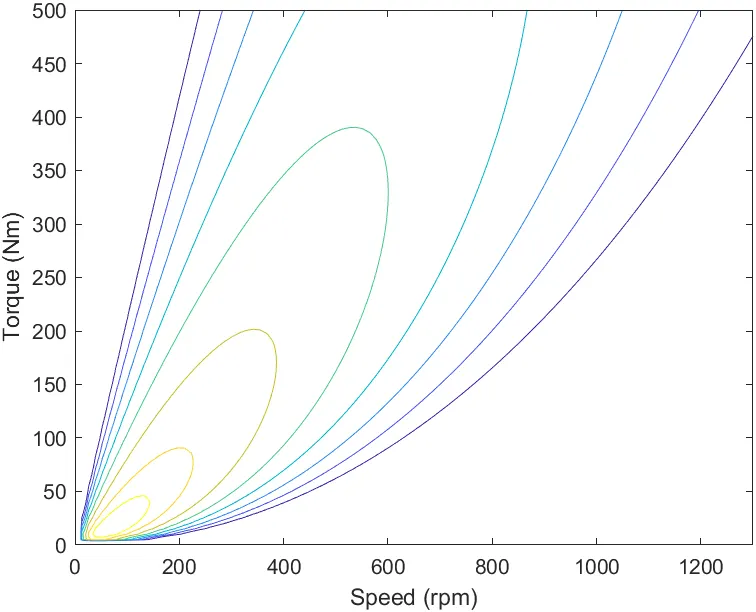
After executing the program, we obtain the plots. We can see that the torque speed characteristics of the motor are plotted for different motor efficiencies. It is noted that as the curve goes inwards, the motor efficiency increases.
CONCLUSION:
- The energy requirement for braking in a given drive cycle is calculated mathematically.
- The different types of braking and braking control strategies are explained along with their outcomes and drawbacks.
- A MATLAB program is written to plot the torque speed characteristics for different efficiencies of the motor.