Week-11 Challenge: Braking
1)
To calculate the energy required for braking during a defined driving cycle, you would need information about the vehicle's mass, velocity profile during the driving cycle, and braking efficiency.
The basic formula to calculate kinetic energy is:
Kinetic Energy= ½ mv2
where:
- m is the mass of the vehicle,
- v is the velocity of the vehicle.
The energy required for braking is essentially the energy that needs to be dissipated to bring the vehicle to a stop. This is equal to the kinetic energy of the vehicle at the end of the braking event.
Energy for Braking = Kinetic Energy at the end of braking
The kinetic energy at the end of braking can be calculated by the same formula mentioned above, using the final velocity of the vehicle after braking.
It's important to note that this is a simplified calculation and assumes 100% efficiency in converting kinetic energy to heat during braking. In reality, the braking system may not be 100% efficient, and some energy may be lost to other forms (such as heat, sound, etc.).
For a more accurate calculation, you would need additional parameters such as the braking efficiency, which is the ratio of the kinetic energy converted to useful braking work. The formula for braking energy with efficiency (η) would be:
Energy for Braking = (Kinetic Energy at the end of braking)/η
In practice, vehicle dynamics, road conditions, and other factors can complicate these calculations. Specialized software or simulations are often used for detailed analyses of energy consumption and braking in specific driving cycles.
Let's assume we have a car with a mass (m) of 1000 kg. The car is initially moving at a velocity (v) of 20 m/s, and it comes to a stop after the braking event.
- Calculate the Initial Kinetic Energy:
Initial Kinetic Energy= ½ mv2
Initial Kinetic Energy=1/2 ×1000kg × (20m/s)2
Initial Kinetic Energy=200,000 JoulesInitial Kinetic Energy=200,000Joules
- Assume the Braking System is 90% Efficient ( η=0.9):
Energy for Braking= (Initial Kinetic Energy)/ η
Energy for Braking= (200,000 Joules)/0.9
Energy for Braking≈222,222Joules
So, in this example, if the car's braking system is 90% efficient, approximately 222,222 Joules of energy would be required to bring the car to a stop.
2)
In electric vehicles, the ability of an electric motor to provide significant braking torque at high speed is limited by the back electromotive force (EMF) generated by the motor. The back EMF is essentially a voltage that opposes the applied voltage, and it increases with the speed of the motor. At high speeds, the back EMF becomes larger, making it more difficult for the motor to generate braking torque.
Here's a more detailed explanation:
- Back EMF: When a motor is operating, it generates a back EMF due to the rotation of the motor. The faster the motor spins, the higher the back EMF becomes. This back EMF opposes the applied voltage, and at some point, it can even equal or exceed the applied voltage, making it challenging to sustain significant current flow through the motor windings. Without a substantial current, the motor can't generate significant braking torque.
- Transition from Motoring to Braking: During motoring (normal operation), the electric motor is driven by an external power source, and during this phase, the motor works against the back EMF. However, when braking is required, the motor can be turned into a generator. The challenge arises when transitioning from motoring to braking, especially at high speeds, where the back EMF is high.
Coordinating electric and mechanical brakes in a vehicle involves various strategies to optimize braking performance and efficiency. Here are some common methods:
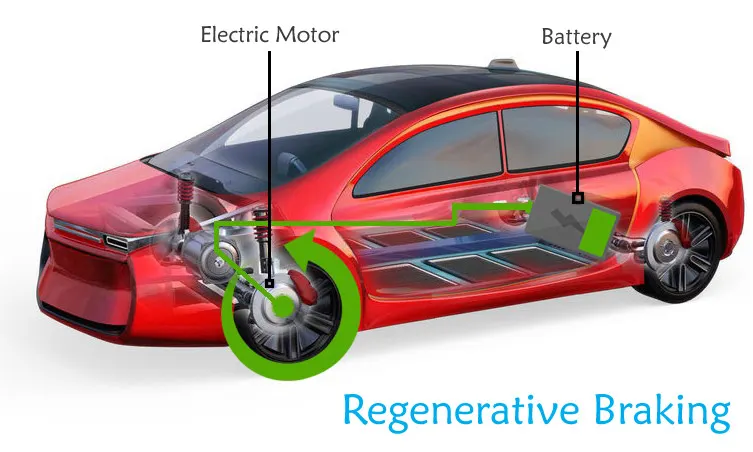
- Regenerative Braking: Electric vehicles often use regenerative braking systems. During regenerative braking, the electric motor acts as a generator, converting kinetic energy back into electrical energy. This energy is then fed back into the battery for later use. Regenerative braking is more effective at lower speeds, where the back EMF is not as significant.
2. Blended Braking Systems:
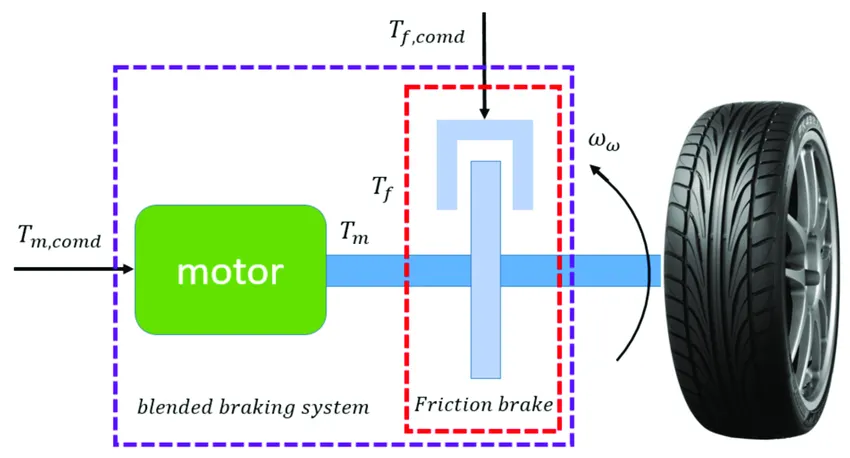
Many electric vehicles use a combination of regenerative braking and traditional friction brakes (such as disc brakes) to provide effective braking across a wide range of speeds. The system determines the optimal blend of regenerative and friction braking based on factors like speed, state of charge of the battery, and braking force required.
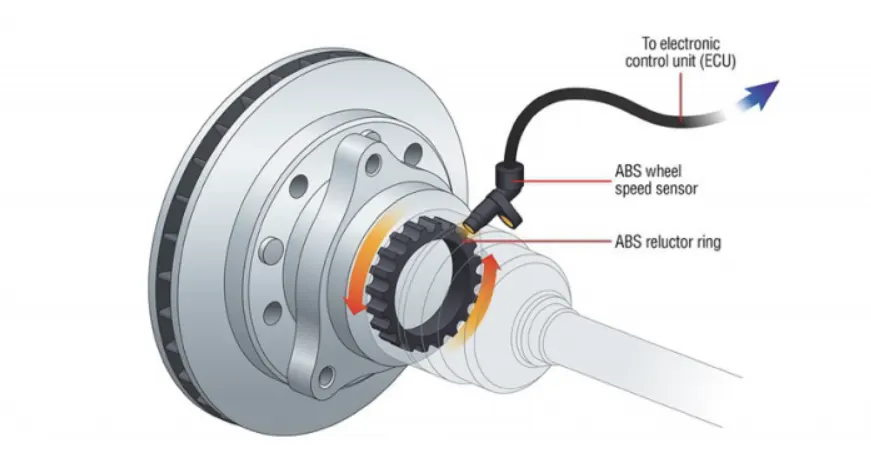
3. Anti-lock Braking Systems (ABS): ABS is a safety system that prevents wheel lockup during braking. In electric vehicles, ABS may need to coordinate regenerative braking with traditional brakes to ensure stability and control during emergency braking situations.
3. Electronic Brake Force Distribution (EBD):
EBD adjusts the distribution of braking force between the front and rear axles based on various factors. In electric vehicles, EBD may take into account the contribution of regenerative braking to optimize overall braking performance.
Coordinating these systems often involves sophisticated control algorithms and sensors that monitor various parameters, allowing the vehicle to adapt to different driving conditions and optimize braking efficiency.
Top of Form
3)
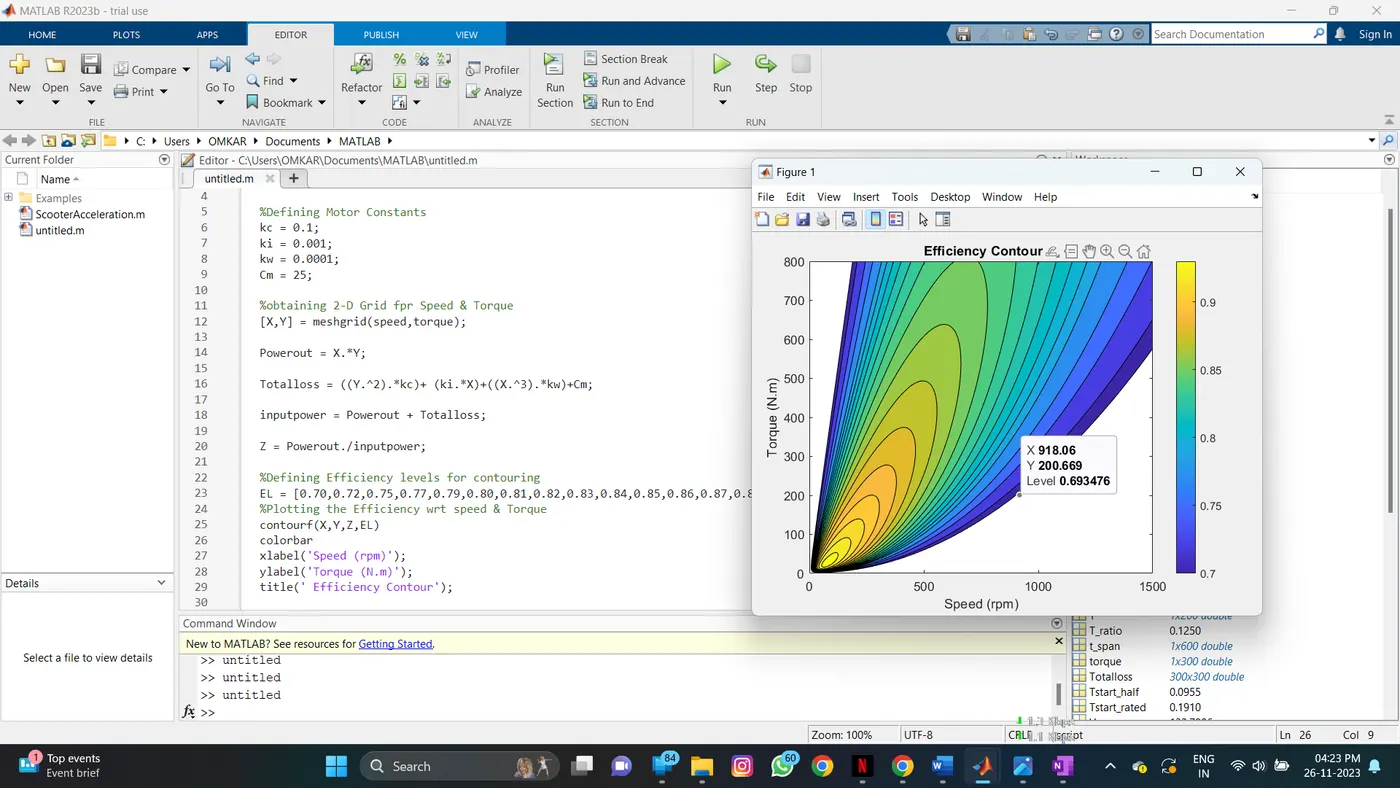
Motor Speed = 0 - 1500rpm
Motor Torque = 0 - 800 N.m
Motor Constants:
- Copper Loss constant, kc = 0.1
- Iron Loss Constant, ki = 0.001
- Windage Loss Constant, kw = 0.0001
- Motor Loss Constant, Cm = 25
MATLAB Code: