Week-11 Challenge: Braking
AIM - To perform the tasks that are given to me.
GOVERNING EQUATION - The governing equation that is used here for the calculation of braking energy.
The braking energy is nothing but the kinetic energy of the vehicle when the brakes are applied.
The equation of kinetic energy is given by:
K.E - 12⋅MV212⋅��2
where M is the mass of the vehicle in kg
V is the velocity of the vehicle in m/s
OBJECTIVES - 1) To calculate the energy required for braking for a defined drive cycle.
2) To give the reason that why electric motor can’t develop braking torque at high speed similar to starting and to describe how the mechanical and electric brakes are co-ordinated.
3) To make a MATLAB program which plots contour of given motor speed, torque and efficiency values.
PROCEDURE - For the first part - Braking - Braking is the process of controlling the velocity of an object by inhibiting its motion. An object in motion possesses kinetic energy and to bring the object to a stop this kinetic energy must be removed. Removing the kinetic energy can be accomplished by dissipating the energy to the atmosphere through friction or by converting it into another form of energy.
so the process of braking must follow the principle of converservation of energy which states that the energy cannot be created or destroyed but only converted from one form to another.
Here i have to calculate the energy required for braking for a defined drive cycle. so here i have used a drive cycle which i created in excel sheet
The excel sheet is shown below:
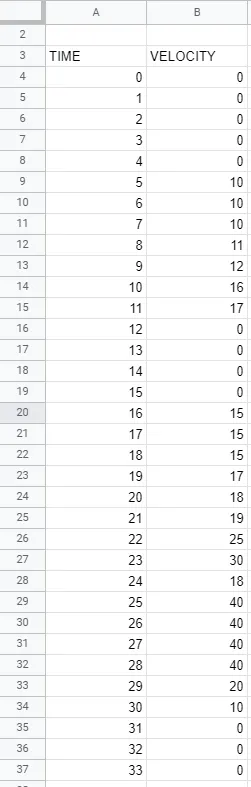
in the above fig. you can see that the drive cycle is created for 33 seconds and velocities are varied up and down. The plot of this drive cycle is shown below:
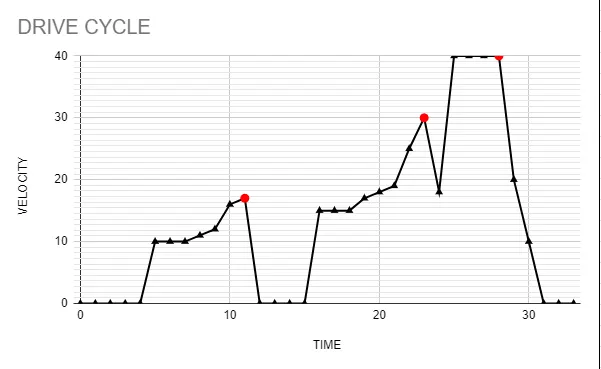
In the above shown plot the points which are highlighted in red are the points in which the brakes are applied.
so i will calculate the braking energy at that points only because those are the points for which the vehicle is decelearting.
The energy required for the first point, from that point the vehicle's speed is reduced from 17 m/s to 0 that means the vehicle is coming at rest.
The braking energy will be nothing but the kinetic energy released during that process.
K.E - 12⋅MV212⋅��2
M is the mass in kg
V is the velocity in m/s
Here the total mass i have assumed as 400kg which will be constant throught the drive cycle and velocity will be varied.
so at first point the velocity is reduced from 17 to 0
V = final - inital velocty
V = 0 - 17
M = 400
K.E = 12⋅(400)⋅(0−17)212⋅(400)⋅(0-17)2
K.E = 57800 J or 57.8 KJ
Now same thing i will do for rest of the points
for point 2 the velocity is reduced from 30m/s to 18m/s
M= 400kg, V = (18-30)
K.E = 12⋅(400)⋅(18−30)212⋅(400)⋅(18-30)2
K.E = 28800 J or 28.8 KJ
for point 3 the velocity is reduced from 40 m/s to 0 that means now the vehicle will be at rest
M = 400kg, V = (0-40)
K.E = 12⋅(400)⋅(0−40)212⋅(400)⋅(0-40)2
K.E = 320 KJ
For the second part - Electric motor - An electric motor is an electrical machine that converts electrical energy into mechanical energy. Most electric motors operate through the interaction between the motor's magnetic field and electric current in a wire winding to generate force in the form of torque applied on the motor's shaft. Electric motors can be powered by direct current (DC) sources, such as from batteries, or rectifiers, or by alternating current (AC) sources, such as a power grid, inverters or electrical generators. An electrical generator is mechanically identical to an electric motor, but operates with a reversed flow of power, converting mechanical energy into electrical energy.
lets look at the speed torque characteristics of a DC motor:
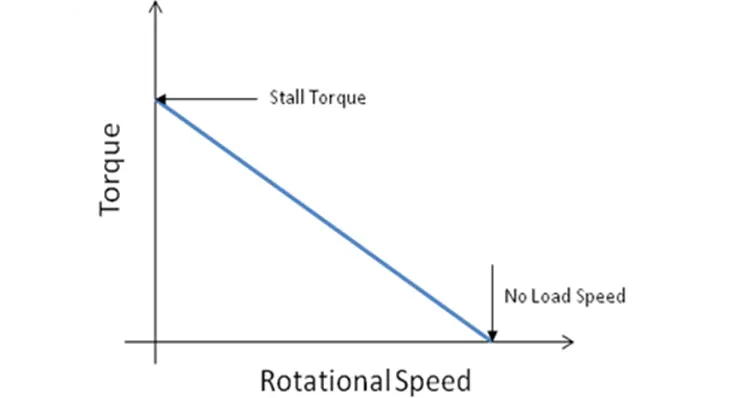
Here you can see that as the speed of the motor is increasing the Torque is decreasing. so what happens is when the motor is starting the speed is less so the torque develop will be more and hence there will be acceleration power available and the vehicle can accelerate easily but during braking the vehicle will be at high speed so the torque will be low and when at high speed if we apply the brakes it won't develop the same torque this is the reason that the regenerative braking cannot be applied effectively so basically we can say that it is a limitation of the motor.
There are some other reasons for electric motor failing to develop similar braking torque as starting torque and those are related to the batteries and powerconverters,The charging rate of batteries lower are than the peak discharging rate.The battries can discharge at double rate than there charging rate.The power converters used are bi directional converter they are bi directional because they need to use the regenerative braking to charge the battery and if the power converter used is of complex type or it is less effective at high speed than it will affect the regenerative braking and hence the brake torque will aslo be affected. so if we want the braking to be effective it is necessary that we use a mechanical brake with electric brake.
There are two types of braking used in vehicles:
1) Mechanical brake
2) Electrical brake
Mechanical brake - Mechanical brakes are assemblies consisting of mechanical elements for the slowing or stopping of shafts in equipment drives. They use levers or linkages to transmit force from one point to another. Braking slows or stops the movement of the coupled shafts. mechanical brake acts by generating frictional forces as two surfaces rub against each other. The stopping power or capacity of brake depends largely on the surface area of frictional surface. They are mainly of two types (Drum brake and Disc brake). These are rough and uncomfortable and they cause wear to braking components. In mechanical braking the whole energy is lost in the form of heat we cannot reuse it.
Electrical brake - Electrical brake is a brake in which the braking is controlled by a electric current. Electric brakes are devices that use an electrical current or magnetic actuating force to slow or stop the motion of a rotating component. They are used in industrial and vehicular braking applications that require fast response times and precise tension control. They are of several types such as (permament brakes, electromagnetic brakes, eddy current brakes, regenerative brake).In electric vehicles regenrative braking is widely used to charge the battery that is providing current to the motor. These are smooth and comfortable and they do not cause any wear and here we can use that the energy that is lost in the form of heat to recharge the battery. For low speed vehicle the electrical brake is itself capable of providing effective braking but fot high speed vehicles it is required to use mechanical brake along with electrical brake.
The electrical and mechanical brake are co-ordinated in two types in electric and hybrid electric vehicles and they are:
1) series braking
2) parallel braking
- series braking - In series braking the brakes are applied one after the other meaning first the electric brakes are applied followed by mechanical brake. suppose if we are driving a vehicle and we are approaching a traffic signal so before reaching the signal if we release the accelerator paddle than the vehicle's speed will be reduced and regenerative braking will occur and when we reach the signal press the brake paddle which will apply mechanical brake. so in this way series braking can be done one after the other.
- parallel braking - In parallel braking both the electric and mechanical brake are applied at the same time. When the brake paddle is pressed the brake fluid will reach the brake piston and cause will retard the motion of wheels, there will be some kinetic energy lost. That kinetic energy lost will be reused at the same time by regenerative braking to charge the power using bi directional motor/generator so in this way both electric and motor brake will work simultaneously.
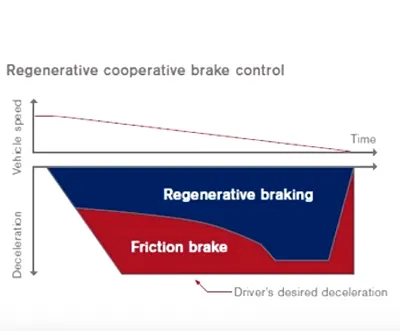
The above fig. is an example of parallel braking of nissan car. In the fig. you can see that when the speed is high the percentage sharing of both regenerative and friction (mechanical) brake is equal and when the speed is low the regenerative braking is doing most of the braking. Here a controller is used which according to the speed will give signals to braking.
For the third part - For this purpose i have to plot the contour of motor speed, torque and efficiency value in MATLAB. But before that lets see what are the losses that occur in motors:
1) copper losses - These losses occur due to current flowing in stator and rotor windings. As the load changes, the current flowing in rotor and stator winding also changes and hence these losses also changes. Therefore these losses are also called variable losses. The magnitude of these losses are given by I2R�2� where I is the current and R is the resistance.
2) Iron losses - The iron or core losses are further divided into hysteresis and eddy currents losses. Hysteresis losses are due to the changing polarity of the flux in the steel core. Hysteresis losses are effected by both the ability of the material to change polarity easily and by the total flux density in the steel. Eddy current losses are circulating currents induced in the steel core by the changing polarity of the flux. Eddy current losses are effected by the total flux density, the frequency at which the polarity of the flux changes and area available for eddy currents to flow. the magnitude of these losses can be calculated as Ki⋅w��⋅�where Ki is the constant and w is the speed.
3) Windage losses - In an air cooled motor, these losses are caused by turbulence in the air acting against the rotation of the rotor. The magnitude of these losses can be calculated as w3⋅Kw�3⋅��where w is the speed and Kw is the constant.
4) Frictional losses - These losses are attributed to the force it takes to overcome the drag associated with rotating the motor’s rotor or armature. Examples of friction losses are friction of bearings, bushings or brushes in a universal or brushed type DC motor. In general, the frictional losses are proportional to the rotor speed.
The MATLAB program is shown below:
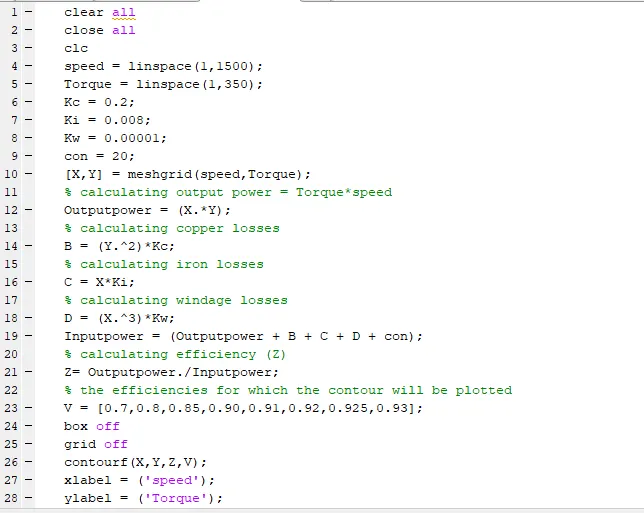
- In the above program in line 4 and 5 linspace command is used because i want different values of speed between (1 to 1500) and for torque between (1 to 350)
- Line 6 donotes the constant for copper losses (kc =0.2)
- Line 7 denotes the constant for iron losses (Ki = 0.008)
- Line 8 denotes the constant for windage losses (Kw =0.00001)
- Line 10 denotes the meshgrid which returns 2-D grid coordinates based on the coordinates contained in vectors 'speed' and Torque. x is a matrix where each row is a copy of 'speed', and Y is a matrix where each column is a copy of 'Torque'. The grid represented by the coordinates X and Y has length(Torque) rows and lenth(speed)columns.
- Line 12 denotes the output power which is a product of speed and Torque
- Line 14 is for the calculation of copper losses (T2⋅kc�2⋅��)
- Line 16 is for calculation of iron losses (W⋅Ki)(�⋅��)
- Line 18 is for calculation of windage losses ((W3⋅Kw)(�3⋅��)
- Line 19 is for calculation of input power. Input power will be the addition of output power and all lossses.
- Line 21 is for calculating the efficiency which is defined as output power/input power
- Line 23 denotes the values of efficiency that i have given as array for which the contour will be plotted
- Line 26 contour command is used to plot the contour (speed,Torque,efficiency,V)
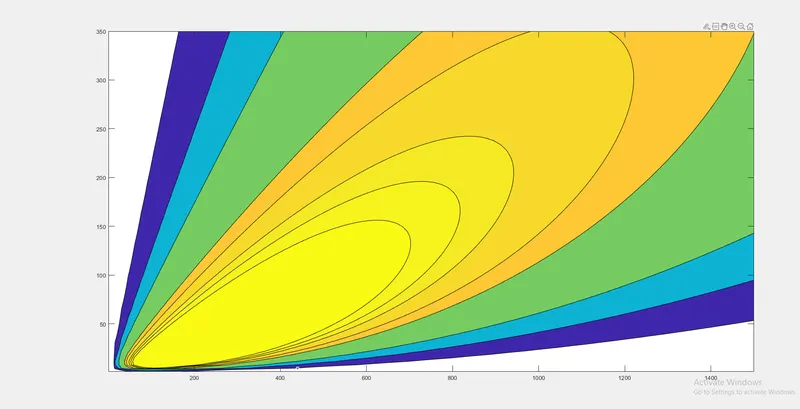
- In the contour x axis will denote speed and y axis will denote Torque.
The contour plot is shown below:
RESULT - 1) The energy required for braking for a defined drive cycle is :
For 1st braking - 57.8 KJ ( velocity reduced from 17 to 0)
For 2nd braking - 28.8 KJ ( velocity reduced from 30 to 18)
For 3rd braking - 320 kj (velocity reduced from 40 to 0)
3) The contour plot of motor speed, torque and efficiency value is shown below:
CONCLUSION - All the tasks that are given to me has been completed successfully and the results are shown and plotted in result section.