Week-11 Challenge: Braking
1)For a defined driving cycle, calculate the energy required for braking.
Answer:-
Calculate the energy required for braking
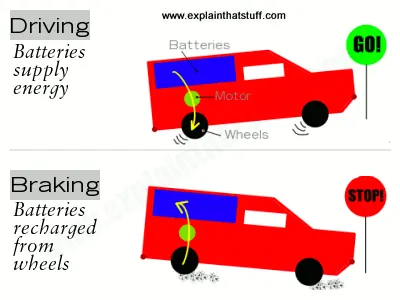
Vehicles with regenerative brakes achieve braking by driving the motor in reverse. As the driver steps on the brake pedal, the vehicle’s electric motor is placed in reverse mode, causing it to run backward. This operation not only slows the car’s wheels but also acts an electric generator for the car. The reverse motion produces electricity that feeds into the car’s battery. Hybrid and electric vehicles also have friction brakes that act as a backup system when the regenerative braking is not supplying enough power to stop the vehicle.
Reverse motor motion can be achieved by using the vehicle’s own momentum. The electronic circuitry and the car’s onboard computer determine when to use the conventional frictional brake system or whether to put the motor into reverse. A slight reduction in the car’s momentum, determined by the driver’s force on the pedal, causes the vehicle’s electronics to activate the regenerative brakes and place the motor in reverse. In contrast, if the vehicle needs to come to a quick stop, to avoid a collision, for example, the conventional brakes will be engaged.
A driving cycle is a series of data points representing the speed of a vehicle versus time.
Driving cycles are produced by different countries and organizations to assess the performance of vehicles in various ways, for instance, fuel consumption, electric vehicle autonomy and polluting emissions.
Calculate the energy required for braking
We are able to use the energy which is been disappeared at the point of breaking. The kinetic energy which helps the vehicle to run also gets wasted while the braking is done. Though it depends on various parameters on how effective the braking would be it can be depended upon.
- Number of Brake Pistons
- Duration and Degree of Brake Pedal been Pressed
- Road Condition
- Temperature
- Brake Pad and Disc Condition
- Mass of the Vehicle
Still with a basic operation where the vehicle is in motion and the brakes are applied the same efficiency could be calculated by the given equations.
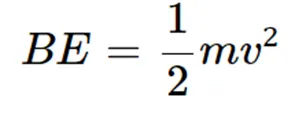
where,
BE=braking energy
m=mass of the vehicle
v = velocity
In this manner, the same calculation is carried out for calculating the brake efficiency required at the peak point.
Suppose we have UDDS cycle: -
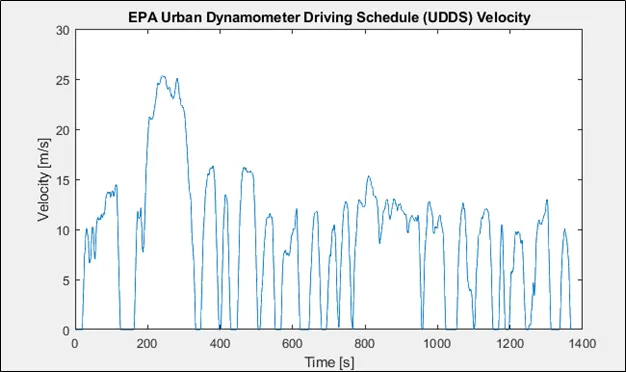
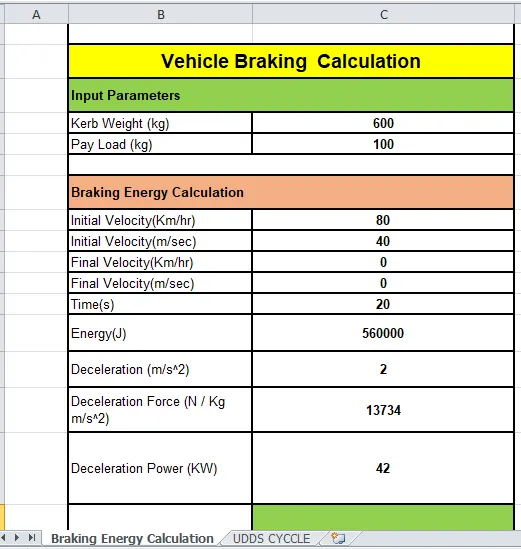
We can observe in this test cycle vehicle needs to stop in given time at some instance also for this we will apply brakes. We will calculate the power require for braking operation.
Please refer the attached sheet for complete calculation of Deacceleration energy require in UDDS cycle.
https://drive.google.com/file/d/1iUzRCWs9wNajJxM-nLx9wDF7rLRJqpOV/view?usp=sharing
- To reduce speed from 80 to 40 Kmph in 20 sec = 292 KJ
- To reduce speed from 80 to 0 Kmph in 10 sec = 560 Kj
2)
a)Why electric motor can’t develop braking torque at high speed similar to starting? How electric and mechanical brakes are coordinated?
Answer:-
When the motor is at rest and it has to operate from a standstill position to reach the moderate speed a higher torque is required to bring the motor into operation. Whereas when the vehicle is already at high speed the capping or the limit is reached by the motor operation and thus any further higher torque could not be obtained while braking. The braking operation happens in the motion which is been distributed as per proportion in the brake energy and the regenerative Braking.
b)How electric and mechanical brakes are coordinated?
In Mechanical braking which we usually see and experience in all vehicles, the brake pedal in the vehicle cabin helps us to engage or disengage the brakes. Currently, braking technology has done wonders by inventing life-saving braking technologies such as ABS, EBD, BA and many others. All these technologies play a vital role in stopping the vehicle and coming back to rest at a high speed. In all these vehicles when the driver applies the brakes the brake pads
come closer to the disc connected with the driving disc. The brake pads usually help inefficient braking.
There are two generic methods by which the vehicle could be braked in the electric brakes.
1.Series - The Regenerative Braking of the Mechanical Braking are applied one after another.
2.Parallel - The Regenerative Braking or the Mechanical Braking both are applied Parallely.
When the brake pedal is pressed the hydraulic fluid reaches the brake piston and created the braking pressure on the wheels and the same kinetic energy is been used by the Regenerative Braking for generating more power using the Bi-directional motor which operates as a
generator while braking An example of the proposition of Regenerative Braking and the Mechanical Braking
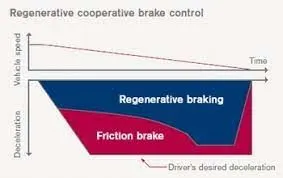
NISSAN LEAF EDIB (Electronic-Driven Intelligent Braking)
EDIB (Electric Driven Intelligent Brake) controls the regenerative brake and friction brake to support both of these requirements. Further, it also controls the reactive force from the pedal in order to unify the feeling when stepping down on the pedal and the sense of deceleration. The e-POWER electric-motor drive system is a state-of-the-art technology that functions to activate regenerative braking when the driver’s foot is removed from the accelerator pedal, but the e-Pedal feature combines friction braking (wheel brake) that is engaged when a vehicle comes to a full stop when the driver’s foot is removed from the accelerator pedal.
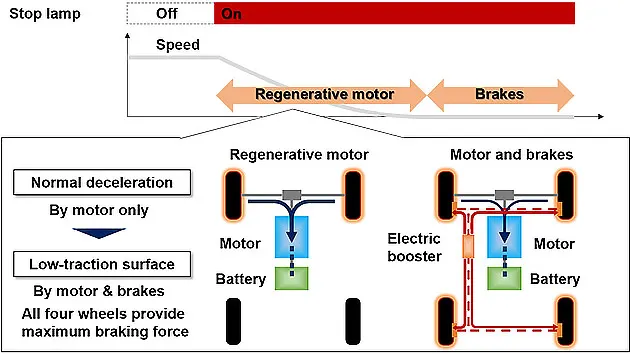
1) The e-Pedal features the deceleration force that is created when the pedal is not depressed. While the maximum deceleration force for the e-POWER system is around 0.15g, for the e-Pedal it is 0.2G at vehicle speeds of 0~50km/h, decreasing gradually at speeds of 50~80km/h and is more than 0.1G at speeds greater than 80km/h. Each of the above values is maximum value and actual values are adjusted according to the return amount of the accelerator pedal.
2) When the battery is fully charged, it cannot be charged further, which complicates the recovery of regenerative braking energy. However, with e-POWER, the combustion engine is stopped and the vehicle is powered by only the electric motor, consuming the energy stored in the battery, thereby making it possible to control regenerative braking comparable to that of engine braking. Even in this situation, e-Pedal is also capable of wheel braking so that the desired braking force can be achieved when the accelerator pedal is OFF.
3) As long as the foot is off the pedal, the vehicle will continue to remain stationary even on a slope. However, it is difficult to maintain a full vehicle stop only with the motor on an uphill slope for a long time because of the need to continuously power the motor on a climbing direction, so the hydraulic brake system is applied automatically when the car comes to a complete stop to keep the car stationary, even on a slope.
* Working of EDIB
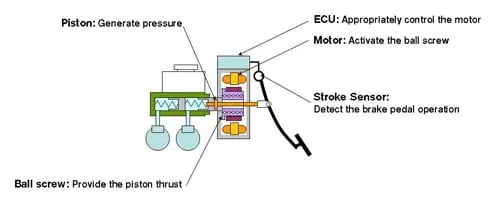
The major difference is that in a conventional Hydraulic system, the Hydraulic System will extract power from the engine, which lowers the total power output of the car and decreases the fuel mileage of the car slightly. On the other hand, in this electro-hydraulic power steering system, the power to the hydraulic system is delivered by an electric motor and not the engine directly. This means that the engine load does not change as the power is being delivered by the battery and motor.
Another added advantage is that the electric motor gets operated and controlled by the ECU unit which controls the motor very precisely by accurately monitoring the steering force, vehicle speed and steering angle. This added intelligence makes the system very comfortable to drive and improves the handling & feel to a great extent.
3Make a MATLAB program which plots contour of given motor speed, torque and efficiency values. Attach the code as a .m file attach a screenshot of all the plots.
Answer:-
Electric vehicles are using electric machines for propulsion and energy recuperation. An electric machine can be of two types: motor and generator. An electric motor converts electric energy into mechanical energy, while an electric generator converts mechanical (kinetic) energy into electrical energy.
* Brushless DC electric motor
When designing from scratch an electric vehicle or when doing a conversion (IC engine to electric machine) there are two options for the powertrain:
- design and build the electric machine
- integrate already existing electric machines
The first option only makes sense for the high volume, mass production of an electric vehicle. Designing and manufacturing an electric machine requires a lot of funding, knowledge, and time. For electric vehicle OEMs (e.g. Tesla, Renault-Nissan, etc.) it makes sense to design and manufacture the electric machines since the overall cost is lower and they have control on the technical specification. For prototypes, conversions or low-volume production electric vehicles, integrating an existing electric machine is more efficient.
The motor efficiency ηm [-] is the ratio between output power Pout [W] and input power Pin [W]:

The input power is the sum between the output power and the power losses Ploss [W]:
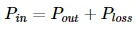
The power losses are going to be approximated by a mathematical equation.

where:
kc [-] – copper losses coefficient
ki [-] – iron losses coefficient
kw [-] – windage losses coefficient
C [W] – constant power losses
T [Nm] – motor torque
ω [rad/s] – motor speed
Matlab Program
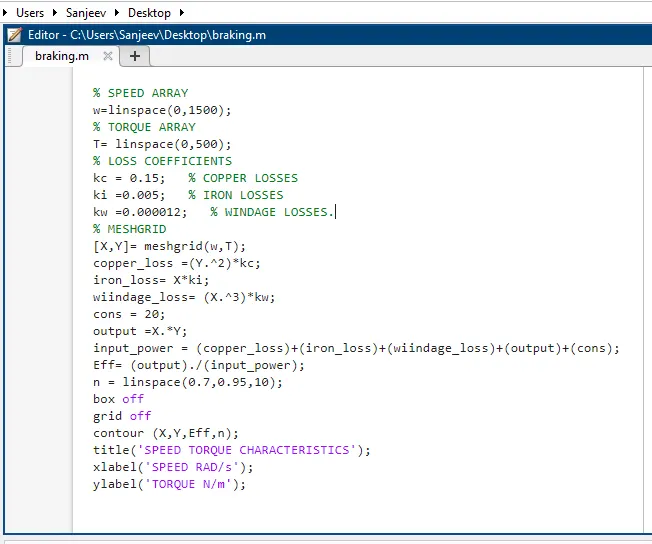
* Explanation:
In this program, we are plotting speed Vs torque characteristics with the efficiency values. For this, first, we are defining the speed and torque values of the motor.
Then as we need to draw a contour, we convert this ID array to a 2D array using the "MESH GRID" command.
Then we are defining the Cu constants for losses, like Cu loss constants, iron loss constant and windage loss constant.
Pi=Pout+KcT^2+Ki*w+Kw*^3+Const
Using this formula, we calculate the efficiency and then plot the contour
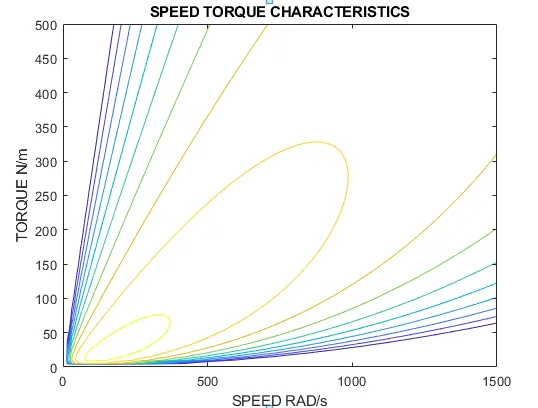
- The above figure shows the contour plot, the X-axis is the speed in RPM and Y-axis is Torque in Nm
- The contour plot represents the operation condition
- the efficiency of the motor is high at lower values of speed and torque. As the speed and torque increases the efficiency of the motor decreases.