Week-11 Challenge: Braking
Week-11 Challenge: Braking
- For a defined driving cycle, calculate the energy required for braking.
- Why electric motor can’t develop braking torque at high speed similar to starting? How electric and mechanical brakes are coordinated?
- Make a MATLAB program which plots contour of given motor speed, torque and efficiency values. Attach the code as a .m file attach a screenshot of all the plots.
Answer: -
- For a defined driving cycle, calculate the energy required for braking.
A driving cycle is a series of data points representing the speed of a vehicle versus time.
Driving cycles are produced by different countries and organizations to assess the performance of vehicles in various ways, for instance, fuel consumption, electric vehicle autonomy and polluting emissions.
Calculation of energy required for braking
we have been able to use the energy which is been disappeared at the point of breaking. The kinetic energy which helps the vehicle to run also gets wasted while the braking is done. Though it depends on various parameters on how effective the braking would be it can be depended upon.
Number of Brake Pistons
Duration and Degree of Brake Pedal been Pressed
Road Condition
Temperature
Brake Pad and Disc Condition
Mass of the Vehicle
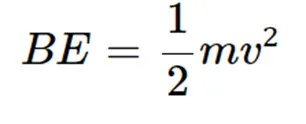
Still with a basic operation where the vehicle is in motion and the brakes are applied the same efficiency could be calculated by the given equations.
where,
BE=braking energy
m=mass of the vehicle
v = velocity
In this manner, the same calculation is carried out for calculating the brake efficiency required at the peak point. It is a drive cycle with speed variations the braking power required would vary but still, the highest braking power required is mentioned below
please refer to the attached sheet for complete calculation of deacceleration energy require in the UDDS cycle
Link:- https://drive.google.com/file/d/1GCIFObS9OWaKkV_r61DLeM1FjSbXKPh-/view?usp=sharing
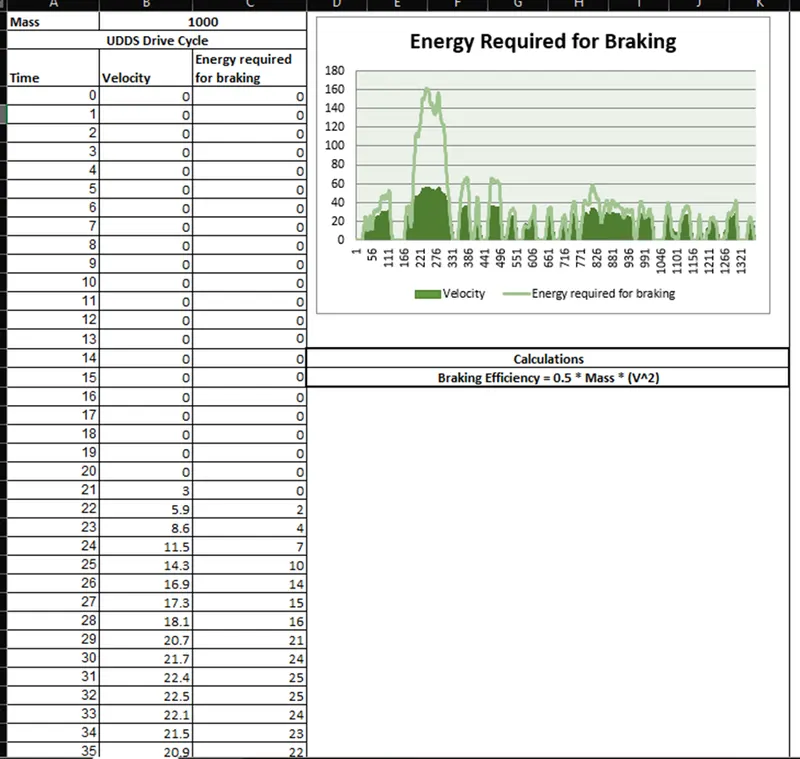
Braking Energy Require
To reduce speed from 80 to 40 kmph in 20 sec =292 KJ
To reduce speed from 80 to 0 kmph in 0 sec =560 KJ
- Why electric motor can’t develop braking torque at high speed similar to starting? How electric and mechanical brakes are coordinated?
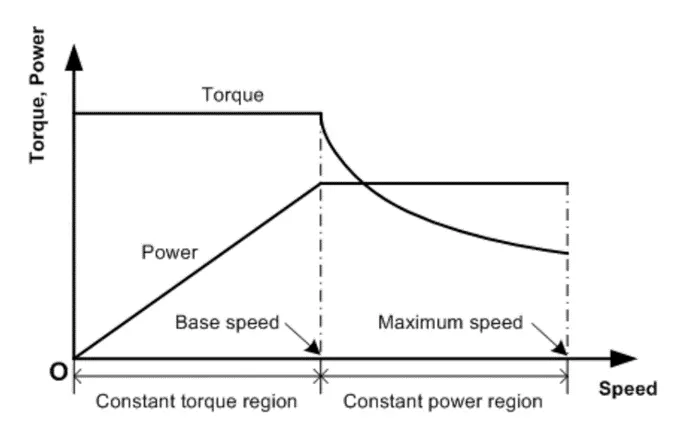
At the time of starting, speed is less or zero, so torque produced by the rotor has high constant value. It will remain so until the speed reaches to the rated or critical speed. This region is constant torque region where motor operates at low speed and high torque delivering increasing power. As speed increases further, torque will reduce gradually. This region is constant Power region, where motor speed is high and torque is low delivering high constant power.
now, in EVs and HVEs, there is a motor-generator, and a battery pack to supply power. As the electric current travels through the motor within a magnetic field, it generates a force. The more current applied, the more the motor will spin.
A generator does something similar, but the direction of the electric flow is reversed, rather than taking in current to spin the armature, the armature is spun through the field by the deceleration of the vehicle i.e. when brakes are applied. This produces electricity, which is used to recharge the battery, and the motor can switch between powering the car and regenerating electricity as fast as the driver can accelerate and lift off.
As the motor revs increase, however, it also creates back EMF. The faster the motor spins, the more back EMF is created, reducing the effective voltage it can deliver.
But at zero RPM, i.e. at the time of starting, all of the electricity the motor creates from the time electric power is applied becomes instant torque—without any back EMF to reduce its output. The higher the revs, the more back EMF, meaning that instantaneous torque effect diminishes.
Hence, at higher speed, electric motor can’t develop braking torque at high speed similar to starting.
- Coordination of Electric and Mechanical brakes :
In Electric Vehicle, braking system comprises the combination of both electric braking i.e. regenerative breaking and conventional mechanical braking i.e. friction brakes. The coordination of these brakes has to be in such a way that it should meet the required braking force.
There are mainly 2 combinations:
1.Series - The Regenerative Braking of the Mechanical Braking are applied one after another.
2. Parallel - The Regenerative Braking or the Mechanical Braking both are applied Parallelly.
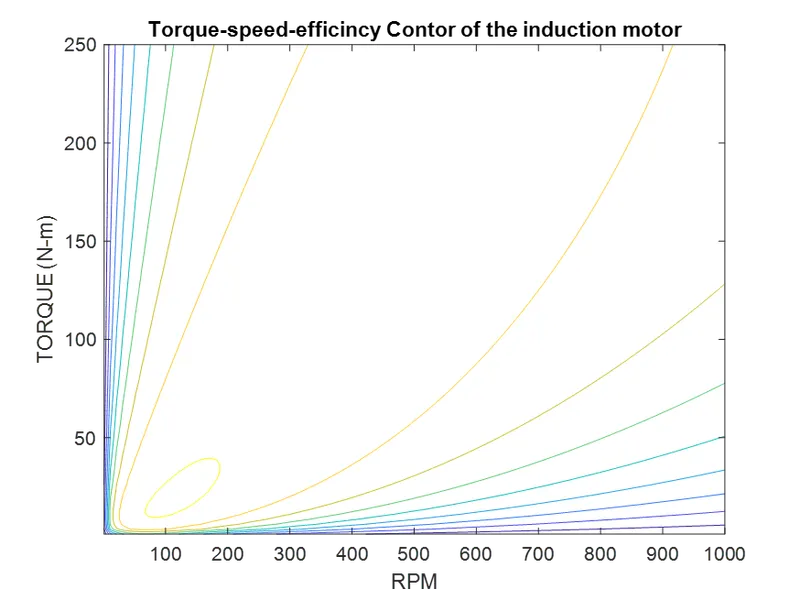
- Make a MATLAB program which plots contour of given motor speed, torque and efficiency values. Attach the code as a .m file attach a screenshot of all the plots.
MATLAB program: -
clear all;
close all;
clc;
Torque= linspace(1,250) %Input Torque
Speed= linspace(1,1000) %Input Speed
[w,T]= meshgrid (Speed,Torque); %Converting to 2D array
Kc= 0.3; % Coppper loss constact
Ki= 0.009; % Iron loss Constant
Kw= 0.00005; % Windage loss constat
C=30; % constant loss
Pout= w.*T; %Output Power
C_loss=Kc*(T.^2); %Copper loss
I_loss=Ki*w; %Iron loss
W_loss=Kw*(w.^3); %Windage loss
Pin=Pout+C_loss+I_loss+W_loss+C; %Input power
eff=Pout./Pin
contour(Speed,Torque,eff)
title('Torque-speed-efficincy Contor of the induction motor');
xlabel('RPM');
ylabel('TORQUE (N-m)');

After running of this program, we can see the result