Week-11 Challenge: Braking
1. For a defined driving cycle, calculate the energy required for braking.
Energy Required for braking is the energy consumed during the braking of a vehicle, during braking, the velocity of a vehicle falls from high values to lower values. The energy is calculated by the difference of nal velocity i.e the velocity before the braking and initial velocity we consider this as the velocity after braking. The braking energy is given by
Braking Energy = 1/2*M*(Vf - Vi)^2,
Where, M = Mass of vehicle(1000kg)
Vf = Final velocity,
Vi = Initial velocity,
Here, we have considered UDDS drive cycle.
Braking energy has been calculated in google sheets as follows :
https://drive.google.com/file/d/1tQCg2fW7S0yUXKG_Ll-cHSZhncnFFWoc/view?usp=sharing
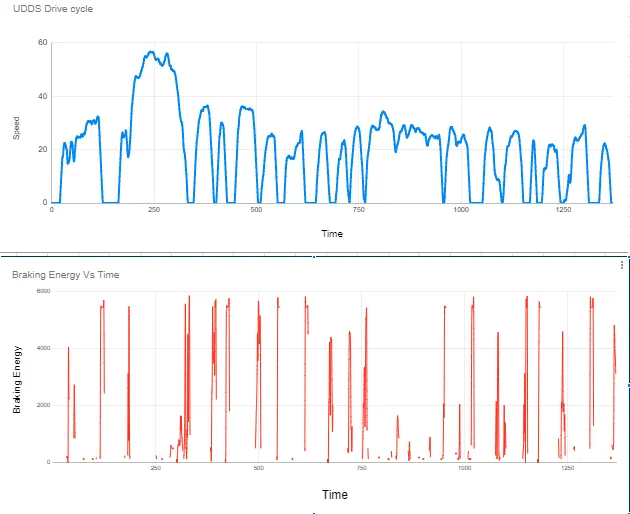
Total braking Energy consumed during UDDS drive cycle = 710740 J
2. Why electric motor can’t develop braking torque at high speed similar to starting? How electric and mechanical brakes are coordinated?
A electric motor requires a high current at starting to make a motor run which produces the high torque at the time of starting. The speed-torque characteristics of an electric motor show us that the torque of a motor will be high and constant for speed below critical speed whereas the torque starts reducing once it reaches the critical speed and maintains the constant power at high speeds, hence EV motors cant develop braking torque at high speeds.
- Brake Control Strategies:
- These strategies are used in order to apply the brakes. As the acceleration torque is higher than deceleration torque, only electric braking is not sucient to stop the vehicle. Also while reducing the speed, the speed is not directly reduced, as a process, the regeneration takes place, where the curve enters into 2nd quadrant and again enter to 3rd to a reduced speed.
- In such cases to obtain the reduction in speed, series and parallel strategies are used.
- In series, mechanical and electric brakes are applied one after the another, whereas, in parallel brakes, these are applied at a time.
- In order to control the system, Electic Driven Intelligent Brake system is used in order to control the vehicle. For low speed generally, only one braking system is used, as a regenerative brake system, whereas for high-speed operations combination is used.
3. Make a MATLAB program which plots contour of given motor speed, torque and efficiency values. Attach the code as a .m file attach a screenshot of all the plots
close all
clear all
clc
w=linspace(0,1000);  % speed array
t=linspace(0,300);   % torque array
%loss coefficient
kc=0.2;
ki=0.008;
kw=0.00001;
%meshgrid
[X,Y]=meshgrid(w,t);
copper_loss=(Y.^2)*kc;
iron_loss=X*ki;
windage_loss=(X.^3)*kw;
constant=20;

o_p=X.*Y
i_p=copper_loss+iron_loss+windage_loss+o_p+constant;
Eff=(o_p)./(i_p);
n=linspace(0.7,0.95,10);

grid on
contour(X,Y,Eff,n)
title('Speed vs Torque')
xlabel('Speed(rad/sec)')
ylabel('Torque(Nm)') 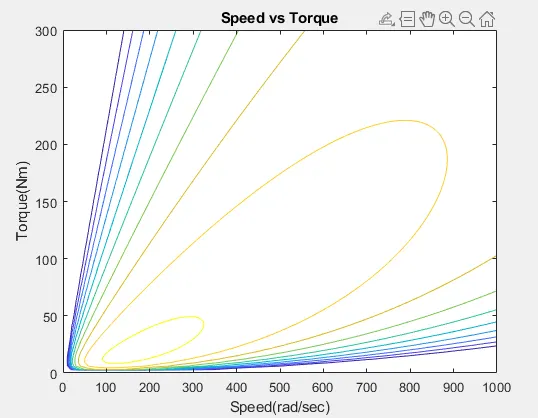
Above is the Speed Torque graph, where we can see the yellow area having the highest efficiency values, and the characteristics should operate in this region for long term performance & durability.