Week-11 Challenge: Braking
EV BATCH - 16
Week-11 Challenge: Braking
Task 1:
For a defined driving cycle, calculate the energy required for braking.
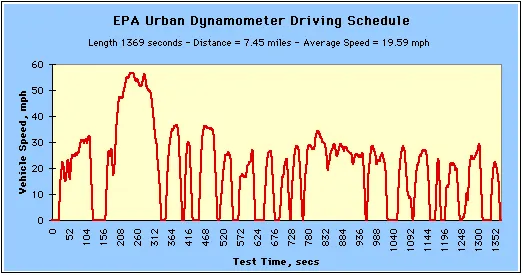
Drive cycle: A driving cycle is a series of data points representing the speed of a vehicle versus time. Driving cycles are produced by different countries and organizations to assess the performance of vehicles in various ways, as for instance fuel consumption, electric vehicle autonomy, and polluting emissions.
We are considering a UDDS drive cycle here. UDDS stands for Urban Dynamometer Driving Schedule, and refers to the United States Environmental Protection Agency mandated dynamometer test on fuel economy that represents city driving conditions that are used for light-duty vehicle testing.
Braking in EVs:
- Mechanical braking is provided in an electric vehicle to delegate and stop the vehicle whenever necessary. The brake system in the electric vehicles shall be a disc or drum brake.
- The actuator pedal is released to slow down the vehicle and when it is completely released, the power flow to the motor from the battery stops. As a result, the vehicle starts to decelerate due to the aerodynamic drag, rolling friction, and other forces that oppose the movement of the vehicle.
- Along with the friction brake system, another type of braking is also possible in an electric vehicle. It is known as Regenerative braking.
- The electric car brake system uses both friction and regenerative braking technologies
- 100% regenerative braking is not yet implemented in an electric car.
The formula for braking energy is given by, E=1/2 * m *(Vf-Vi)
where E = Braking energy (kJ)
m = mass of the vehicle (kg)
Vf = Final velocity
Vi = Initial velocity
The velocity input is taken in miles per hour from the standard UDDS drive cycle which is uploaded as an uddsdrive.xlsx file.
The total braking energy is found at the end, by adding up all braking energies at each input divided by vehicle mass.
MATLAB code to calculate the braking energy of an electric vehicle and plot the drive cycle
%Calculating braking energy for UDDS drive cycle

clear all
close all
clc

%Load drive cycle file
drivecycle = xlsread('uddsdrive');
t=drivecycle(:,1);
s=drivecycle(:,2);
mass=1000 %Vehicle mass (kg)

for i=1:1300  %Calculating braking energy
    if s(i+1)<s(i);
        brake_energy(i)=0.5*mass*(s(i+1)-s(i))^2;
    end
end

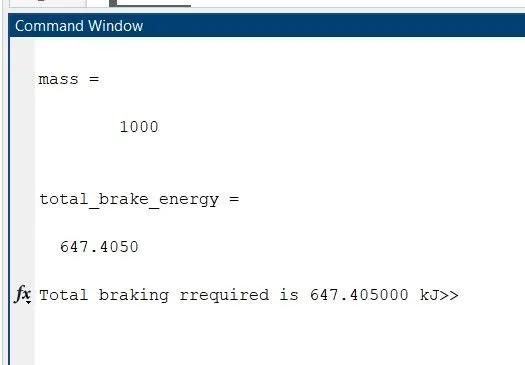
total_brake_energy=sum(brake_energy)/1000
fprintf("Total braking rrequired is %f kJ",total_brake_energy)

%Plotting
figure(1)
subplot(2,1,1)
plot(t,s)
xlabel('Time (s)');
ylabel( 'Velocity');
subplot(2,1,2)
plot(brake_energy)
xlabel('Time (s)');
ylabel('Braking energy');
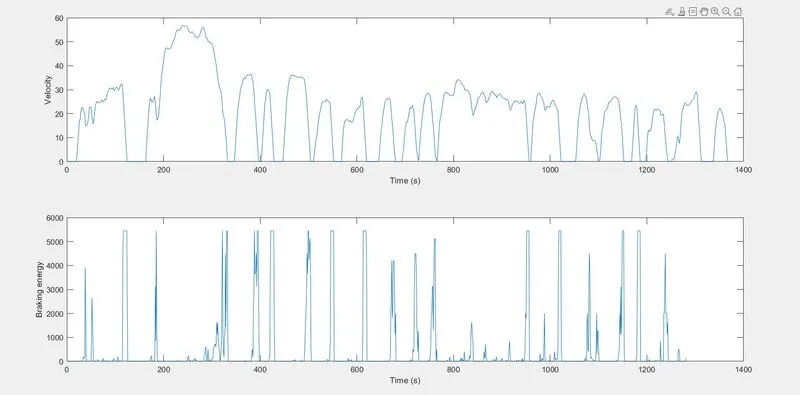
Output:
Output plot:
Task 2:
Why electric motor can’t develop braking torque at a high speed similar to starting? How electric and mechanical brakes are coordinated?
Friction braking/mechanical braking: The most common type of braking is a friction brake which inhibits motion through the friction created by the brake pads on a brake drum or a brake disc. A mechanical brake applies a friction force to convert the kinetic energy of the vehicle into heat, which then dissipates into the atmosphere.
Electric Braking: If the load is removed from an electric motor and the supply to it is disconnected, it will continue to run for some time due to inertia, and eventually stop with a sudden decrease in velocity due to zero acceleration. This is called electric braking.
Regenerative braking: It is an energy recovery mechanism in an electric vehicle that slows down the vehicle by converting its kinetic energy into electrical energy and storing it in the battery. In this mechanism, the electric traction motor acts as a generator and uses the vehicle's momentum to recover energy and convert the negative torque developed into energy that would otherwise be lost to the brake discs as heat. This technology also helps to achieve the One Pedal Driving ability in an electric vehicle.
One Pedal Driving: The phrase "one-pedal driving" refers to the ability of some electric cars to be driven almost entirely with the accelerator pedal alone. One-pedal driving combines conventional acceleration, using the right-hand pedal, with a much higher degree of deceleration than in a conventional car. That means that when a driver lifts off the pressure from the accelerator pedal, the car slows down more quickly than an IC engine car would. Lifting the pressure from the accelerator pedal kicks in a little regeneration, but the car largely continues to glide, slowly losing speed due to wind resistance and tire friction.
Why electric motor can’t develop braking torque at a high speed similar to starting?
For lower velocities, the regenerative braking is capable of providing effective braking power since the motor provides enough braking torque. At higher velocities, the motor torque will be decreased and the motor doesn't produce enough braking torque to decelerate the vehicle and provide efficient braking. Therefore the braking power has to be distributed across electric brakes and friction brakes for faster effective braking of the vehicle.
How electric and mechanical brakes are coordinated?
- The pedal-generated pressure is used to stimulate a pressure sensor in the system that makes up the brake request rather than initiating instant friction braking.
- The higher the request for braking, the system electronically calculates and decides how to apply friction and regenerative braking to meet the demand.
- From feather-light braking to a panic stop, all brake applications are electronically calculated and delivered from a normally operating electrohydraulic brake system all to provide a quick, safe, and most efficient braking.
Task 3:
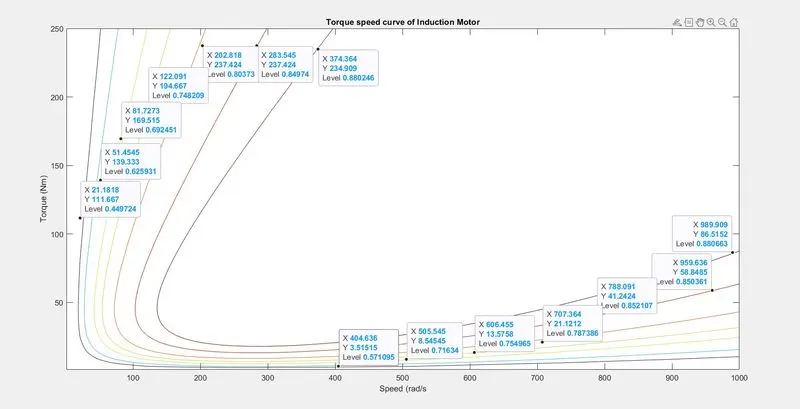
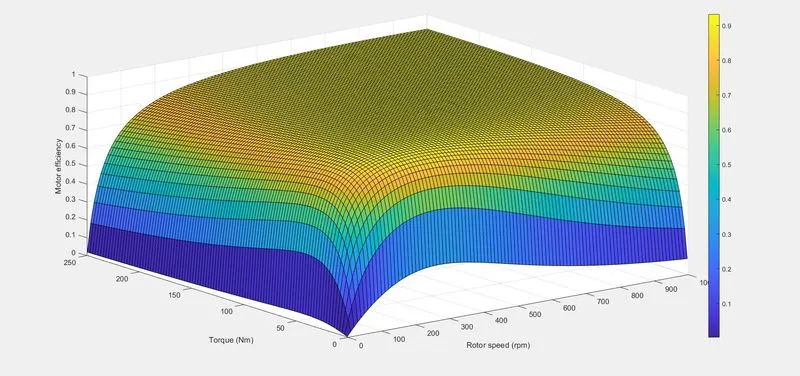
Make a MATLAB program that plots the contour of given motor speed, torque, and efficiency values. Attach the code as a .m file and attach a screenshot of all the plots.
The efficiency of the induction motor can be given by the contour plot of torque and speed. To plot the contour we need to find the losses in the motor namely/
- Iron loss: Iron or core losses are further divided into hysteresis and Eddy current loss. Eddy current losses are minimized by using lamination on the core. Since by laminating the core, the area decreases, and hence resistance increases, which results in a decrease in eddy currents. Hysteresis losses are minimized by using high-grade silicon steel.
- Copper loss: Mechanical losses occur at the bearing and brush friction loss occurs in the wound rotor induction motor. These losses are zero at the start and with the increase in speed these losses increases. These losses are also called copper losses.
- Windage loss: Windage is a force created on an object by friction when there is relative movement between air and the object. Windage loss is the reduction in efficiency due to windage forces. Electric motors are affected by friction between the rotor and air.
%MATLAB code forInduction motor efficiency

clear all
close all
clc

x = linspace(1,1000); %Speed (rad/s)
y = linspace(1,250); %0 to 40 Nm
%Allocate motor loss constants
kc = 0.2; %for copper loss
ki = 0.008; %for iron loss
kw = 0.00001; %windage loss
conL = 400; %constant motor losses

[X,Y]=meshgrid(x,y);
Outputpower=(X.*Y); %Power=Torque*Power
B=(Y.^2)*kc %Copper loss
C=(X*ki); %Iron loss
D=(X.^3)*kw %Windage loss
Inputpower=Outputpower+B+C+D+conL;
Z=Outputpower./Inputpower;

%We know set of efficiencies for which a contour will be plotted
V=[0.5,0.6,0.7,0.75,0.8,0.85,0.88];
box off
grid off
contour(X,Y,Z,V);
xlabel('Speed (rad/s');
ylabel('Torque (Nm)');
zlabel('Efficiency');
hold on
title('Torque speed curve of Induction Motor');
figure
surf(X,Y,Z)
colorbar
xlabel('Rotor speed (rpm)');
ylabel('Torque (Nm)');
zlabel('Motor efficiency');
Result plots: