Week-11 Challenge: Braking
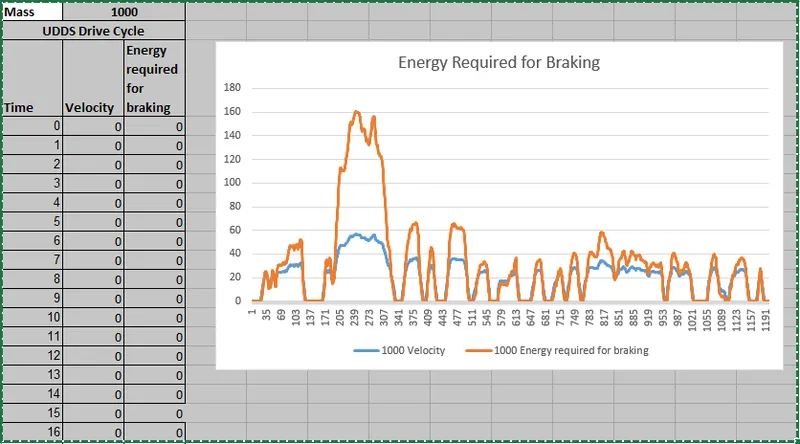
1. For a defined driving cycle, calculate the energy required for braking.
We have been able to utilize the energy which is been wasted at the time of braking. The kinetic energy which assist the vehicle to move also gets dissipated while the braking is done. Through it depends on multiple parameters on how efficient the braking would be it can be depended upon.
Number of brake pistons
Road condition
Temperature
Brake pad and Disc condition
Mass of the vehicle
Still with a basic operation where the vehicle in motion and the brakes are applied the same efficiency could be calculated by the given equations.
B.E = 1/2 mv^2
B.E = Braking energy
m = mass of the vehicle
v = velocity
2.Why electric motor can’t develop braking torque at high speed similar to starting? How electric and mechanical brakes are coordinated?
Based on the advantages of the electric motor such as fast and precise torque response, the performance of the electric vehicle (EV) can be improved. During braking or driving on the cornering, the vehicle will over steer or under steer if a car turns by more or less than the amount commanded by the driver.
To improve the stability of the small EV with four in-wheel motors, the differential regenerative braking torque control is proposed. In this system, the regenerative braking torque at each wheel will be controlled individually based on the value of slip ratio. If the slip ratio is greater than the optimum value, the regenerative brake will turn off.
In this situation, the electric motor will not produce the regenerative braking torque. Conversely, if the slip ratio lower than the optimum value, the regenerative brake will turn on and the electric motor will generate the regenerative braking torque. In the numerical analysis, to investigate the effectiveness of the proposed model, the road condition is set to an icy road on the left tire and dry asphalt on the right tire. From the simulation results, the differential regenerative braking torque control can prevent the tire from lock-up and avoid the vehicle from skidding.
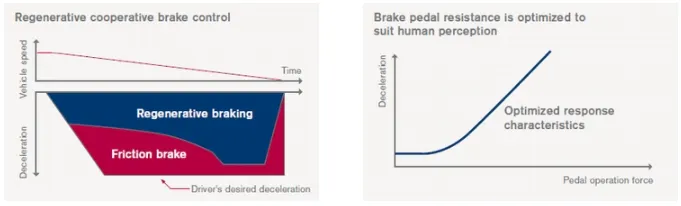
NISSAN LEAD - EDIB (Electric Driven Intelligent Braking):
EEDIB - (Electric Driven Intelligent Braking ). Controls the regenerative brake and friction brake to support both of these requirements. Further,it also controls the reactive force the pedal in order to unify the feeling when stepping down on the pedal and the sense of deceleration.
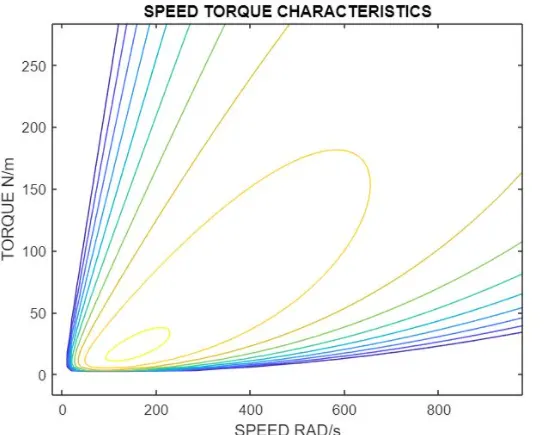
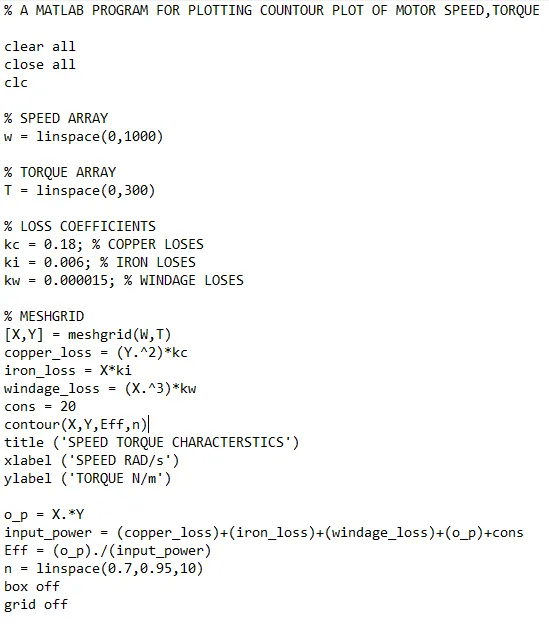
3. Make a MATLAB program which plots contour of given motor speed, torque and efficiency values. Attach the code as a .m file attach a screenshot of all the plots.
OUTPUT: