Week 11 Car Crash simulation
Car Crash simulation
Objective: To run the car crash simulation using various parameter thickness and compare the results.
Case setup & Execution:
- Open ansys workbench, click on explicit dynamics.
- Open engineering material edit, insert stainless steel NL for simulation.
- Next import geometry and open the same in space claim, check for default connection or joints.
- Further click on model, click edit to open.
- Now rename the model in geometry section. Provide stainless NL material to car body and structural steel to wall. As we have to procced the challenge guidance with comparison, so we have to provide a parametric sheet thickness of 0.3mm to car body
- In contact delete the generated contacts. Next move to mesh.
- In mesh insert patch confirming choose tetrahedron in method for wall & again insert a patch confirming and select triangles for car body. Now to run simulation smoothly we have to insert a face sizing of 170mm and select back portion of the car which will not come in contact with the wall.
- Now in analysis setting provide an end time of 0.001. Next insert fixed support and select the 5 faces of the car as shown. Also insert a displacement, select the face of wall and provide 500mm in z direction.
- Further we have to insert two symmetry zone by selecting the wall in first and car body in second.
- After all the above steps we can insert various output such as equivalent stress, strain & deformation required.
- Hit solve to run the simulation and check for output results.
Results & Conclusion:
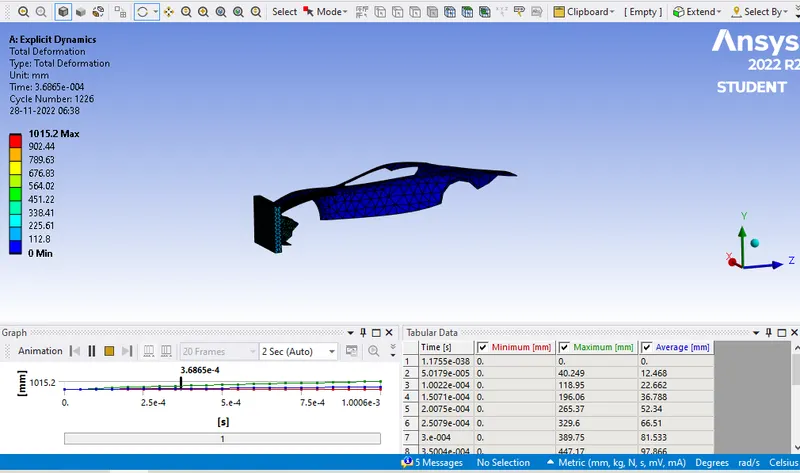
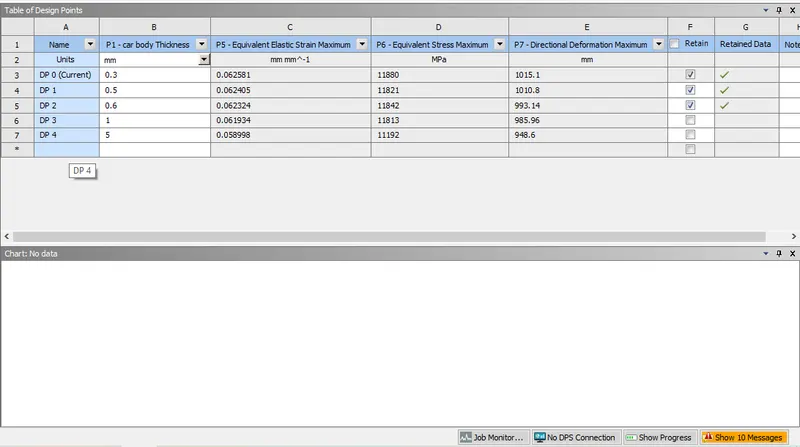
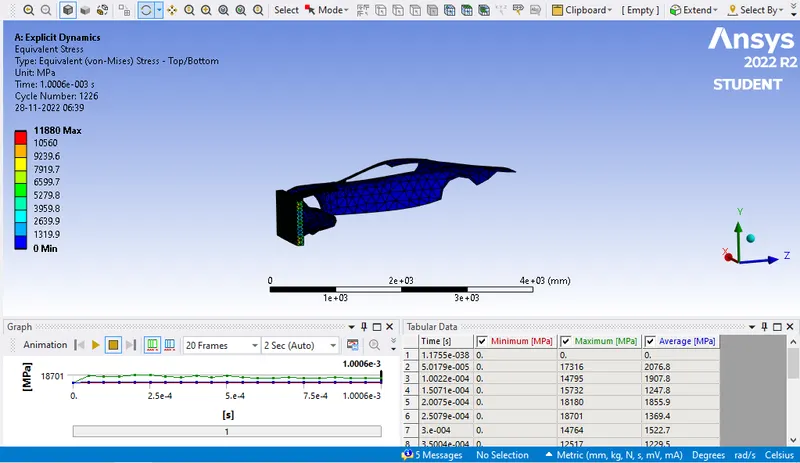
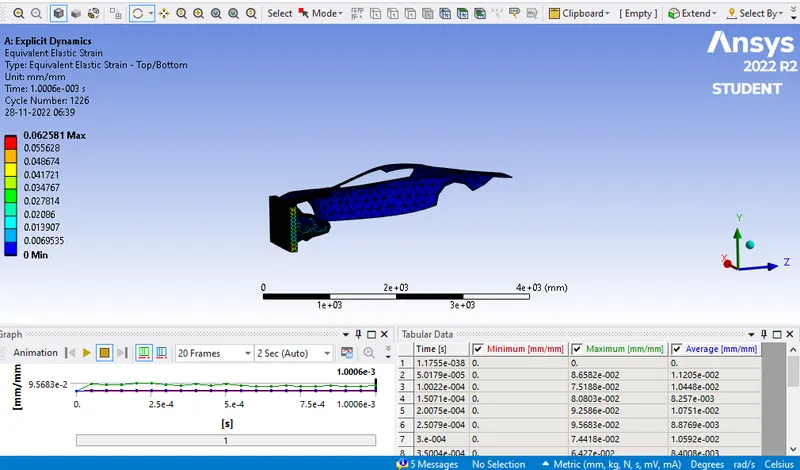
|
Sr no |
Parameter Thickness (mm) |
Equivalent stress (mpa) |
Equivalent strain |
Total Deformation (mm) |
|
1. |
0.3 |
11880 |
0.062581 |
1015.1 |
|
2. |
0.5 |
11821 |
0.062405 |
1010.8 |
|
3. |
0.6 |
11842 |
0.62324 |
993.14 |
|
4. |
1 |
11813 |
0.61934 |
985.96 |
|
5. |
5 |
11192 |
0.58998 |
948.6 |
In this simulation we have provided various thickness to car body and then compared the results. So it can be observed that as the sheet thickness increases there is a decrement in stress value. Thus it provides more strength to car structure. Similarly we can also see that as thickness increases the strain value decreases gradually. Both parameter stress & strain are directly proportional to thickness of the car body so it can be said that as thickness increases the life also increases but definitely the weight of the body will impact which will directly impact the efficiency of the engine. For deformation it can also be seen that for each higher thickness there is a decrement in the deformation value. So we can conclude that in this simulation as we increase the thickness of the car body we can observe a decreased value in stress strain & deformation.