Week 11- Broadband Noise modelling over Ahmed body
AIM
This simulation aims to model computational acoustics in Ahmed body
OBJECTIVES
- Setup the domain and setup assuming body is traveling at 110 kmph
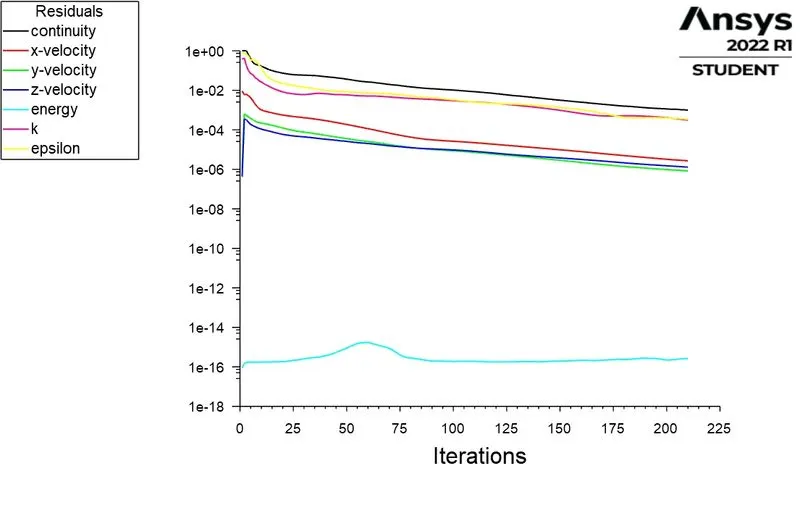
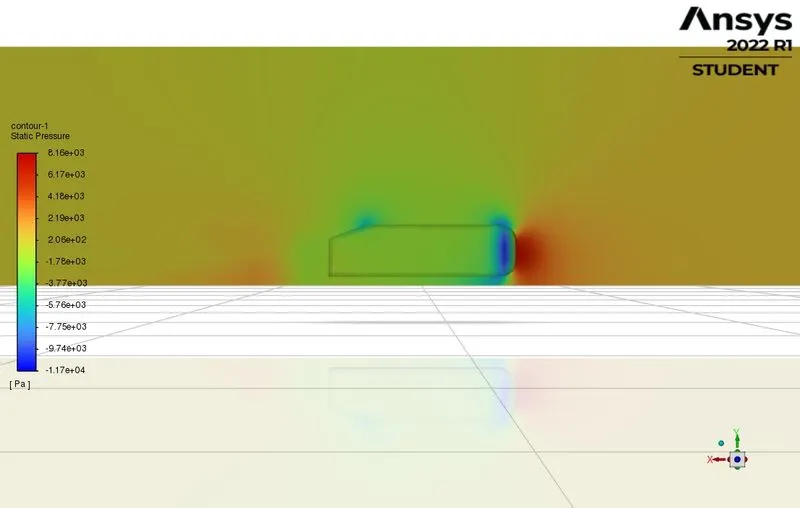
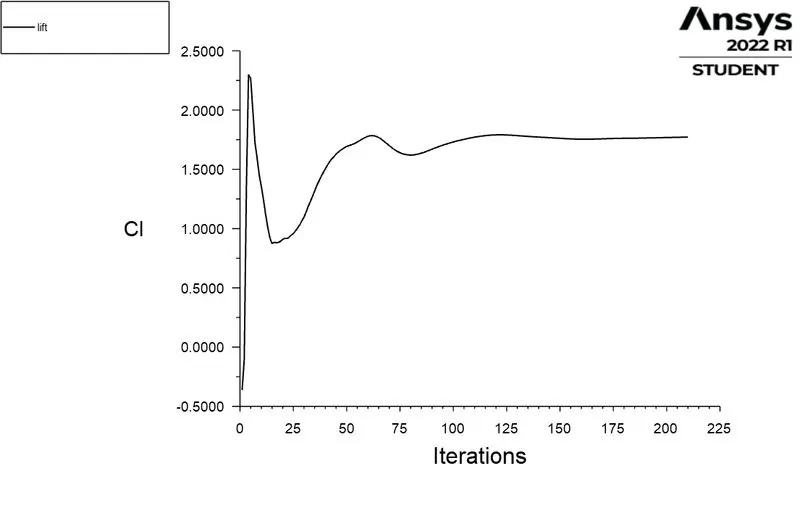
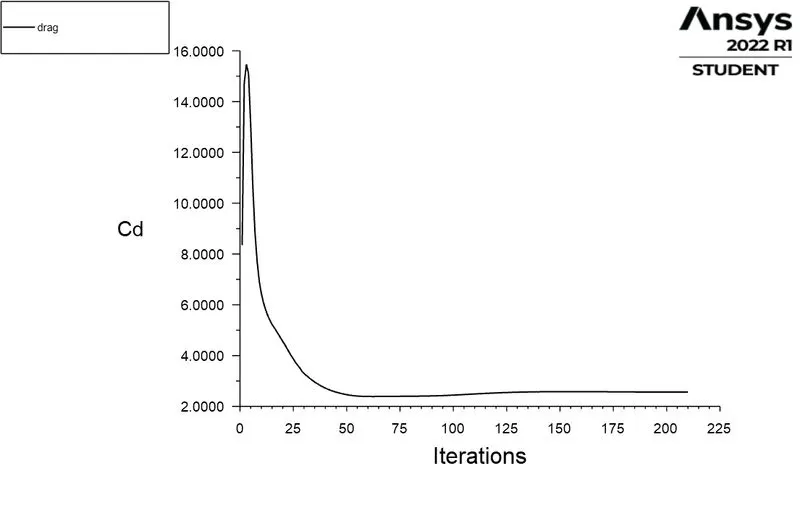
- Run the setup till convergence and plot for static pressure and coefficient of drag and lift to check for convergence
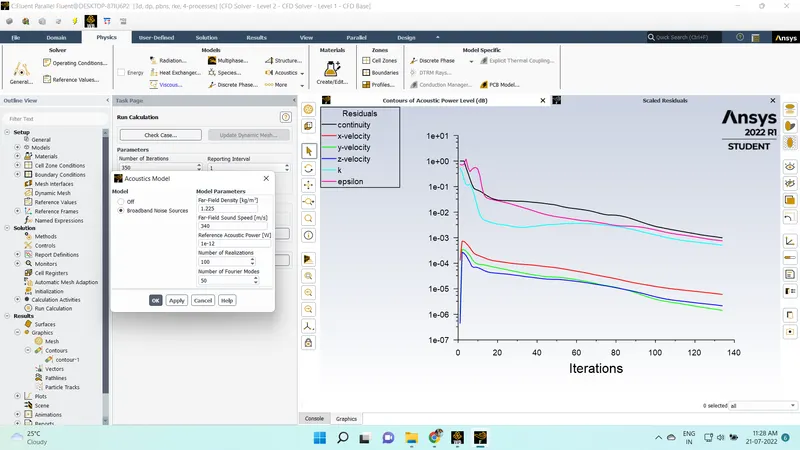
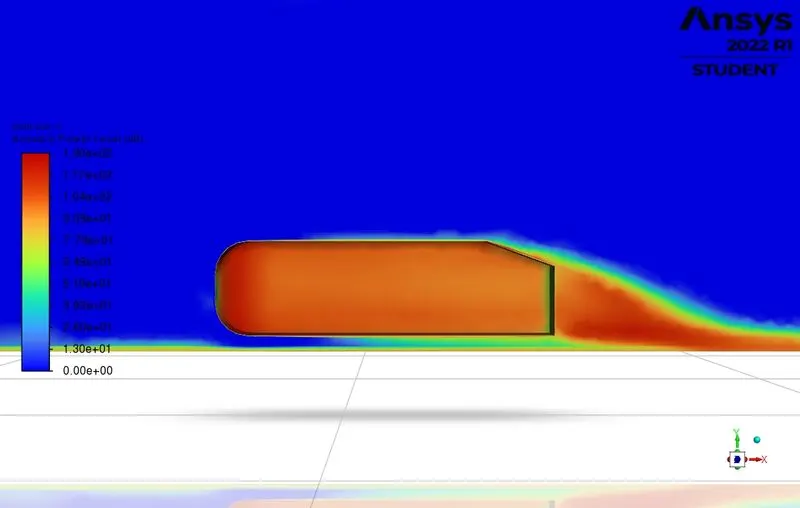
- Turn on Broadband- modeling and detail the acoustic field study over Ahmed's body.
The Ahmed body was described originally by S. R. Ahmed in 1984. Three main features were seen in the wake:
1. The A recirculation region that is formed as the flow separates at the top of the vertical back surface of the model
2. The B recirculation region is formed due to the separation at the base of the model.
3. The c-pillar vortices that form as the vorticity in the side boundary layers roll up over the slant edges.
The wake was shown to be highly dependent on slant angle. For slant angles less than 12°, the flow remains attached over the slant. The flow is essentially two-dimensional and has low drag. Between 12° and 30° the flow becomes much more three-dimensional as the c-pillar vortices form. These reach maximum strength at 30°. The drag increases significantly as the low-pressure cores act on the rear surfaces. Past 30° the flow separates fully off the slant. This results in a sudden decrease in drag and weaker c-pillar vortices.
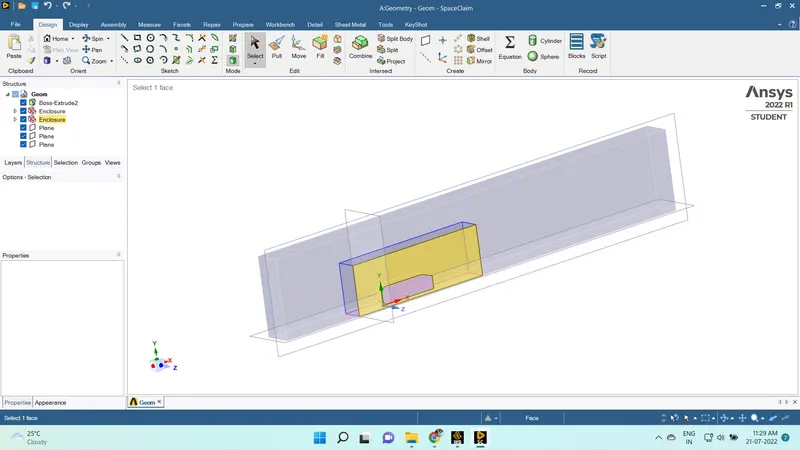
The Ahmed body (Fig. 1) was first defined and its characteristics were described in the experimental work of Ahmed. Two configurations with slant angles of 25°and 35°are considered as a test case. For these configurations detailed LDA Measurements have been performed by Becker, Lienhart, and Stoots in the LSTM low-speed wind tunnel with a cross-section of 1.87x1.4 m2 (width x height) with a bulk velocity of 40 m/s. The test section of the wind tunnel was 3/4 open (only ground plate present). The distance between the body and the plate representing the ground is 50 mm. In the experiment performed by Ahmed, flow velocity was taken 60 m/s, Reynolds number was 4.29 million based on model length.
The “Ahmed” body has the form of a highly simplified car, consisting of a blunt nose with rounded edges fixed onto a box-like middle section and a rear end that has an upper slanted surface (like a “hatch-back” car), the angle of which can be varied. The model is supported on circular-sectioned legs or stilts, rather than wheels. Despite neglecting a number of features of a real car (rotating wheels, rough underside, surface projections, etc.) the Ahmed body generates the essential features of flow around a car, namely: flow impingement and displacement around the nose, relatively uniform flow around the middle and flow separation and wake generation at the rear. Studying such a simplified car body aims to understand the flow processes involved in drag production. By understanding the mechanisms involved in generating drag, one should design a car to minimize drag and, therefore, minimize fuel consumption and maximize performance. The principal contribution to drag experienced by a car is pressure drag. The rear of the vehicle provides a major contribution to pressure drag. In particular, the rear slant angle is critical in determining the mode of the wake flow and hence the drag experienced by the vehicle. Janssen & Hucho found that the maximum drag was obtained for a vehicle with rear slant angle β ≈ 30◦ (to the horizontal) where the flow over the slant remained partially attached and longitudinal trailing vortices were formed at the edges of the slant. For steeper slant angles (β > 30◦ ) the flow over the rear slant became fully separated and the drag decreased.
BROADBAND NOISE MODELLING
In many practical applications involving turbulent flows, noise does not have any distinct tones, and the sound energy is continuously distributed over a broad range of frequencies. In those situations involving broadband noise, statistical turbulence quantities readily computable from RANS equations can be utilized, in conjunction with semi-empirical correlations and Lighthill's acoustic analogy, to shed some light on the source of broadband noise.
ANSYS FLUENT
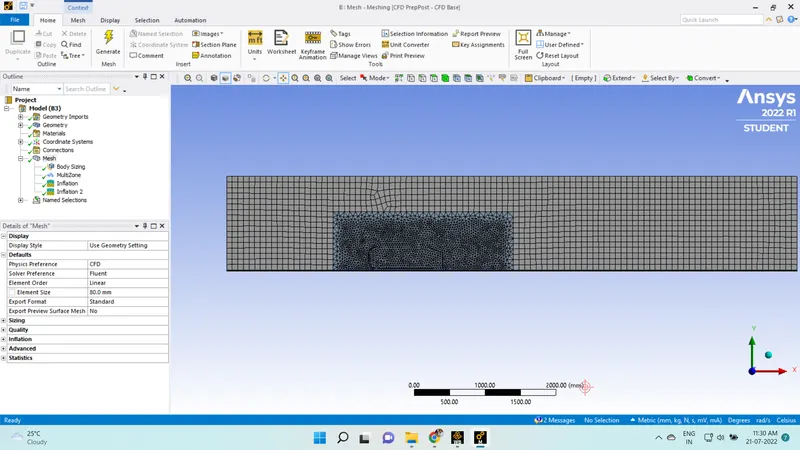
- Mesh Size = 80 mm
- Sizing - Body Sizing
- Mesh size of Ahmed body = 30 mm
- Inflation layer = 15 layers
- Growth rate = 1.2
- Mesh Type - First Layer Thickness
- First Layer Thickness size = 0.01 mm
Inlet
- Velocity = 110 m/s
- velocity inlet
- Temperature = 300 K
Outlet
- pressure = 0 Pa
- Pressure Outlet
- Temperature = 300 K
CONCLUSION
- The acoustic model was run on Ahmed body.
- Various contours of the acoustic model are shown in images