Thermal Management
Thermal Management
Aim:
Summarizing thermal management techniques for the electric car battery pack.
Answer:
Active thermal control is a key element within modern Li-Ion battery packs as cell temperature for charging has to be kept between 0 to 45°C and for discharging between -20 to 60°C; operation outside these ranges results in accelerated aging, reduced capacity, or even full damage of the battery. The relationship between temperature and degradation can be formulated by an Arrhenius-type behavior where the degradation rate increases exponentially with temperature. Although the capacity increases as the operating temperature are raised, the degree of capacity fade also increases. On the other hand, poor performance is observed at low operating temperatures. In addition, excessive or uneven temperature rises in a system or pack reduce its lifecycle significantly.
The battery pack for safety, performance of both power and capacity, and lifespan reasons should be stored in a controlled surrounding where the temperature is controlled and there is no risk of thermal runaway. The BTMS should be equipped with four essential functions to ensure the right operation conditions of the battery pack:
1. Cooling
Due to inefficiency, battery cells will not only generate electricity but also heat. This heat should be moved from the battery pack when the battery temperature reaches the optimum temperature or even in advance. Thus, a cooling function is required in BTMS.
2. Heating
In cold climates, battery pack temperature probably falls below the lower temperature limit. Hence, a heating function, such as a PTC heater, is required to assist the battery pack to reach the proper temperature range in a shorter time.
3. Insulation
In extreme cold or hot weather, the temperature difference between the inside and outside of the battery pack is much larger than that in mild weather. Battery temperature will thus fall (cold) or rise (hot) sooner out of the proper temperature range. To prevent this, good insulation can slow down the falling or rise of battery temperature, especially when the vehicle is parked outdoors.
4. Ventilation
Ventilation is required to exhaust the hazardous gases within the battery pack. In some systems, such as air systems, this function is combined with cooling and heating functions.
Technologies of BTMS
1. Air Cooling and Heating
Air systems use air as the thermal medium. The intake air could be direct either from the atmosphere or from the cabin and could also be conditioned air after a heater or evaporator of an air conditioner. The former is called a passive air system and the latter is an active air system. Active systems can offer additional cooling or heating power. A passive system can offer hundreds of watts of cooling or heating power and active system power is limited to 1 kW. Because in both cases the air is supplied by a blower, they are also called forced air systems. The following figure shows a schematic description of systems:
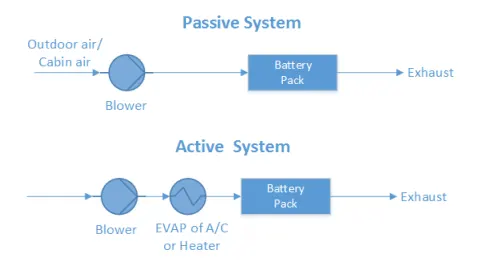
Fig: Forced air systems (passive and active)
2. Liquid Cooling and Heating
Besides air, the liquid is another heat transfer fluid to transfer heat. There are generally two groups of liquids applied for thermal management systems. One is dielectric liquid or direct-contact liquid which can contact the battery cells directly, such as mineral oil. The other is conducting liquid or indirect-contact liquid which can only contact the battery cells indirectly, such as a mixture of ethylene glycol and water. Depending on the different liquids, different layouts are designed. For direct-contact liquid, the normal layout is to submerge modules in mineral oil. For indirect-contact liquid, a possible layout can be either a jacket around the battery module, discrete tubing around each module, placing the battery modules on a cooling/heating plate, or combining the battery module with cooling/heating fins and plates.
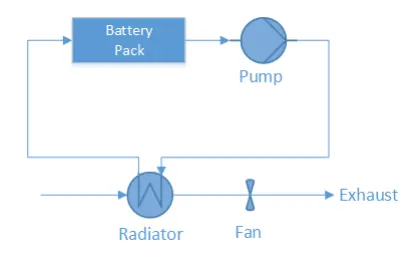
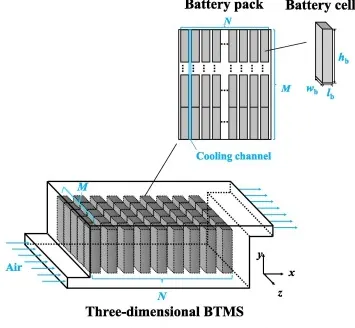
Fig: Passive liquid cooling system.
In a passive liquid system, the heat-sink for cooling is a radiator. This system has no ability to heat. The above presents the systematic scheme of a passive liquid system. Heat transfer fluid is circulated by the pump within a closed system. The circulating fluid absorbs heat from the battery pack and releases heat via a radiator. The cooling power depends strongly on the temperature between ambient air and battery. Fans behind the radiator can improve the cooling performance, but if the ambient air is higher than the battery temperature or the difference between them is too small, the passive liquid system becomes ineffective.
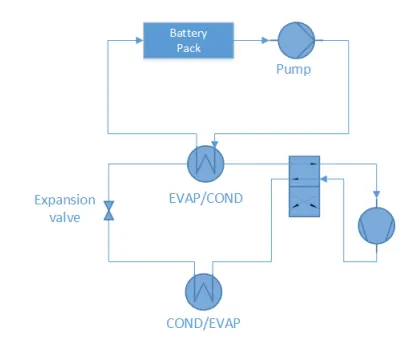
Fig: Active liquid cooling system.
The figure shows the systematic scheme of an active liquid system. There are two loops. The upper is called the primary loop and the lower the secondary loop. The primary loop is similar to the loop in a passive liquid system, where the heat transfer fluid is circulated by the pump. The secondary loop is actually an air conditioning loop. The upper heat exchanger instead of being a radiator works as an evaporator for cooling operation and connects both loops. During heating operation, the 4-way valve will be switched, and the upper heat exchanger works as a condenser and the lower heat exchanger works as an evaporator. The heating operation loop is also called the heat pump loop.
3. Direct Refrigerant Cooling and Heating
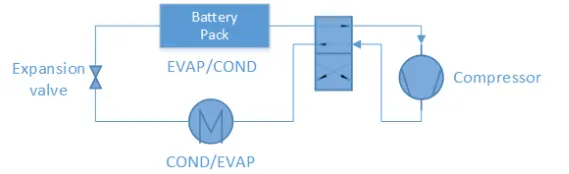
Fig: Direct refrigerant cooling system.
Similar to active liquid systems, a direct refrigerant system (DRS) consists of an A/C loop, but DRS uses refrigerant directly as heat transfer fluid circulating through the battery pack.
4. PCM
Phase change material (PCM) is commonly used in the study of battery thermal management systems. However, with low thermal conductivity, pure PCM is not sufficient for transferring the heat generated from battery cells. To resolve this problem, the thermal conductivity of PCM was enhanced using copper foam. Active liquid cooling was also combined with copper foam/paraffin composite phase change material to provide extra cooling ability. The cooling tube is evenly distributed in the copper foam, and a coolant is circulated through the tube. The copper foam has a porosity of 98% and pore size of 20 PPI, and the paraffin has a melting point of 25 °C. During melting, heat is absorbed by PCM and is stored as latent heat until the latent heat is up to the maximum. The temperature is kept at the melting point for a period and the temperature increase is delayed. Therefore, PCM is used as a conductor and buffer in
battery thermal management systems. The following figure shows the working mechanism of PCM on battery cells. Also, a PCM is always combined with an air cooling system or liquid cooling system to manage the battery temperature.
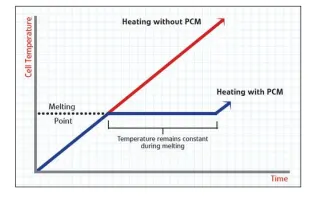
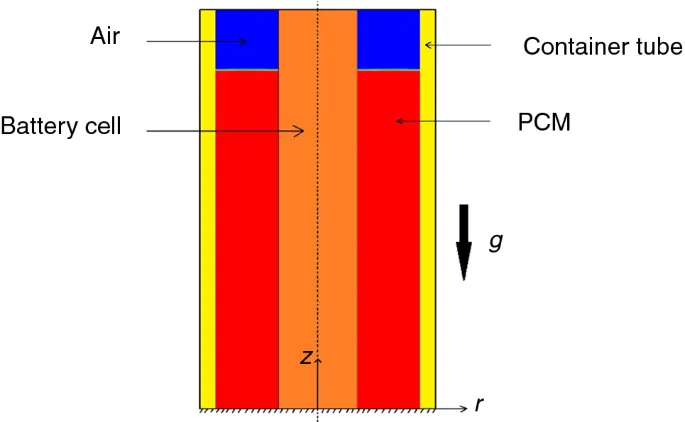
Fig: The working mechanism of PCM on battery cells
5. Thermo-electric Module
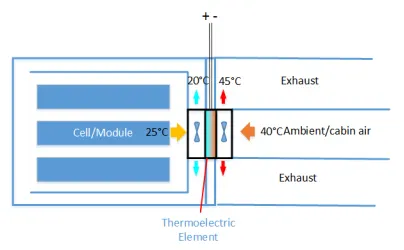
Fig: Thermoelectric cooling/heating system
To improve the cooling/heating power of passive air systems, there are two possible upgrades. One is through thermo-electric modules, which will be introduced here. The other is a heat pipe. The thermoelectric module can convert the electric voltage to temperature difference and vice versa. Here the former effect is adopted. That means it transfers heat through the module by consuming electricity directly. In the above figure, two fans are installed to improve heat transfer by forced convection. To combine a passive air system with the thermoelectric module, the combined system is able to cool down the battery even lower than the intake air temperature, but the power is still limited to around some hundreds of watts and less than one kW. It’s easy to switch between cooling and heating operations. To achieve that, the poles of electrodes need to be reversed.
6. Heat Pipe
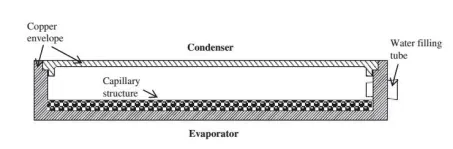
Fig: Structure of the heat pipe
Besides thermo-electric modules, a heat pipe is another way to upgrade passive air systems. The flat copper envelope of the heat pipe was under partial vacuum. The capillary structure is made of sintered copper powder. The heat pipe uses water as the working fluid. Water on the evaporator side will absorb heat and become vapor lower than 100°C due to low pressure inside. Water on the condenser will dissipate heat to the surrounding and become liquid again. This cycle repeats again and again
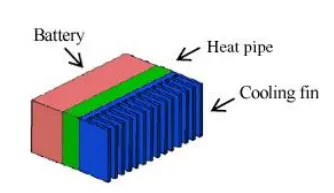
Fig: Scheme of heat pipe cooling system.
A battery as a heat source sits below the heat pipe (on the evaporating side). Cooling fins as heat sinks are on the heat pipe (on the condensing side). According to the conclusion of an experiment, the heat pipe cooling system can reduce the thermal resistance by 30% under natural convection as compared to without a heat pipe. A thermal resistance reduction of 20% under low air velocity convection is possible. In comparison to thermo-electric, a heat pipe is more reliable, because there are no moving parts and no energy consumption. However, a heat pipe is unable to heat the battery due to its fixed structural layout.
7. PTC Heater
Resistive heaters can be made of conducting PTC rubber materials where the resistivity increases exponentially with increasing temperature. Such a heater will produce high power when it is cold and rapidly heat up itself to a constant temperature. Due to the exponentially increasing resistivity, the heater can never heat itself to warmer than this temperature. Above this temperature, the rubber acts as an electrical insulator. The temperature can be chosen during the production of the rubber. Typical temperatures are between 0 and 80 °C. It is a point-wise self-regulating heater and self-limiting heater. Self-regulating means that every point of the heater independently keeps a constant temperature without the need for regulating electronics. Self-limiting means that the heater can never exceed a certain temperature at any point and requires no overheat protection.
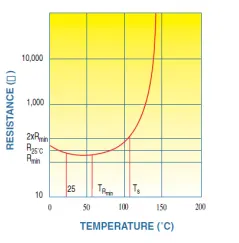
Fig: Resistance versus Temperature for a PTC
PTC thermistors have many self-heated applications by utilizing their own voltage current or current-time characteristics. One of the applications is a self-regulating heater known as a PTC heater. The temperature of a PTC heater can be kept at a fixed point by adjusting the resistance of the PTC heater automatically.