Week 10 Thermal Management
Introduction:
Thermal management become a hot topic for automakers and suppliers. Because optical batery performance depends on keeping the battery pack from getting too warm or too cold.
Air Cooling:
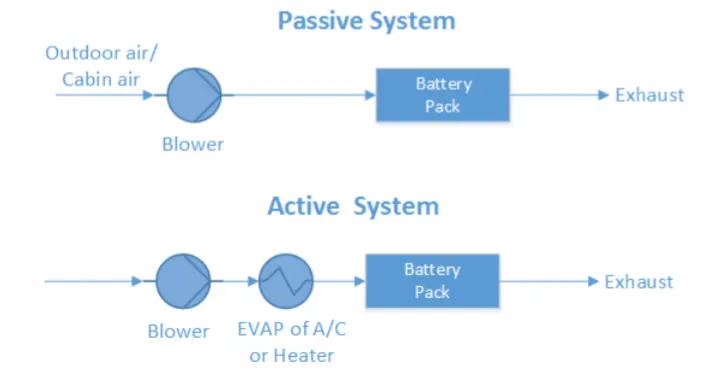
Air systems use air as the thermal medium. The intake air could be direct either from atmosphere or from the cabin and could also be conditioned air after a heater or evaporator of an air conditioner. The former is called passive air system and the latter is active air system. Active systems can offer additional cooling or heating power. A passive system can offer some hundreds of watts cooling or heating power and an active
system power. Because in both cases the air is supplied by a blower, they are also called forced air systems. The following figure shows a schematic description of systems.
Direct or Indirect Cooling:
Besides air, liquid is another heat transfer fluid to transfer heat. There are generally two
groups of liquids applied for thermal management systems. One is dielectric liquid
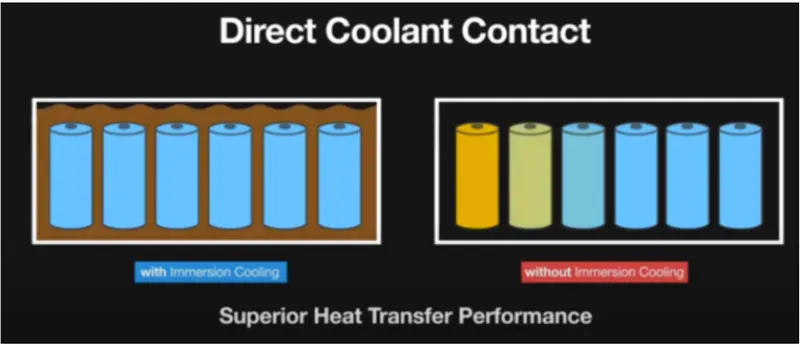
(direct-contact liquid) which can contact the battery cells directly, such as mineral oil.
The other is conducting liquid (indirect-contact liquid) which can only contact the
battery cells indirectly, such as a mixture of ethylene glycol and water. Depending on
the different liquids, different layouts are designed. For direct-contact liquid, the normal
layout is to submerge modules in mineral oil. For indirect-contact liquid, a possible
layout can be either a jacket around the battery module, discrete tubing around each
module, placing the battery modules on cooling/heating plate or combining the battery
module with cooling/heating fins and plates. (Pesaran, 2001) Between these two groups,
indirect contact systems are preferred in order to achieve better isolation between
battery module and surroundings and thus better safety performance.
By different heat-sinks for cooling, liquid systems can also be categorized into either
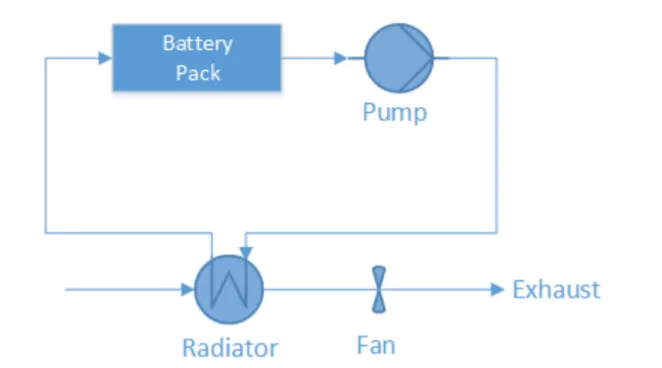
passive systems or active systems. In passive liquid system, the heat-sink for cooling is
a radiator. This system has no ability to heat. The systematic scheme
of a passive liquid system. Heat transfer fluid is circulated by the pump within a closed
system. The circulating fluid absorbs heat from battery pack and releases heat via a
radiator. The cooling power depends strongly on the temperature between ambient air
and battery. Fans behind the radiator can improve the cooling performance, but if
ambient air is higher than the battery temperature or the difference between them is too
small, the passive liquid system becomes ineffective.
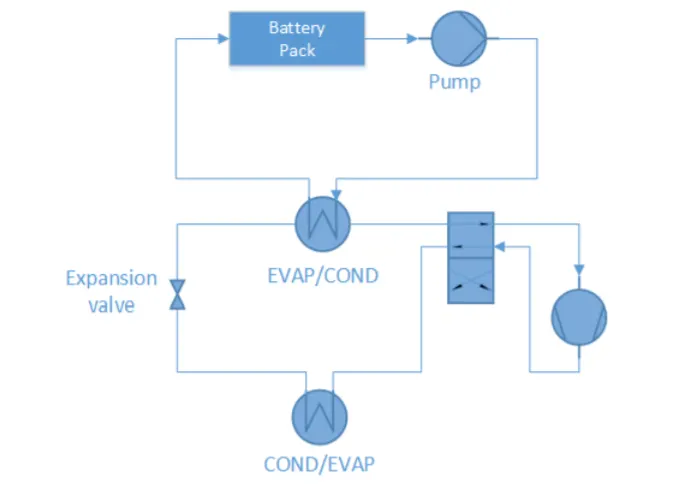
There are two loops.The upper is called the primary loop and the lower the secondary loop. The primary loop is similar to the loop in a passive liquid system, where the heat transfer fluid is
circulated by pump. The secondary loop is actually an air conditioning loop (A/C loop).
The upper heat exchanger instead of being a radiator works as an evaporator (EVAP)
for cooling operation and connects both loops. During heating operation, the 4 way
valve will be switched, and the upper heat exchanger works as a condenser (COND)
and the lower heat exchanger works as an evaporator. The heating operation loop is
also called heat pump loop.
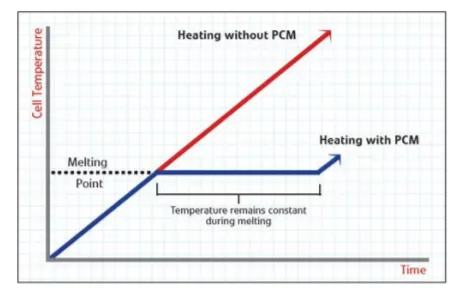
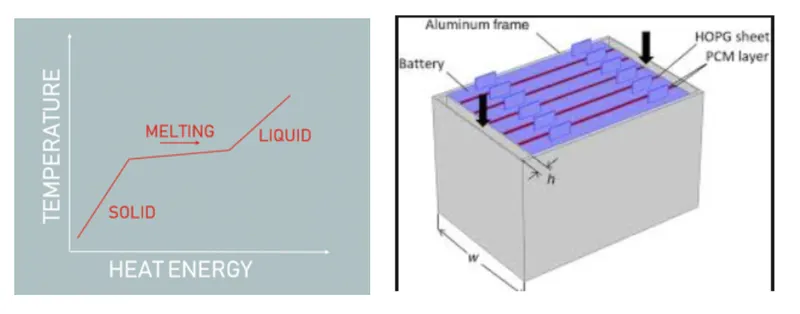
During melting, heat is absorbed by PCM and is stored as latent heat until the latent
heat is up to the maximum. The temperature is kept at melting point for a period and
the temperature increase is delayed. Therefore, PCM is used as conductor and buffer in
battery thermal management systems. The working mechanism of
PCM on battery cells. Also, a PCM is always combined with air cooling system or
liquid cooling system to manage the battery temperature.
To improve cooling/heating power of passive air systems, there are two possible
upgrades. One is through thermo-electric modules, which will be introduced here. The
other is a heat pipe will be discussed in Section 3.2.6.
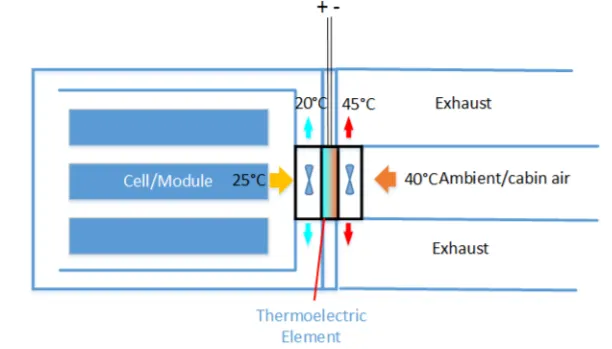
Thermo-electric module can convert electric voltage to temperature difference and viceversa. Here the former effect is adopted. That means it transfers heat through the module
by consuming electricity directly. The schematic structure is presented in Figure 3.7.
Two fans are installed to improve heat transfer by forced convection. To combine a
passive air system with thermo-electric module, the combined system is able to cool
down the battery even lower than the intake air temperature, but the power is still
limited to around some hundreds of watts and less than one kW. (Valeo, 2010) It’s easy
to switch between cooling and heating operation. To achieve that, the poles of
electrodes need to be reversed.
Heat Pipe:
Besides thermo-electric modules, a heat pipe is another way to upgrade passive air
systems. The structure of a heat pipe is shown below. The flat copper envelope
of the heat pipe was under partial vacuum. The capillary structure is made of sintered
copper powder. The heat pipe uses water as the working fluid. Water on the evaporator
side will absorb heat and become vapour lower 100°C due to low pressure inside. Water
on the condenser will dissipate heat to the surrounding and become liquid again. This
cycle repeats again and again.
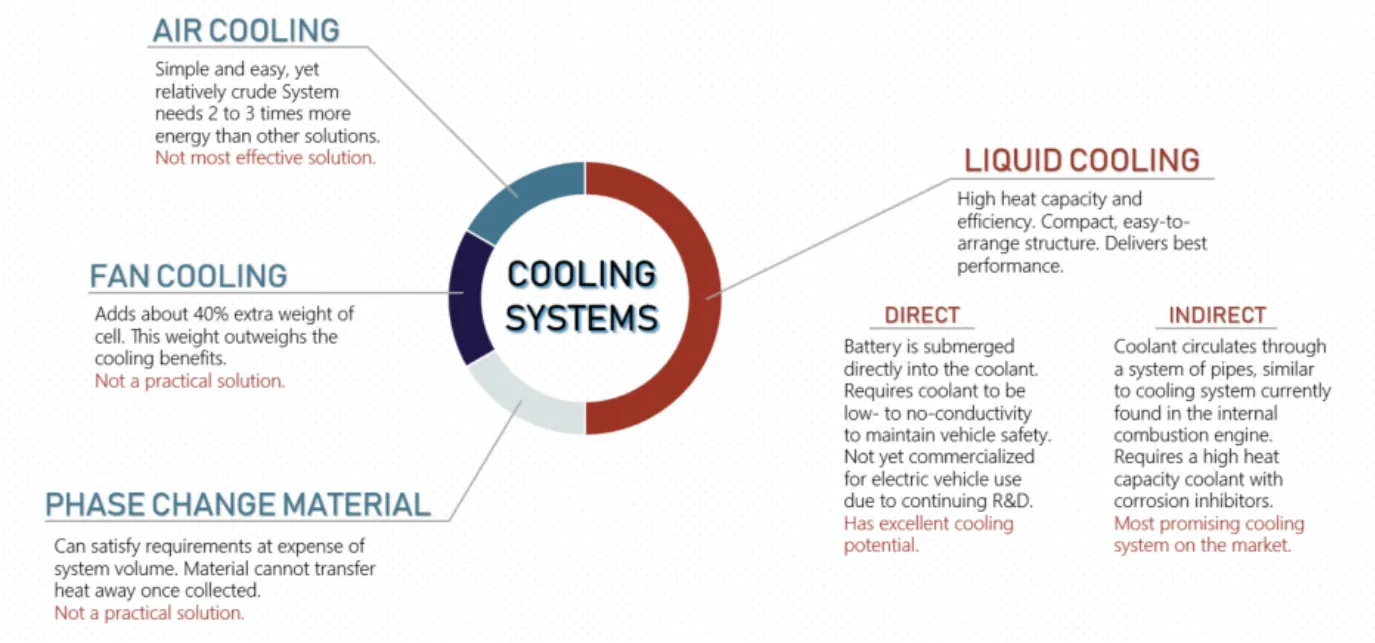
Overview Of Cooling Systems: