Week 10 Thermal Management
Thermal Management
Thermal Management Techniques for Electric Car Battery Pack
In both HEVs and PHEVs, the battery pack is a key component of their fuel savings potential, and the battery is also one of the most expensive components in the vehicle. One of the most significant factors impacting battery performance and life is temperature. In particular, operating the battery at high temperatures can lead to damaging electrochemical side reactions.
- For some batteries, higher temperatures will also increase the internal rates of thermal reactions, which lead to even greater heat generation, higher temperatures, and a “thermal runaway” condition potentially ending in fire or explosion.
- The lifespan of batteries also greatly depends on the operating temperature. Under normal operating conditions, of say −30 °C to 60 °C, the battery health varies significantly from the optimal battery temperature range. However, studies suggest that working at above 50 °C can be harmful to the lifespan of batteries. “Further studies indicated that a temperature ranges from -25 °C to 40 °C (a maximum 5 °C difference from this temperature range) provides the best working environment for batteries such as lead–acid, NiMH, and Li-ion”.
BTMS (battery thermal management system) has been developed to meet:
- The demand for higher power
- Faster charge rates
- Improved driving performance
To avoid the adverse impacts of high-temperature conditions, battery systems designed for vehicle applications typically employ convective thermal management in the form of air or liquid cooling.
On the low end of complexity, the thermal management system might use a small fan to circulate ambient air from the environment through the battery chamber. This approach is fairly simple and inexpensive to implement, but it might not manage heat effectively enough to permit high-rate battery use in all conditions or to prevent a sizable temperature imbalance in the pack.

At the high end of complexity, the management system might include a temperature-controlled liquid cooling circuit passing across the cells in the pack. This approach would regulate the pack temperature evenly and allow full power capability over a range of ambient temperatures and operating conditions. In practice, present-day battery thermal management solutions fall between these two extremes and employ trade-offs among management effectiveness, complexity, and cost.
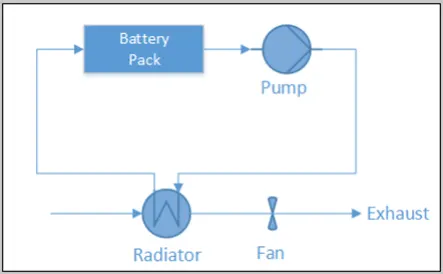
Conversely, traditional active methods generally lead to forced circulation and circulation of specific cooling materials and substances such as water and air. The main issue is that the cooling effect can be very limited under certain circumstances.
One alternative battery thermal management approach that has been investigated for soldier-carried battery applications is passive thermal management using phase-change material (PCM). In order to maximize the amount of stored battery energy available for its primary function, a passive management solution is appealing. This can be accomplished by integrating a structure with the battery so that the PCM is in direct thermal contact with the battery cells. When a soldier draws power from the battery, usually during a constant current discharge, the added thermal mass of the PCM system helps to absorb the waste heat given off by the cells and slows their temperature rise. If the temperature continues to rise, especially when the battery operates at a high rate and in high ambient temperatures, the PCM melts and effectively limits peak temperature. In addition, the thermally conductive structure holding the PCM provides a fast heat transfer path through a battery module, minimizing the temperature difference between the cells in the module. This paper explores whether thermal management using PCM could provide similar benefits in HEV or PHEV applications. Vehicle batteries can have duty cycles that are significantly different from those of soldier applications. Therefore, PCM technology should be carefully assessed to determine whether it would improve upon existing vehicle battery thermal management technologies.
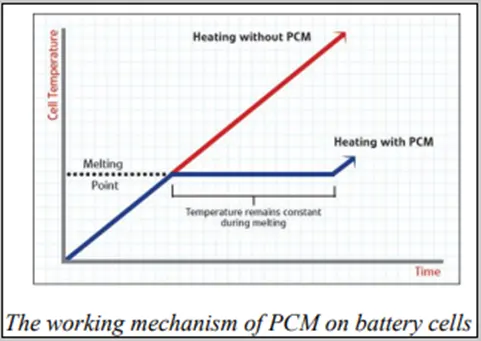
Passive BTMS generally employ phase change materials (PCM), heat pipes, and hydrogels. Zero extra power consumption is the most prominent feature of these systems. However, the cooling process is difficult to manage. Thermoelectric power generation devices for vehicles have been developed for years.
In contrast, thermoelectric coolers (TEC) which employed by battery thermal management are a comparatively new candidate for electric vehicles. These benefit from strong cooling capacities and reliable working potential, and have attracted increasingly more attention for integration into BTMS. Thermoelectric coolers (TEC) are based on the conversion of voltage to the temperature difference. This Peltier–Seebeck effect together with Thompson effect belongs to the thermoelectric effect. The thermoelectric effect refers to all of the transformation processes from heat to electricity, and vice versa. The main advantages of thermoelectric coolers are relatively quiet, stable, and reliable. Furthermore, the temperature can be easily controlled by varying the voltage supply. These technologies have been used in medical and instrumentation applications for years; however, for battery thermal management applications, the history is limited. In practical applications, batteries may be operated in either hot or cold ambient temperature. TEC modules can be used for both heating and cooling scenarios. The ‘hot end’ has heat dissipated and absorbed by the ‘cold end’.
“Literature shows that the use of TEC for BTMS is inadequate due to the low thermal efficiency, novelty of the application of TEC. Starting from 2003, researchers have been considering TEC for better BTMS; however, only few literatures has been coming forward as reference. Most of the studies take air as the medium of heat transportation from the cold end to the battery. Cold sides of the thermoelectric coolers are connected to the heat sink in these designs and maximum temperature was kept below 55 °C. The cold air was blown into the battery pack and cabin for cooling. There incorporated a heatsink-fan set for both the cold side cooling and the hot side heat dissipation.
TEC is used as a source of cooling medium which can be used as both heating and cooling purposes depending on the surrounding environmental conditions just by switching the current polarity. Moreover, no similar experimental work has been reported in the literature that deals with TEC-liquid based battery thermal management systems. This new BTMS design is a combination of TEC with forced air cooling and liquid cooling in which the liquid coolant works as the medium to remove heat from batteries.
Reference: -
file:///C:/Users/kk/AppData/Local/Temp/MicrosoftEdgeDownloads/65d2bfe0-70b8-4192-90ee-aceddeae474c/wevj-02-00134.pdf
http://publications.lib.chalmers.se/records/fulltext/200046/200046.pdf
https://www.sciencedirect.com/science/article/pii/S2352484719300137