Week 10 Thermal Management
- Thermal management:
- Battery thermal management systems can be either passive or active, and the cooling medium can either be air, liquid, or some form of phase change. Air cooling is advantageous in its simplicity. Such systems can be passive, relying only on the convection of the surrounding air, or active, utilizing fans for airflow. Commercially, the Honda Insight and Toyota Prius both utilize active air cooling of their battery systems. The major disadvantage of air cooling is its inefficiency. Large amounts of power must used to operate the cooling mechanism, far more than active liquid cooling.The additional components of the cooling mechanism also add weight to the BMS, reducing the efficiency of batteries used for transportation.
- Liquid cooling has a higher natural cooling potential than air cooling as liquid coolants tend to have higher thermal conductivities than air. The batteries can either be directly submerged in the coolant or coolant can flow through the BMS without directly contacting the battery. Indirect cooling has the potential to create large thermal gradients across the BMS due to the increased length of the cooling channels. This can be reduced by pumping the coolant faster through the system, creating a tradeoff between pumpingspeedand consistency.
- Large variations in temperature of batteries causes reductionin life span & power of battery. It also reduces working of
electrochemical systems & efficiency of battery. Forexample, as temperature falls below -10℃, theperformance of Li-ion batteries deteriorates severely ,while at high temperature, these types of batteries areprone to uncontrolled temperature build-up . Hence there’s a requirement of using battery thermal management system in high voltage battery pack.For battery packs it's important to manage the pack to stay within the desired temperature range for optimum performance and life, and also to scale back uneven distribution of temperature throughout a pack which might cause reduced performance. If a battery is operated outside of its operating temperature range, then battery thermal management system will always include an indoor switch. This would prevent fire or explosion risk, but the battery also becomes temporarily unavailable. A number of works have reported that Li-ion battery calendar life and cycle life degrade quickly if kept or used at high temperature.
A well-designed battery thermal management system ensure good battery performance, safety and better capacity. Methods like liquid cooling (indirect or direct passive or active, air cooling (natural or forced), cooling with the help of phase change materials, or combination of them have been used. Natural air cooling or forced air cooling can’t provide uniform temperature to battery pack. By using indirect active liquid cooling method, a large amount of heat can be dissipated compare to natural
air cooling or forced air cooling. Some ventilation should always be provided for the passing out potentially hazardous gases generated by batteries. However, it's desirable to stay the cooling fluid break away the battery then for little battery packs, cooling by fluid might not actually be possible. It is known that the desired operating temperature for most Li-ion batteries is 0℃ to 35°C, although ambient temperatures can vary from50°C to 50°C.
2. DESIGNING IN COMSOL MULTIPHYSICS
. This model simulates a temperature profile in a number of cells and cooling fins in a liquid cooled lithium-ion battery pack. The model is based on two assumptions: The first one is that the material properties of the cooling fluid and battery
material can be calculated using an average temperature for the battery pack, and the second one is that the variations in heat generation during the load cycle are significantly slower than the heat transport within the battery pack. The first assumption is valid if the temperature variations in the battery pack are small. The second assumption implies that the thermal balance is quasi-stationary for the given battery heat source and at a given operational point during the load cycle.
2.2 Construction
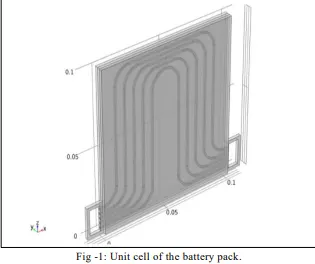
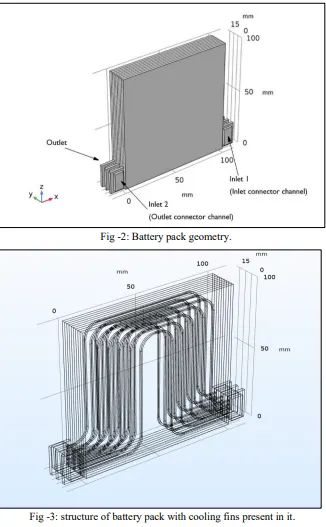
Basically, the design consists of a model of six lithium-ion prismatic cells in series, placing three coolant plates in between group of two cells each, in order to cool the cell temperature by flowing of coolant from cooling fins present in coolant plates. In this design water is used as coolant.The repetitive unit cell of the battery packconsists of two prismatic batteries and a cooling fin plate with five flow cooling channels, with one battery on eachside, The cooling fins and batteries are 2
mm thick each, summing up to a total unit cell thicknessof 6 mm. The overall volume of one cell is (100*2*100)mm (depth*width*height).The modeled battery pack geometry consists of total no. of six cells, three stacked unit cells and two flow connector channels: one on the inlet and one on the outlet side of the cooling fins. The geometry represents the last cells towards the outlet end of a battery pack. The overall volume of battery pack is(100*15*100) mm (depth*width*height). For betterunderstanding of geometry of design.