Week 10 - Simulating Combustion of Natural Gas.
AIM: To perform the Combustion simulation of a non-premixed model using Ansys Fluent.
OBJECTIVE:
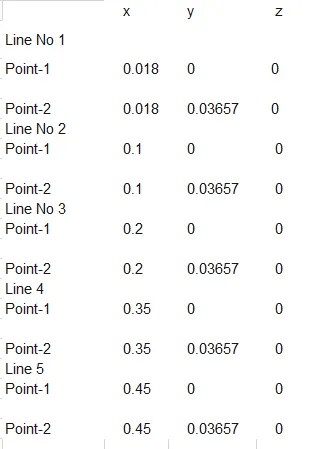
- To Perform a combustion simulation on the combustor model and plot the variation of the mass fraction of the different species’ in the simulation using line probes at different locations of the combustor as shown in Fig. Plot for CO2, H2O, CH4, N2, O2, NOx emissions & Soot formation.
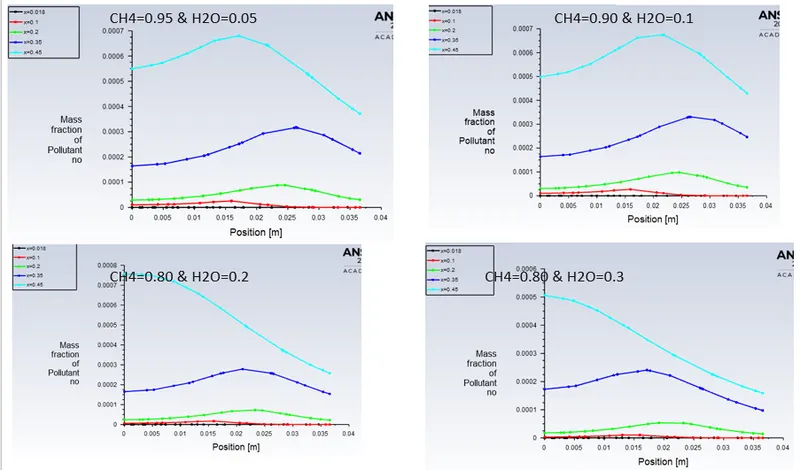
- By adding water content yo the fuel in mixture from 5%-30%by mole, show the effect of the NOx and soot particles formed at the outlet of the combustor.
- Support your study by plotting necessary plots and contour
- Introduction
Combustion of a fuel with air results in release of energy which is used to perform the intended mechanical work. Limited fuel consumption and emissions released by the combustion process. The methane in the fuel reacts with oxygen to produce products of compounds of oxygen called oxides. As methane encompasses atoms of carbon and hydrogen, the products of its combustion reaction are oxides of carbon and hydroge. Hence Bi products formed are carbon dioxide and water. A mole is defined as the mass of a substance equal to its molecular mass or molecular weight and the amount of substance present in a sample is indicated by its mass or by the number of moles of the substance.
To reduce the testing and development expenditure, CFD models were developed and the combustion process was simulated using numerical integration. The complexity of numerous species and their interactions were tackled with separating the combustion process into different types. Based on mixing, it can be classified into non-premixed, premixed and partially pre-mixed combustion. Based on phase, it can be classified into fluid phase or volumetric reactions, surface reactions and porous region combustion reactions. CFD models could solve the coupled partial differential equations for mass, momentum in general. Additionally, a species transport equation is solved with the laminar or turbulent diffusion models. The source term is calculated depending on the case and the various models used are finite rate chemistry models, mixing rate models or the finite rate eddy dissipation model.
In this Challenge , a 2D model with air and fuel inlet is defined and used to simulate combustion of methane CH4 in presence of air to determine the temperature characteristics, species mass fractions and study the effect of water content in fuel on the emissions.
Mass fraction calculation for air and fuel:
The combustion reaction can be written as follows:
CH4 + a (O2 + 3.76 N2) --> C02 + bH2O + cN2
we get the coefficients a= 2 moles on solving the stoichiometric equation.
For 1 mol CH4 combustion, 2 mol of air is required. Considering atomic weight of O= 16 and N=14,
Mass fraction of O2 in 2 mol of air = Mass of O2 / Mass of air = 32/137.28 = 0.23
Mass fraction of N2 in 2 mol of air = Mass of N2 / Mass of air = 105.28/137.28 = 0.77
PROCEDURE:
GEOMETRY:
Import the geometry into space claim
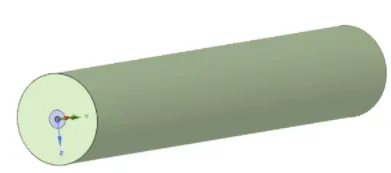
3D geometry is converted to 2D to solved under Axisymmetric condition to save computational time. Body is split into 1/4th of the entire geometry. On extracting the fluid volume we get the perfect 2D representation. Copy the 2D representation to anaother window and delete the previous.

MESH:
Fluid Volume is imported onto the meshing module
element size is considered as 5.e-003m. Also select Capture proximity=ON.
Named Selection:
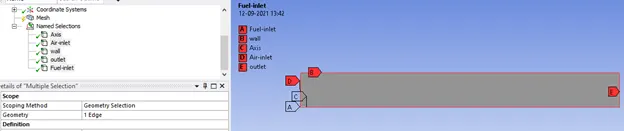
Close and Update the mesh module
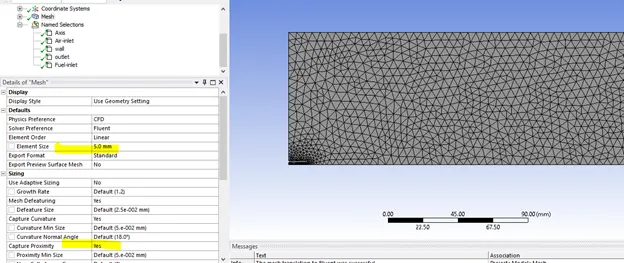
SETUP:
Double precision with single processor
Inlet is denoted by blue and outlet face is denoted by red
Model:
Turbulence model k-Ɛ Standard.
The species model is turned by selecting species transport with volumetric reaction and Eddy dissipation source calculation. The diffusion is also calculated at the inlet.
Material Selection
- for fuel without water select- 'methane-air'.
- for adding water content to fuel select - 'methane-air 2-step'.
NOx and soot formation, the species models are turned on with fuel as CH4 and oxidant as O2.
For soot prediction, one factor model is selected.
Boundary Condition
Air-Inlet velocity = 0.5 m/s
Air-inlet mass fraction: O2 = 0.23
Fuel-inlet velocity = 80 m/s
Fuel-inlet mass fraction: CH4 = 1.00
Outlet: Pressure-outlet
Post processing
Insert plane --> z=0-->create contour--> species contour in that plane
ANIMATION
Solving --> create --> solution animation--> contour-->change animation view and use it as active
RESULTS AND DISCUSSION
Part 1
Fuel without water
Contour plots
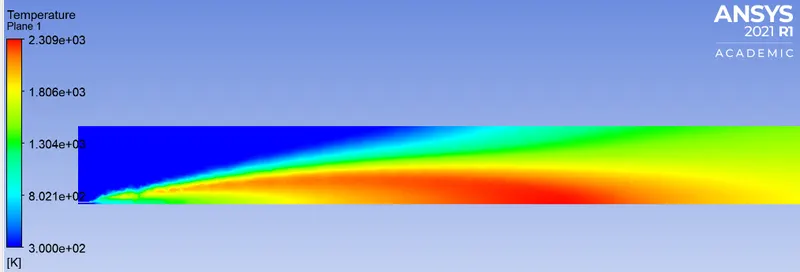
Inference: combustion starts at intermixing and spreads in the direction of flow and temperature increases as we move away from the inlet towards the outlet. At the outlet, the temperature distribution is uniform shhowing complete combustion of the fuel inside the combustor. The maximum temperature attained inside the combustor is 2309 K
Inference:
Line Plots Location
| Parameters | Inferences |
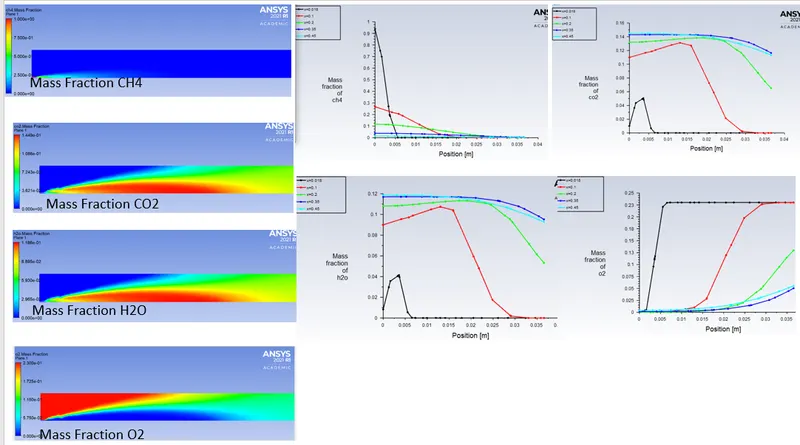
| Ch4 | CH4 concentration is visible only in the inlet and intermixing region with air. As the fuel is injected into the air stream and combustion occurs, the fuel is converted to intermediary species and products. Thus, the mass fractions at the other regions is found to be zero. |
| CO2 | CO2 is a product of combustion formed during the intermixing of the fuel and air. when flame advances, the concentration of CO2 increases and the mass fraction of CO2 increases along the direction of flow. whereas along the y-direction, the concentration decreases since combustion occurring close to the lower surface. But, diffusion occurs as we move towards the outlet and distribution along y-direction becomes uniform at the outlet. |
| H2O | The characteristics of H2O and CO2 species are very similar as both are products of combustion process. |
| O2 | Fuel burns by consuming oxygen resulting in reduction of O2 mass fraction as we move away from inlet. At outlet we have uneven temperature distribution, resulting in some unburnt O2 as an intermediary species. Thus we have relatively low mass fractions of oxygen at the outlet region. |
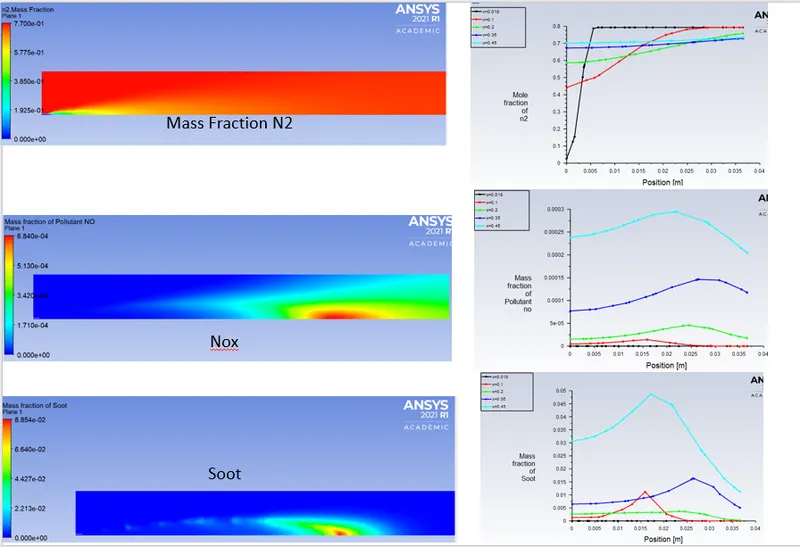
| N2 | Due to inert nature of Nitrogen upto certain temperature, the concentration of N2 measured using mass fractions does not change much. |
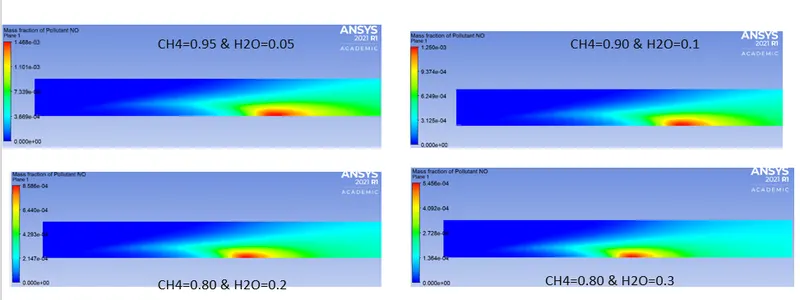
| Nox | At high temperatures N2 reacts with oxygen to form different compounds such as NO, NO2 and N2O. NOx compound is NO and its maximum concentration increases towards the outlet where flame concentration occurs or complete flame development and its high temperature leads to NO formation. NO diffuses into the mixture and emitted through the outlet. |
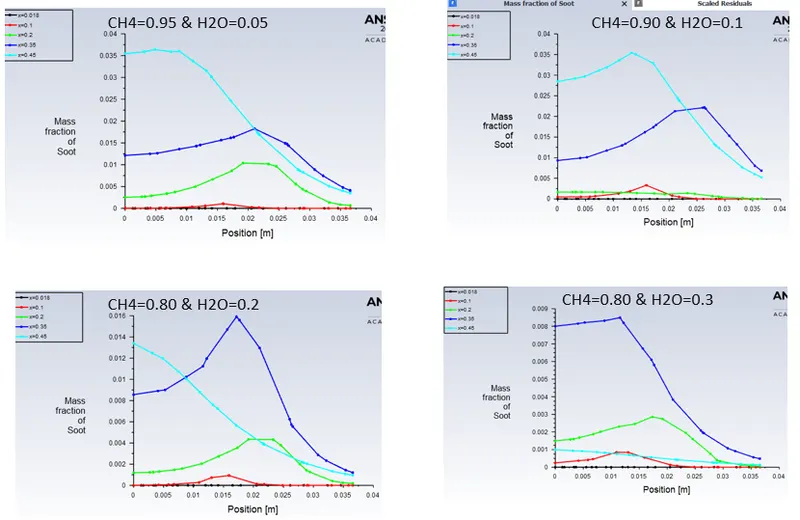
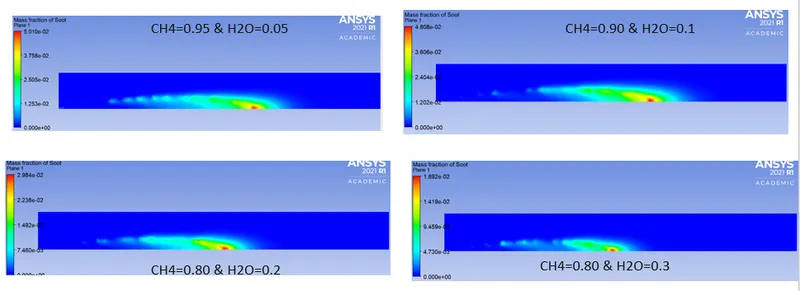
| Soot | unburnt carbon particulate matter formed due to incomplete combustion inside the combustion chamber is soot.It is envisaged from the plot that soot formation occurs at the mid region after complete development of the flame and gets concentrated at the end of combustion. These soot particles are carried through the air flow via the outlet.The soot mass fraction decreases along Y- direction. |
Part 2: Influence of water content in fuel on emission reduction (NOx, CO2 and Soot)
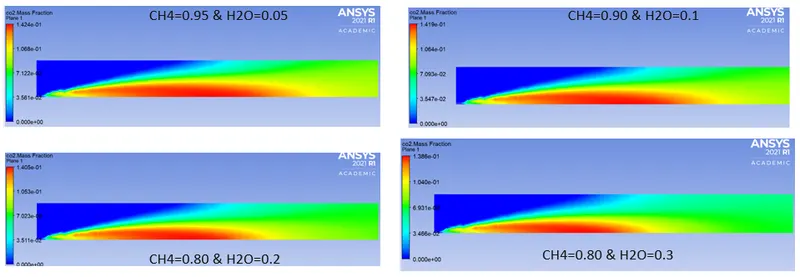
Add the water content in the fuel from 5% to 30% by mole
Physics --> Boundary Conditions --> go to Fuel-Inlet --> move to Species --> cases add the water content in the fuel from 5% to 30% by mole i.e. change values of CH4 & H2O.
Inference:
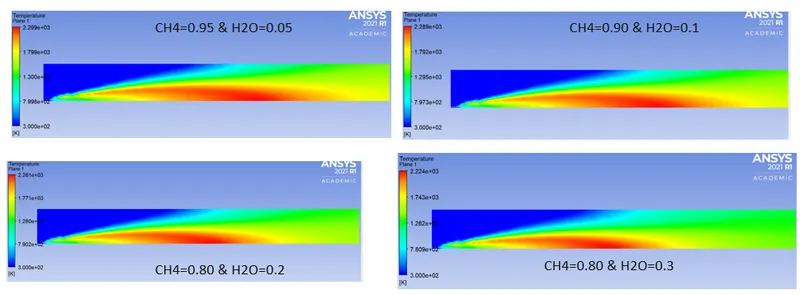
| Nox/Soot/Co2 | It is envisaged from the above contour plots of mass concentrations for emission CO2, NO and soot that the characteristics for all cases are very similar and the distributions inside the combustor are not significantly affected by the water content of the fuel mixture. But, the maximum concentrations for the species were found to decrease with increase in water content which is visible in line plots and contour graphs. |
| Temperature | Increase in water content in fuel resulted in decrease in peak temperature which in turn reduced the favouring condition for NOx formation |
| C02 | CO2 mass fraction reduces with increase in water content in fuel due to equilibrium shift towards the reactant side due to presence of water concentration. |
Conclusion:
The study to simulate the combustion of methane in presence of air for a 2D axisymmetric combustor using CFD was completed successfully and the following observations were made: Increase in water content in the fuel mixture results in reduced level of emissions of CO2, NO and soot.