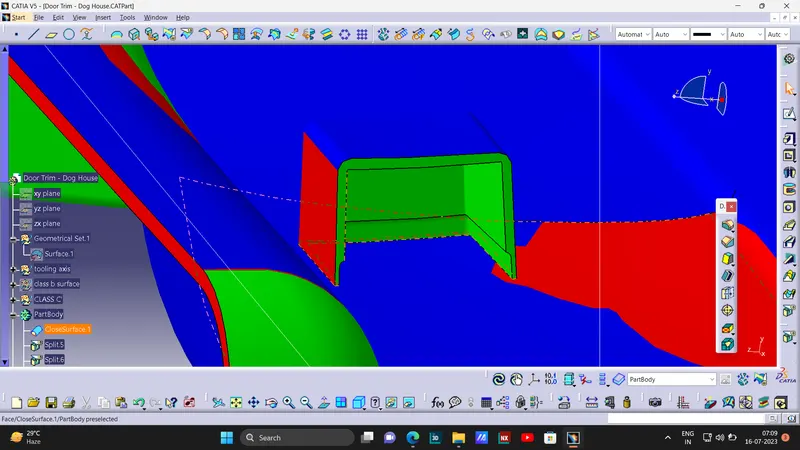
Week 10 - Challenge 2- Attachment Feature Creation (Dog House)
Detailed Report on Dog House Design and Draft Analysis
Introduction:
The objective of this report is to provide a detailed analysis of the design considerations, draft analysis, and tooling axis creation for the Dog House project. The project involves creating a Dog House for the Door Trim while adhering to specific design rules. This report aims to explain the draft analysis process and the method used for tooling axis creation, particularly focusing on the Bisecting method.
Design Considerations:
The following design rules were considered while creating the Dog House for the Door Trim:
a. Doghouse wall thickness at the intersection of the part wall (C) should be 40% or less than the main wall stock (T):
To ensure structural integrity and proper manufacturing feasibility, it is crucial to maintain appropriate wall thickness. The doghouse wall thickness (C) should be kept at 40% or less of the main wall stock thickness (T). This guideline ensures that the doghouse maintains sufficient strength while minimizing material usage.
b. The height of (B) should be between 3.0 – 6.0 mm:
The height of the doghouse (B) is another important parameter to consider. It should be within the range of 3.0 – 6.0 mm to meet functional requirements and design aesthetics.
Draft Analysis:
Draft analysis is a critical step in designing plastic parts to ensure proper mold release during the manufacturing process. It involves analyzing the angles and slopes of the part surfaces to facilitate smooth ejection from the mold. In the context of the Dog House project, draft analysis would assess the angles and draft requirements of the doghouse walls and surfaces.
The draft angle is the taper or inclination provided to the vertical walls of the part. It allows the part to be easily ejected from the mold without causing damage or sticking. In this project, the draft analysis should consider the doghouse walls' draft angles and their impact on the overall design.
The analysis results should indicate whether the designed doghouse has sufficient draft angles to enable easy ejection and prevent any potential manufacturing issues.
Tooling Axis Creation:
The tooling axis is a crucial aspect of the manufacturing process for parts with complex shapes or features. It determines the direction of the tool movement during the machining or molding process. In the Dog House project, the tooling axis creation plays a vital role in achieving the desired shape and precision.
a. Bisecting Method:
The Bisecting method is commonly used for creating the tooling axis. It involves dividing the complex part geometry into simpler sections and determining the axis for each section. This method ensures that the tool path is created efficiently, minimizing errors and ensuring accurate machining.
To create the tooling axis using the Bisecting method, the following steps can be followed:
Divide the part into distinct sections based on its geometry, such as flat surfaces, curves, and inclined features.
Determine the axis for each section individually, considering the machining requirements, part geometry, and desired finish.
Align the tooling axis of each section to ensure a continuous and smooth transition between them.
Validate the tooling axis by simulating the machining process and verifying its compatibility with the part geometry and desired outcomes.
The Bisecting method provides a systematic approach to creating the tooling axis, ensuring optimal machining performance and accuracy.
DOG HOUSE FOR DOOR DRIM:
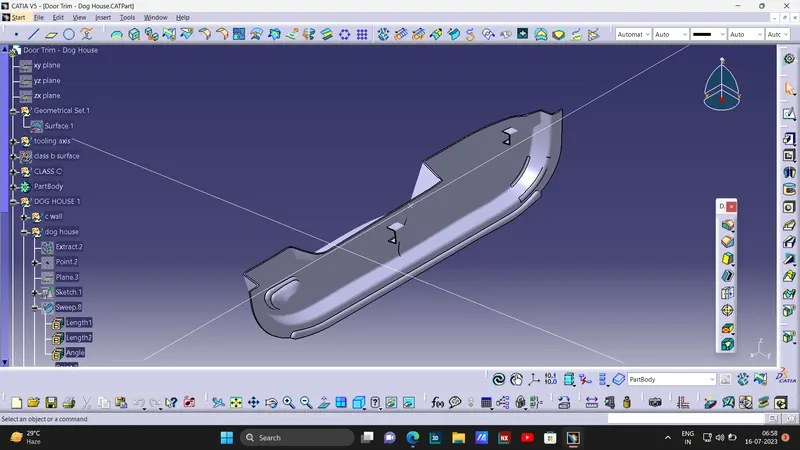
TOP VIEW:
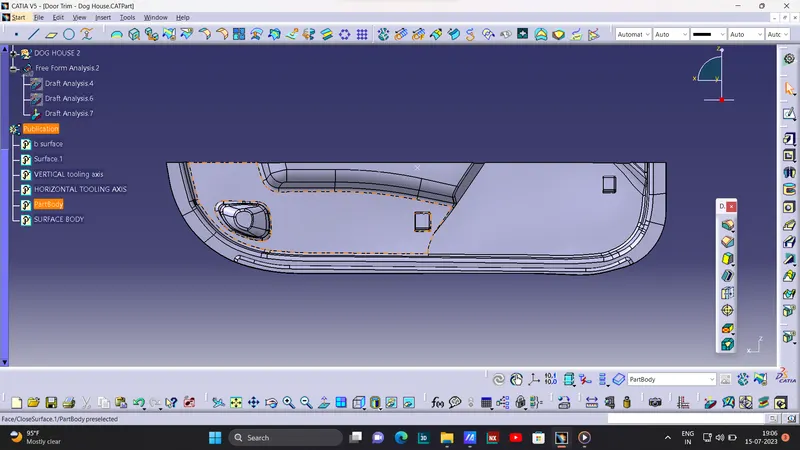
DOG HOUSE 1:
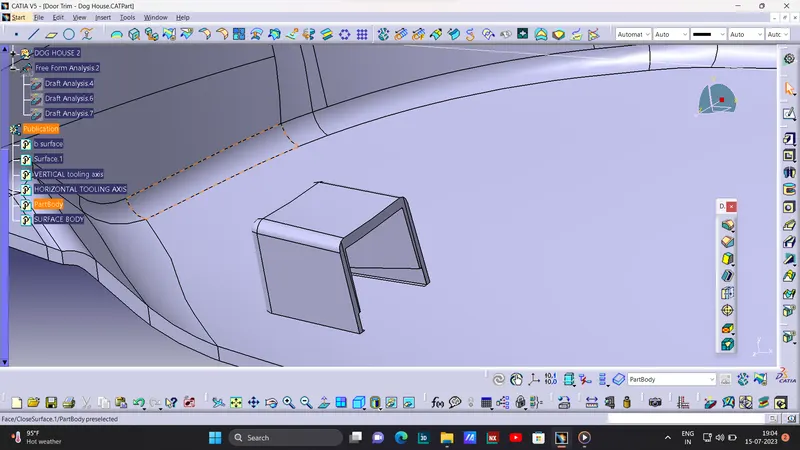
DOG HOUSE 2:
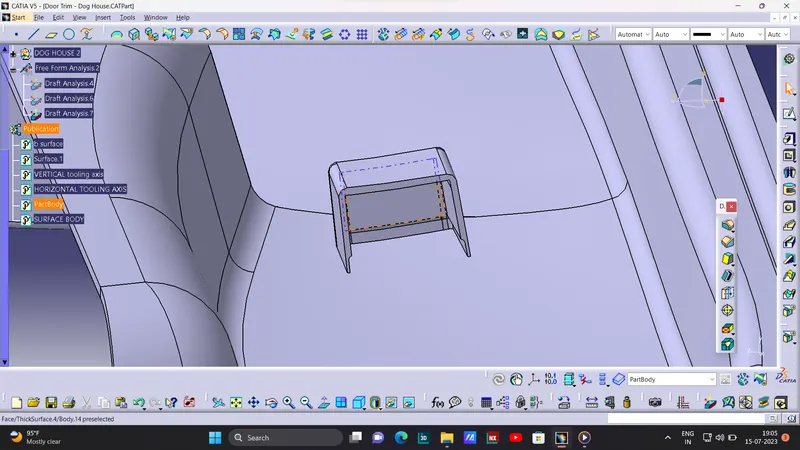
DRAFT ANALYSIS IN VERTICAL TOOLING AXIS IN WHOLE PART BODY:
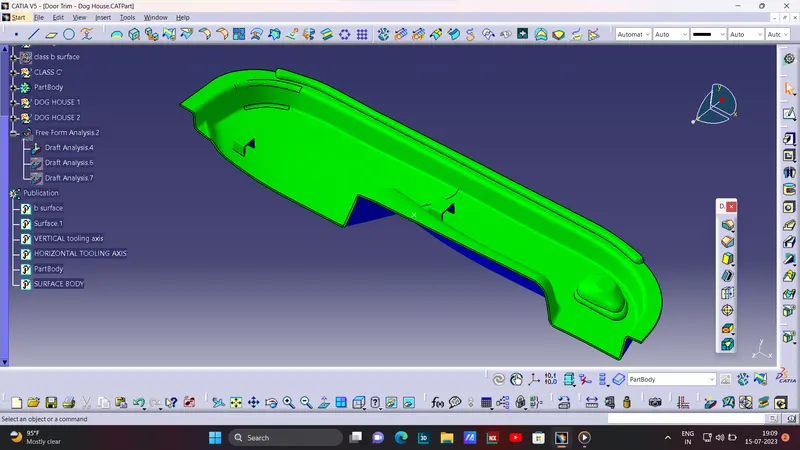
DOG HOUSE IN HORIZONTAL TOOLKING AXIS IN DOG HOUSE 1:
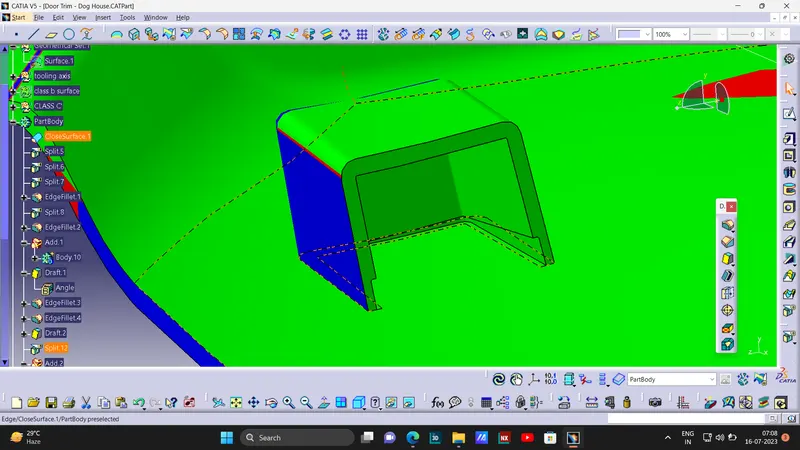
DOG HOUSE IN HORIZONTAL TOOLKING AXIS IN DOG HOUSE 2: