Week 10- Assembly Workbench
ASSEMBLY WORKBENCH
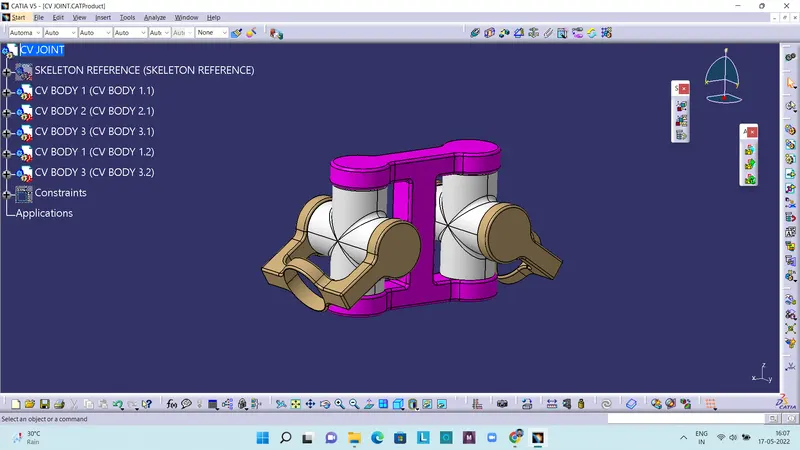
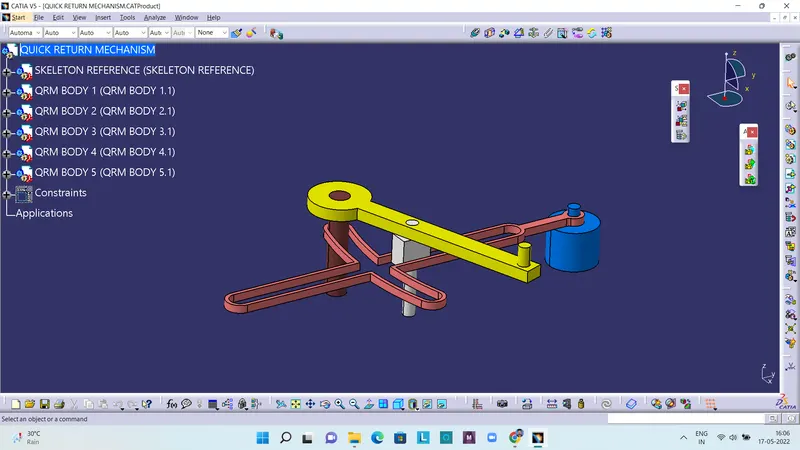
Aim: To create parts of Quick Return Mechanism and CV Joint and then assemble each mechanism in assembly workbench.
Quick Return Mechanism
A quick return mechanism is an apparatus to produce a reciprocating motion in which the time taken for travel in return stroke is less than in the forward stroke. It is driven by a circular motion source and uses a system of links with three turning pairs and a sliding pair.
Procedure
1. First of all, created all the four parts using part workbench
2. Then opened the assembly workbench and inserted all the parts
3. The skeleton reference is then created for the assembly and reference axis for each parts have also been created
4. The skeleton reference is then published and is constrained with fixed constraint option
5. Then each of the parts of quick return mechanism is joined using coincident constraint option and the assembly is completed
CV joints
Constant-velocity joints are mechanical joints which allow a drive shaft to transmit power through a variable angle, at constant rotational speed, without an appreciable increase in friction or play. They are mainly used in front wheel drive vehicles. Modern rear wheel drive cars with independent rear suspension typically use CV joints at the ends of the rear axle halfshafts and increasingly use them on the drive shaft.
Procedure
1. First of all, created all the four parts using part workbench
2. Then opened the assembly workbench and inserted all the parts
3. The skeleton reference is then created for the assembly and reference axis for each parts have also been created
4. The skeleton reference is then published and is constrained with fixed constraint option
5. Then each of the parts of CV Joint is joined using coincident constraint option and the assembly is completed