Week 1 Understanding Different Battery Chemistry
|
Cell Type |
Cathode Material |
Anode Mterial |
Cathode Reaction |
Anode Reaction |
|
LCO |
Lithium Cobalt Oxide |
Graphite |
LiCoO2 ↔ CoO2 + Li+ + e- |
LiC6 ↔ 6Li+ + 6e- |
|
LMO |
Lithium Manganese Oxide |
Graphite |
LiMn2O4 ↔ MnO2 + Li+ + e- |
LiC6 ↔ 6Li+ + 6e- |
|
NCA |
Lithium Nickel Cobalt Aluminum Oxide |
Graphite |
Li(Ni0.8Co0.15Al0.05)O2 ↔ NiO2 + CoO2 + Al2O3 + Li+ + e- |
LiC6 ↔ 6Li+ + 6e- |
|
NMC |
Lithium Nickel Manganese Cobalt Oxide |
Graphite |
Li(Ni0.33Mn0.33Co0.33)O2 ↔ NiO2 + MnO2 + CoO2 + Li+ + e- |
LiC6 ↔ 6Li+ + 6e- |
|
LFP |
Lithium Iron Phosphate |
Graphite |
LiFePO4 ↔ FePO4 + Li+ + e- |
LiC6 ↔ 6Li+ + 6e- |
|
LTO |
Lithium Titanium Oxide |
Lithium Titanium Oxide |
Li4Ti5O12 ↔ 4Li+ + 4e- + Ti5O12 |
Li ↔ Li+ + e- |
Explanation:
- LCO (Lithium Cobalt Oxide): LCO batteries have a cathode made of lithium cobalt oxide (LiCoO2) and an anode made of graphite. During charging, lithium ions move from the cathode to the anode.
- Cathode Reaction: LiCoO2 ↔ CoO2 + Li+ + e-
- Anode Reaction: LiC6 ↔ 6Li+ + 6e-
- LMO (Lithium Manganese Oxide): LMO batteries use lithium manganese oxide (LiMn2O4) as the cathode material and graphite as the anode material.
- Cathode Reaction: LiMn2O4 ↔ MnO2 + Li+ + e-
- Anode Reaction: LiC6 ↔ 6Li+ + 6e-
- NCA (Lithium Nickel Cobalt Aluminum Oxide): NCA batteries have a cathode composed of lithium nickel cobalt aluminum oxide and a graphite anode.
- Cathode Reaction: Li(Ni0.8Co0.15Al0.05)O2 ↔ NiO2 + CoO2 + Al2O3 + Li+ + e-
- Anode Reaction: LiC6 ↔ 6Li+ + 6e-
- NMC (Lithium Nickel Manganese Cobalt Oxide): NMC batteries use lithium nickel manganese cobalt oxide as the cathode material and graphite as the anode material.
- Cathode Reaction: Li(Ni0.33Mn0.33Co0.33)O2 ↔ NiO2 + MnO2 + CoO2 + Li+ + e-
- Anode Reaction: LiC6 ↔ 6Li+ + 6e-
- LFP (Lithium Iron Phosphate): LFP batteries have a cathode made of lithium iron phosphate (LiFePO4) and a graphite anode.
- Cathode Reaction: LiFePO4 ↔ FePO4 + Li+ + e-
- Anode Reaction: LiC6 ↔ 6Li+ + 6e-
- LTO (Lithium Titanium Oxide): LTO batteries use lithium titanium oxide (Li4Ti5O12) as both the cathode and anode material.
- Cathode Reaction: Li4Ti5O12 ↔ 4Li+ + 4e- + Ti5O12
- Anode Reaction: Li ↔ Li+ + e-
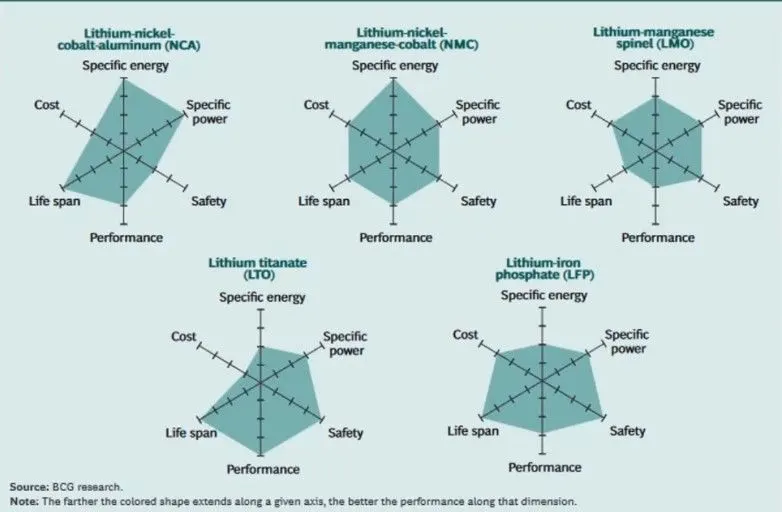
The primary distinction between these different lithium-ion cell types lies in their cathode materials, which affect their characteristics and the overall performance of the battery.
Comparison of Different Lithium-ion Battery Types:
- Energy Density: LCO and NCA batteries typically have higher energy densities compared to LFP and LTO batteries. NMC batteries fall in between in terms of energy density.
- Safety: LFP and LTO batteries are considered safer than LCO and NCA batteries due to their stable chemical structures and reduced risk of thermal runaway.
- Cycle Life: LFP and LTO batteries tend to have longer cycle lives and better calendar lives compared to LCO and NCA batteries.
- Cost: LFP and LTO batteries are generally more cost-effective than LCO and NCA batteries, which contain more expensive materials like cobalt and nickel.
- Operating Temperature Range: LFP and LTO batteries can operate in a wider temperature range compared to other types, making them suitable for extreme conditions.
- Applications: Each type of lithium-ion battery has its applications. LCO and NCA batteries are commonly used in high-performance applications like electric vehicles, while LFP batteries find use in power tools and stationary energy storage systems.