Week 1 Understanding Different Battery Chemistry
Challenge 1
1. Prepare a table that includes materials & chemical reactions occurring at the anode and cathode of LCO, LMO, NCA, NMC, LFP, and LTO-type lithium-ion cells. Give your detailed explanation of it.
Introduction to a lithium-ion battery and its types
The phrase "lithium-ion" are either written in full or abbreviated using the chemical symbols for the materials that make up the battery. In addition to being difficult to remember and even more difficult to pronounce, a string of letters and numbers can also identify the battery chemistries.
One of the most prevalent Li-ions, lithium cobalt oxide, has the chemical symbol LiCoO2 and the acronym LCO. For simplicity's sake, this battery can also be referred to by its abbreviation, Li-cobalt. The primary active component that gives this battery its distinct characteristics is cobalt. Similar short-form designations are given to other Li-ion chemistries.
Although lithium-ion batteries can be made to have the highest possible capacity, the drawbacks include limited loading, a slow rate of charging, and a short lifespan. The durability of an industrial battery is more important than its moderate Ah rating. The performance of batteries is only partially provided by specific energy. Six of the most prevalent Li-ions are included in this section. All readings are current estimates that are on average.
Lithium Cobalt Oxide (LiCoO2) — LCO
Although lithium-ion batteries can be made to have the highest possible capacity, the drawbacks include limited loading, a slow rate of charging, and a short lifespan. The durability of an industrial battery is more important than its moderate Ah rating. The performance of batteries is only partially provided by specific energy. The cathode is composed of layers. Lithium ions flow from the anode to the cathode during discharge, but from the cathode to the anode during charging.
Lithium Manganese Oxide (LiMn2O4) — LMO
The Materials Research Bulletin initially reported on Li-ion with manganese spinel in 1983. Lithium manganese oxide was used as the cathode material for the Li-ion cell that Moli Energy launched in 1996. The construction creates a three-dimensional spinel structure on the electrode to enhance ion flow, which lowers internal resistance and enhances current handling. High thermal stability and improved safety are further benefits of spinel, although its cycle and calendar lives are constrained.
Low internal cell resistance makes high-current discharging and quick charging possible. Li-manganese batteries in 18650 packages can discharge at currents of 20–30A with only a little heat rise. Additionally, one-second load pulses of up to 50A are practicable. The cell temperature cannot rise over 80°C (176°F) under a continuous heavy load at this current. Power tools, medical equipment, as well as electric and hybrid vehicles all use lithium manganese.
Lithium Nickel Manganese Cobalt Oxide (LiNiMnCoO2) — NMC
The nickel-manganese-cobalt (NMC) cathode combination is one of the most effective Li-ion systems. These systems can be configured to function as Energy cells or Power cells, much like Li-manganese. For instance, NMC in a 18650 cell optimized for specific power has a capacity of just around 2,000mAh but offers a continuous discharge current of 20A. NMC in the same cell designed for moderate load conditions has a capacity of about 2,800mAh and may deliver 4A to 5A. The maximum capacity of a silicon-based anode is 4,000mAh, though with a reduced loading capability and a shorter cycle life. The disadvantage of silicon added to graphite is that the anode expands and contracts with charge and discharge, resulting in mechanical instability in the cell.
Nickel and manganese in combination is the key secret in the construction of NMC. An analogy of this is table salt, whose primary components, sodium and chloride, are harmful when consumed separately but act as a food preservative when combined. Manganese has the advantage of developing a spinel structure to create low internal resistance but delivers low specific energy. Nickel is renowned for its high specific energy but poor stability. The metals' combined strengths are increased.
Power tools, e-bikes, and other electric vehicles all use NMC batteries as their primary power source. The cathode combination, often known as 1-1-1, typically consists of one-third nickel, one-third manganese, and one-third cobalt. Cobalt is pricey and hard to get by. Manufacturers of batteries are lowering the cobalt concentration while making some performance sacrifices. NCM532, which contains 5 parts nickel, 3 parts cobalt, and 2 parts manganese, is an effective combination. NMC622 and NMC811 are more combinations. Nickel, a substance with strong energetic activity, is stabilized by cobalt.
Lithium Iron Phosphate (LiFePO4) — LFP
Phosphate was identified in 1996 by the University of Texas (together with other contributors) to be a cathode material for rechargeable lithium batteries. Li-phosphate has a low resistance and strong electrochemical performance. Phosphate cathode material on a nanoscale enables this. The main advantages include a high current rating, a long cycle life, strong thermal stability, increased safety, and abuse tolerance.
If sustained at high voltage for an extended period of time, lithium-phosphate is more resilient to full-charge circumstances and experiences less stress than other lithium-ion systems. In exchange, its lower nominal voltage of 3.2V/cell lowers the specific energy below that of lithium-ion with a cobalt combination. Li-phosphate batteries are not an exception; like most batteries, they perform worse in cold temperatures and last shorter at warmer storage temperatures. Li-phosphate batteries have a higher self-discharge than conventional Li-ion batteries, which over time might lead to balancing issues. High-quality cell purchases and/or the use of advanced control electronics, both of which raise the price of the pack, can reduce this. For lifespan, production cleanliness is crucial. Moisture is not tolerated, or the battery will only operate for 50 cycles.
For starter batteries, lithium-phosphate is frequently used in place of lead acid. Similar to six 2V lead acid cells connected in series, four cells produce 12.80V when connected in series. Lead acid batteries are charged in vehicles to 14.40V (2.40V/cell) and maintained at a topping charge. On lead acid batteries, a topping charge is used to keep the charge level at 100% and avoid sulfation.
Each Li-phosphate cell peaks out at 3.60V when four of them are connected in series, which is the appropriate full-charge voltage. The charge should now be turned off, however, it keeps topping off while you're driving. Li-phosphate can withstand some overcharging; but, holding the voltage at 14.40V for an extended period of time, as most cars do on long drives, could put Li-phosphate under stress. We will have to wait and see how long-lasting Li-Phosphate will be in comparison to lead acid in a typical automobile charging system. Li-ion batteries operate worse in cold temperatures, which, in some severe circumstances, may impede their capacity to crank.
Lithium Nickel Cobalt Aluminum Oxide (LiNiCoAlO2) — NCA
Since 1999, lithium nickel cobalt aluminum oxide batteries, or NCAs, have been used for specialized purposes. It has high specific energy, decent specific power, and long life duration, which are parallels to NMC. Cost and safety are less appealing. Lithium nickel oxide has been developed further into NCA, which adds aluminum to make the chemistry more stable.
Lithium Titanate (Li2TiO3) — LTO
Since the 1980s, Li-titanate anodes have been used in batteries. In the anode of a conventional lithium-ion battery, Li-titanate takes the role of graphite and crystallizes into a spinel structure. Lithium manganese oxide or NMC can be used as the cathode. Li-titanate batteries deliver a high discharge current of 10C, or 10 times the rated capacity, and have a nominal cell voltage of 2.40V. They can also be quickly charged. The cycle count is claimed to be higher than a typical Li-ion. Li-titanate is secure, exhibits outstanding low-temperature discharge characteristics, and achieves an 80 percent capacity at -30°C (-22°F).
When fast charging and charging at low temperatures, LTO (commonly known as Li4Ti5O12) has benefits over the traditional cobalt-blended Li-ion with graphite anode in that it achieves zero-strain property, prevents SEI film formation, and prevents lithium plating. The battery is pricey but has higher thermal stability at high temperatures than conventional Li-ion battery systems. The specific energy is low, surpassing NiCd at only 65Wh/kg. Lithium-ion batteries charge to 2.80V/cell and discharge to 1.80V/cell. Table 1 summarizes the different materials and chemical reactions used for the various types of lithium-ion batteries.
Table 1: Summary of Chemical Reactions and Materials for Different Lithium-Ion Batteries
|
Chemical Reactions and Materials for Different Lithium-Ion Batteries |
|||||||
|
Battery Type |
Anode |
Cathode |
Electrolyte |
Anode Reaction |
Cathode Reaction |
||
|
Salt |
Solvent |
||||||
|
Lithium Cobalt Oxide — LCO |
Graphite (C6) |
Lithium Cobalt Oxide (LiCoO2) |
Lithium Hexafluorophosphate (LiPF6) |
Ethylene Carbonate |
C6Li↔6C+Li++e- |
Li(1-x)CoO2(s) + xLi+ + xe-↔ LiCoO2 (s) |
|
|
Lithium Manganese Oxide — LMO |
Graphite (C6) |
Lithium Manganese Oxide (LiMn2O4) |
Lithium Hexafluorophosphate (LiPF6) |
Ethylene Carbonate |
C6Li↔6C+Li++e- |
Li(1-x)Mn2O4(s) + xLi+ + xe-↔ LiMn2O4 (s) |
|
|
Lithium Nickel Manganese Cobalt Oxide — NMC |
Graphite (C6) |
Lithium Nickel Manganese Cobalt Oxide (LiNiMnCoO2) |
Lithium Hexafluorophosphate (LiPF6) |
Ethylene Carbonate |
C6Li↔6C+Li++e- |
Li(1-x)NiMnCoO2(s) + xLi+ + xe-↔ LiNiMnCoO2 (s) |
|
|
Lithium Iron Phosphate — LFP |
Graphite (C6) |
Lithium Iron Phosphate (LiFePO4) |
Lithium Hexafluorophosphate (LiPF6) |
Ethylene Carbonate |
C6Li↔6C+Li++e- |
Li(1-x)FePO4(s) + xLi+ + xe-↔ LiFePO4 (s) |
|
|
Lithium Nickel Cobalt Aluminum Oxide — NCA |
Graphite (C6) |
Lithium Nickel Cobalt Aluminum Oxide (LiNiCoAlO2) |
Lithium Hexafluorophosphate (LiPF6) |
Ethylene Carbonate |
C6Li↔6C+Li++e- |
Li(1-x)NiCoAlO2(s) + xLi+ + xe-↔ LiNiCoAlO2 (s) |
|
|
Lithium Titanate — LTO |
Titanate (Ti5O12) |
Lithium Maganese Oxide (LiMn2O4) |
Lithium Hexafluorophosphate (LiPF6) |
Ethylene Carbonate |
Li7Ti5O12↔ Li4Ti5O12+3Li++3e- |
Li(1-x)Mn2O4(s) + xLi+ + xe-↔ LiMn2O4 (s) |
|
- Compare the differences between each type of Li-ion batteries based on their characteristics
Comparison
Comparisons between different Li-ion battery types used in EVs from the viewpoints of specific energy (capacity), specific power, safety, performance, life span, and cost (the outer hexagon is preferred). Among these six possibilities, Lithium Nickel Manganese Cobalt Oxide (NMC), Lithium Iron Phosphate (LiFePO4), and Lithium Manganese Oxide stand out as the best. Figure 1 and Table 2 show how these six criteria are compared and favored among the different lithium-ion batteries.
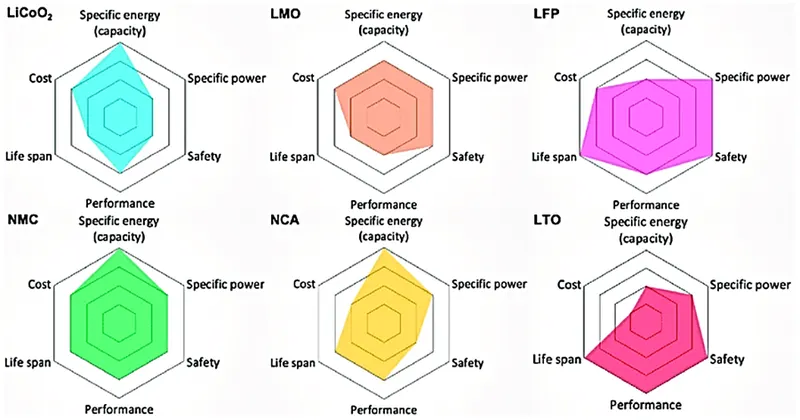
Figure 1: Comparisons between different Li-ion battery types used in EVs from the viewpoints of specific energy (capacity), specific power, safety, performance, life span, and cost. Available at: https://www.researchgate.net/publication/331904470
Table 2: Summary of Chemical Reactions and Materials for Different Lithium-Ion Batteries
|
Chemical Reactions and Materials for Different Lithium-Ion Batteries |
|||||||||||
|
Lithium-ion Battery Type |
PF |
CS |
LS |
SF |
SE |
SP |
|||||
|
Lithium Cobalt Oxide — LCO |
M |
L |
L |
L |
H |
L |
|||||
|
Lithium Manganese Oxide — LMO |
L |
L |
L |
M |
M |
M |
|||||
|
Lithium Nickel Manganese Cobalt Oxide — NMC |
M |
L |
M |
M |
H |
M |
|||||
|
Lithium Iron Phosphate — LFP |
M |
L |
H |
H |
L |
H |
|||||
|
Lithium Nickel Cobalt Aluminum Oxide — NCA |
M |
M |
M |
L |
H |
M |
|||||
|
Lithium Titanate — LTO |
H |
H |
H |
H |
L |
M |
|||||
PF stands for performance
CS stands for cost
LS stands for lifespan
SF stands for safety
SE stands for specific energy
SP stands for specific power
H stands for high
M stands for moderate
L stands for low
Remarks on the Table
Lithium Cobalt Oxide (LiCoO2 or LCO)
- With its elevated energy density, this battery type offers extended durations of operation.
- The battery exhibits a remarkable specific power, making it well-suited for applications with high power demands.
- While it maintains a moderate level of thermal stability, there may be safety concerns associated with overheating.
- This type of battery is widely utilized in portable electronic devices like laptops and smartphones.
Lithium Manganese Oxide (LiMn2O4 or LMO)
- This battery type exhibits favorable thermal stability and enhanced safety compared to LCO batteries.
- It has a lower energy density in comparison to LCO batteries.
- Moreover, it boasts a higher specific power, making it well-suited for applications with significant power requirements.
- This type of battery finds application in power tools, medical devices, and electric vehicles (EVs).
Lithium Nickel Manganese Cobalt Oxide (LiNiMnCoO2 or NMC)
- This battery type demonstrates a well-rounded performance when it comes to energy density, power capability, and safety.
- It exhibits enhanced thermal stability in comparison to LCO batteries.
- It finds extensive usage in electric vehicles (EVs), hybrid electric vehicles (HEVs), and energy storage systems.
Lithium Iron Phosphate (LiFePO4 or LFP)
- This battery type demonstrates outstanding thermal stability and safety, reducing the likelihood of thermal runaway.
- Compared to LCO batteries, it has a lower energy density.
- Additionally, it boasts an extended cycle life, enabling a greater number of charge-discharge cycles.
- This type of battery is commonly employed in electric vehicles, renewable energy storage, and UPS (Uninterruptible Power Supply) systems.
Lithium Nickel Cobalt Aluminum Oxide (LiNiCoAlO2 or NCA)
- NCA batteries possess a significant capacity to store a substantial amount of energy in a compact form, which contributes to their high energy density. energy storage capacity.
- NCA batteries demonstrate a high power density, enabling them to deliver a considerable amount of power rapidly.
- NCA batteries exhibit comparatively favorable thermal stability when compared to certain other types of Li-ion battery chemistries. Nonetheless, it is crucial to acknowledge that NCA batteries can still be sensitive to elevated temperatures and may experience thermal runaway if not appropriately managed.
Lithium Titanate (Li4Ti5O12 or LTO)
- This battery type possesses exceptional power capability and exhibits rapid charging and discharging rates.
- Compared to other Li-ion chemistries, it has a lower energy density.
- It boasts an impressive cycle life, enabling a significant number of charge-discharge cycles.
- This type of battery finds application in electric buses, grid energy storage, and in scenarios where fast charging is essential.
The specific characteristics mentioned can differ within each battery type, influenced by distinct formulations and manufacturing methods. Selecting the appropriate battery chemistry relies on the specific needs of the application, including factors such as energy density, power capability, safety, cycle life, and cost considerations.
References
- Armand, M., & Tarascon, J. M. (2008). Building better batteries. Nature, 451(7179), 652-657.
- Balakrishnan, P. G., Ramesh, R., & Sundara, R. (2004). Development of new lithium-ion battery materials: A perspective. Journal of Power Sources, 136(2), 386-394.
- Etacheri, V., Marom, R., Elazari, R., Salitra, G., & Aurbach, D. (2011). Challenges in the development of advanced Li-ion batteries: a review. Energy & Environmental Science, 4(9), 3243-3262.
- Goodenough, J. B., & Park, K. S. (2013). The Li-ion rechargeable battery: A perspective. Journal of the American Chemical Society, 135(4), 1167-1176.
- Li, J., Liu, J., Yuan, C., & Wu, F. (2019). Recent advances in lithium-ion batteries: From materials to manufacturing techniques. Advanced Energy Materials, 9(45), 1901581.
- Li, M., Lu, J., Chen, Z., & Amine, K. (2020). 30 years of lithium-ion batteries. Advanced Materials, 32(49), 2001963.
- Manthiram, A., Choi, W., & Li, Y. (2017). A perspective on the high-voltage LiMn2O4 spinel cathode for lithium-ion batteries. Energy & Environmental Science, 10(2), 410-424.
- Ohzuku, T., & Ueda, A. (2001). Solid-state chemistry of nonstoichiometric Li1−xCoO2−δ (0 ≤ x ≤ 1) and its application as a cathode for a lithium rechargeable battery. Journal of The Electrochemical Society, 148(8), A899-A904.
- Whittingham, M. S. (2004). Lithium batteries and cathode materials. Chemical Reviews, 104(10), 4271-4302.
- Zhang, H., Li, C., Cheng, F., & Chen, J. (2019). Advanced anode materials for lithium-ion batteries. Nature Energy, 4(5), 366-377.