Week 1 Understanding Different Battery Chemistry
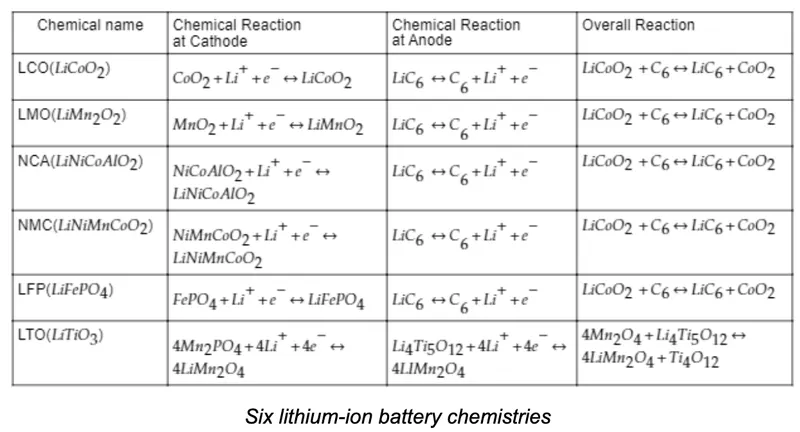
(1) Prepare a table which includes materials & chemical reactions occurring at the anode and cathode of LCO, LMO, NCA, NMC, LFP and LTO type of lithium ion cells.Give your detailed explanation on it
What are li-ion batteries?
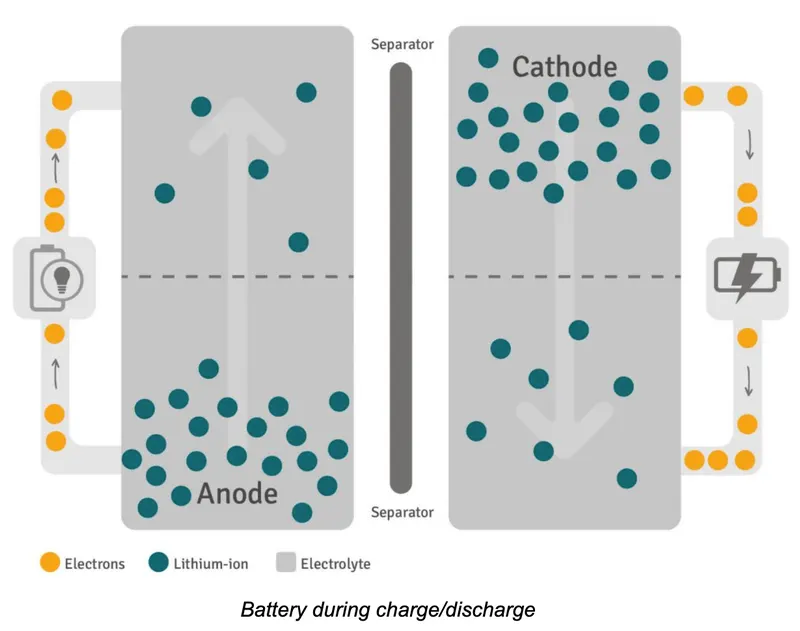
Lithium ion batteries are made of li-ion cells. Anode, cathode, separator, electrolyte, and two current collectors (positive and negative) make up a battery. Lithium is stored in the anode and cathode. Positively charged lithium ions are transported through the separator by the electrolyte from the anode to the cathode and vice versa.
A charge is produced at the positive current collector by the movement of the lithium ions, which releases free electrons in the anode. The electrical current then travels from the positive current collector to the negative current collector after passing through a powered device. The separator prevents electrons from moving freely inside the battery.
Components:
- Positive electrode: The cathode of the lithium-ion battery consists of lithium metal oxide, which may contain variable amounts of nickel, manganese and cobalt.
- Negative electrode: The anode is usually made of graphite.
- Electrolyte: In order for the lithium ions to move as charge carriers in the cell, anhydrous electrolyte can also be found in the battery.
- Separator: To avoid short circuits, the separator is permeable to lithium ions and can absorb large quantities of the ions.
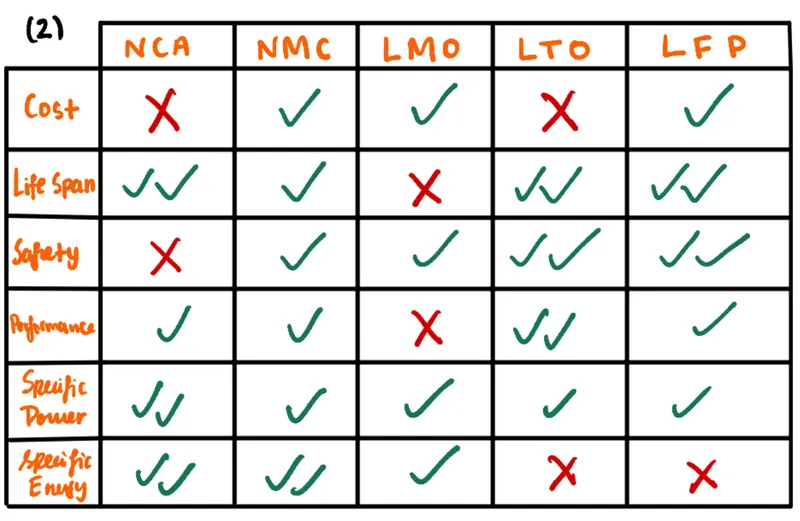
 (2) Compare the differences between each type of Li+ion batteries based on their characteristics