Week 1 Understanding Different Battery Chemistry
- Different kinds of Li-ion battery chemistries:
1) LCO based Li-ion cells
In the year 1991, a substance known as LCO (Lithium cobalt oxide) was developed. LiC6 makes up its anode, while LiCoO2 composes its cathode, and lithium ions serve as the charge carrier. It has a wide variety of applications and is utilised in everything from electronic devices to the batteries of laptops and mobile phones. Cobalt is used in the production of the vast majority of lithium-ion batteries used in portable electronic devices. The cathode of the system is made of cobalt oxide, making it a positive electrode. The anode is made of graphite carbon (negative electrode).
2) LMO based Li-ion cells
A lithium-ion manganese oxide battery, also known as an LMO battery, is a type of lithium-ion cell that has manganese dioxide, also known as MnO2, serving as its cathode material. They operate through the same mechanism of intercalation and de-intercalation as other commercially available secondary battery technologies, such as LiCoO2 batteries. Components of manganese oxide cathodes are abundant in the earth, they are not toxic, they are inexpensive, and they provide better thermal stability.
3) NMC based Li-ion cells
This type of chemistry combines the three previously mentioned types of chemistry in a controlled manner. The three elements that make up NMC batteries are nickel, manganese, and cobalt. Lithium manganese cobalt oxide batteries are another name for these types of cells. The energy or power density of NMC batteries is extraordinarily high.
4) LFP based Li-ion cells
Batteries that are powered by lithium iron phosphate (LiFePO4) are also referred to as "li-phosphate" batteries in common parlance. Long-life polymer batteries, or LFP batteries, are another name for these types of batteries. They make the cathode out of phosphate as the primary component. Additionally, they take advantage of the increased thermal stability and security afforded by the product's low resistance characteristics, which is another benefit for them.
5) LTO based Li-ion cells
A type of rechargeable battery with the advantage of being able to charge more quickly than other lithium-ion battery types but at the cost of having a significantly lower energy density is the lithium-titanate-oxide battery, also referred to as an LTO battery. An LTO battery is another name for a lithium-titanate-oxide battery. The graphite does not perform the role of the anode in this particular battery.
6) NCA based Li-ion cells
For use in specialised applications, lithium nickel cobalt aluminium oxide batteries, also known as NCA batteries, have been accessible since 1999. It provides a high specific energy along with a respectable specific power and a respectable amount of specific energy, and like NMC, it has a long lifespan.
These chemistries are tabulated in the table given in the table below.
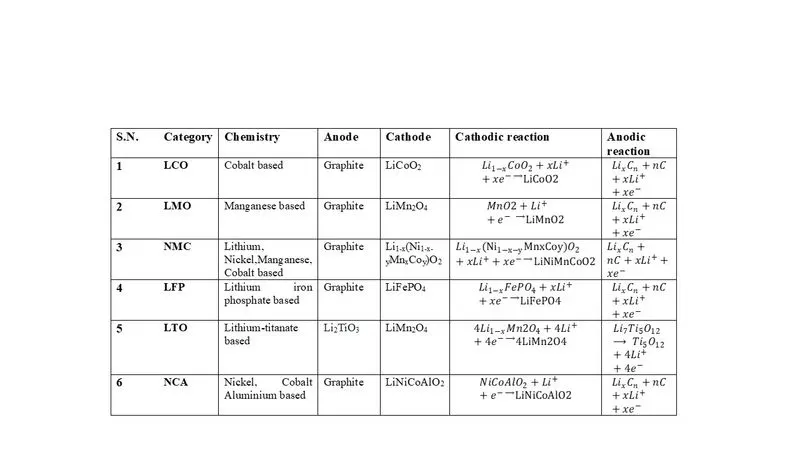
- Comparison of each type of Li+-ion batteries based on their characteristics:
a) Lithium Cobalt Oxide(LCO)
Because it has a higher specific energy than the other batteries, it is the one that is recommended for use in portable electronic devices like as laptops and mobile phones. Additionally, it has a cheap cost and a performance that is average. On the other hand, when contrasted with the performance of other lithium-ion batteries, it does very poorly in all of the other categories. It has a short lifetime, a poor safety rating, and a low specific power rating.
b) Lithium Manganese Oxide(LMO)
It has a degree of safety that is about average compared to other kinds of lithium-ion batteries, a particular power that is roughly average compared to other types of lithium-ion batteries, and a specific energy that is roughly average compared to other types of lithium-ion batteries. It is advantageous to use in several ways, one of which is that it is inexpensive. The device has a variety of serious problems, but its low performance and short lifetime stand out as the most noteworthy ones. Typical uses may be seen, among other areas, in the realms of medicine and power equipment.
c) Lithium Nickel Manganese Cobalt Oxide (NMC)
It is distinct from the other batteries in that it provides two important benefits that are not shared by the others. One of its primary advantages is that it has a high specific energy, which, among other things, makes it an attractive candidate for incorporation into electric powertrains, electric automobiles, and electric bicycles. One further advantage is that it is not too expensive. When compared to other lithium-ion batteries, it has a lifetime that is roughly equivalent to the average, a specific power that is droughly equivalent to the average, and performance that is roughly equivalent to the average. It's possible to modify it such that it has either a high specific power or a high specific energy instead.
d) Lithium Nickel Cobalt Aluminium Oxide(NCA)
Because it delivers such a high specific energy, it stands out among the other five batteries in the pack. It scores somewhat in the middle in terms of various measures such as performance, cost, specific power, and longevity. The atmosphere provided by this kind of battery is not particularly safe, which is a great disappointment. Due to the fact that it has a relatively short lifetime and a high specific energy, it is a contender that has a lot of potential for use in electric powertrains.
e) Lithium Titanate(LTO)
It provides top-notch security, exceptional performance, and a long lifetime, which are three characteristics that are essential for any battery. The specific power of this lithium-ion battery more than makes up for the fact that its specific energy is lower than that of the other five lithium-ion batteries. The price of lithium titanate batteries is much higher than the cost of other types of lithium-ion batteries, which is the sole significant downside of using lithium titanate batteries. It is also important to note that this battery has the potential to be charged quite rapidly. The storage of solar energy and the creation of intelligent grids are two possible applications for this material.