Week 1 Understanding Different Battery Chemistry
Introduction:
Li-ion cells:
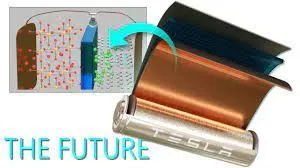
Lithium is one of the main building blocks used in the development of lithium-ion cells, which are rechargeable. Li-ion cell development began in the early 1970s, and in 2019 its creators were awarded the Nobel Prize in Chemistry for Chemistry because of its creation and promise to propel energy storage systems into the adoption of EVs. These are rechargeable cells that are frequently utilised to store energy generated by renewable energy sources in everything from small handheld gadgets to big Discoms. Li-ion battery research is advancing rapidly, which will lead to a significant increase in battery capacity in the near future. Battery prices have dropped by 97% over the last three decades and by 88% over the past ten years.
Types of Li-ion batteries:
1. LCO - Lithium Cobalt Oxide(LiCoO2):
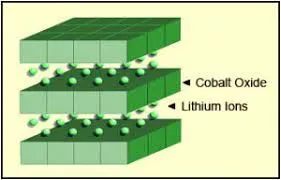
Li-cobalt is a common choice for cell phones, laptops, and digital cameras due to its high specific energy. A cobalt oxide cathode and a graphite carbon anode make up the battery. Lithium ions flow from the anode to the cathode during discharge due to the cathode's layered nature. On charging, the flow changes. Li-cobalt has a constrained range of load capabilities, a short life duration, and poor thermal stability (specific power).
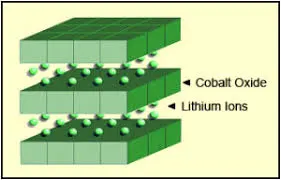
Reaction of LITHIUM COBALT OXIDE BATTERIES :
During Discharge
At the anode, lithium is oxidised.Lithium ions are released from the carbon, along with electrons:
LiC6 ==> xLi+ + xe- + C6
At the cathode, lithium-ions are absorbed by the lithium dioxide, and the electrode is reduced as it also receives the electrons from the circuit:
Li1-xCoO2 + xLi+ + xe- ==> LiCoO2
The overall reaction is :
C6 + LiCoO2 <==> LixC6 + Li1-xCoO2
2. LMO - Lithium Manganese Oxide (LiMn2O4) :
The Materials Research Bulletin initially reported on Li-ion with manganese spinel in 1983. Lithium manganese oxide used as the cathode material for the Li-ion cell that Moli Energy launched in 1996. The construction creates a three-dimensional spinel structure on the electrode to enhance ion flow, which lowers internal resistance and enhances current handling. High thermal stability and improved safety are further benefits of spinel, although its cycle and calendar lives are constrained.
Low internal cell resistance makes high-current discharging and quick charging possible. Li-manganese batteries in 18650 packages can discharge at currents of 20–30A with only little heat rise. Additionally, one-second load pulses of up to 50A are practicable. The cell temperature cannot rise over 80°C (176°F) under a continuous heavy load at this current. Power tools, medical equipment, as well as hybrid and electric cars, all use lithium manganese.
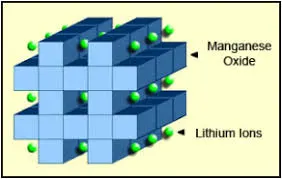
Reaction of Lithium Manganese Oxide BATTERIES :
During Discharge
At the anode, lithium is oxidised.Lithium ions are released from the carbon, along with electrons:
LiC6 ==> xLi+ + xe- + C6
At the cathode, lithium-ions are absorbed by the lithium dioxide, and the electrode is reduced as it also receives the electrons from the circuit:
Li1-xMn2O4 + xLi+ + xe- ==> LiMnO2
The overall reaction is :
LiC6 + Mn2O4 <==>C6 + LiMnO2
3. NMC - Lithium Nickel Manganese Cobalt Oxide (LiNiMnCoO2 ) :
An effective Li-ion system uses nickel, manganese, and cobalt as the cathode (NMC). These systems, like Li-manganese, can be configured to service 4,000mAh and higher, but at the expense of a reduced loading capability and a shorter cycle life. The disadvantage of silicon added to graphite is that the anode expands and contracts with charge and discharge, resulting in mechanical instability in the cell.
Nickel and manganese together is the key of NMC. An illustration of this is table salt, whose primary components, sodium and chloride, are harmful when consumed separately but act as a food preservative when combined. Manganese has the advantage of developing a spinel structure to create low internal resistance but delivers a low specific energy. Nickel is noted for its high specific energy but poor stability. The metals' combined strengths are increased.
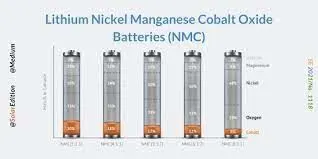
Reaction of Lithium Manganese Cobalt Oxide BATTERIES :
During Discharge
At the anode, lithium is oxidised.Lithium ions are released from the carbon, along with electrons:
LiC6 ==> xLi+ + xe- + C6
At the cathode, lithium-ions are absorbed by the lithium dioxide, and the electrode is reduced as it also receives the electrons from the circuit:
Li1-xMO2 + xLi+ + xe- ==> LiMO2
The overall reaction is :
Li1-xMO2 + LiC6 <==> Li1-xMO2 + C6
4. LFP - Lithium Iron Phosphate(LiFePO4) :
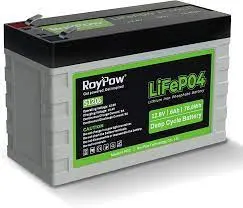
This cell discharges at a high rate, and because phosphate (PO), which can withstand high temperatures, has superior thermal stability, the battery's safety is increased. Because of this, it is a suitable option for storing energy at power plants as well as for things like electric vehicles and power equipment. It may also be discharged and recharged numerous times because to its high cycle life. Though it has a higher self-discharge rate and a lower energy density than a lithium cobalt oxide cell.
Comparable to a lithium cobalt oxide cell is a lithium iron phosphate battery cell. The electrolyte and anode are both still made of graphite. The lithium iron phosphate cathode, which is more stable, has been used in place of the lithium cobalt dioxide cathode. A fully charged cell's iron phosphate (FePO4) cathode actually contains no lithium or iron ions.
Without significantly changing the iron phosphate framework, the lithium ions can intercalate into or out of the cathode material through clearly defined tunnels in its structure.
Reaction of Lithium Iron Phosphate BATTERIES :
During Discharge
At the anode, lithium is oxidised.Lithium ions are released from the carbon, along with electrons:
LiC6 ==> xLi+ + xe- + C6
At the cathode, lithium-ions are absorbed by the lithium dioxide, and the electrode is reduced as it also receives the electrons from the circuit:
LiFe(III)PO4 + xLi+ + xe- ==> LiFe(II)PO4
FePO4 + Li+ + e- ==> LiFePO4
The overall reaction is :
LiFePO4 + 6C ==> LiC6 + FePO4
5. NCA - Lithium Nickel Cobalt Aluminum Oxide (LiNiCoAlO2) :
Since 1999, lithium nickel cobalt aluminium oxide batteries, or NCAs, have been used for specialised purposes. It has high specific energy, decent specific power, and a long life duration, which are parallels to NMC. Cost and safety are less appealing. Lithium nickel oxide has been developed further into NCA, which adds aluminium to make the chemical more stable.
NCA is a potential choice for EV powertrains because of its high energy and power densities and long lifespan. Low safety and high expense are drawbacks.
Reaction of Lithium Nickel Cobalt Aluminum Oxide BATTERIES :
During Discharge
At the anode, lithium is oxidised.Lithium ions are released from the carbon, along with electrons:
LiC6 ==> xLi+ + xe- + C6
At the cathode, lithium-ions are absorbed by the lithium dioxide, and the electrode is reduced as it also receives the electrons from the circuit:
Li1-xMO2 + xLi+ + xe- ==> LiMO2
The overall reaction is :
Li1-xMO2 + LiC6 <==> Li1-xMO2 + C6
6. LTO - Lithium Titanate (Li2TiO3) :
Since the 1980s, lithium titanate anodes have been used in batteries. In the anode of a conventional lithium-ion battery, lithium titanate takes the role of graphite and crystallises into a spinel structure. Lithium manganese oxide or NMC can be used as the cathode. Li-titanate batteries deliver a high discharge current of 10C, or 10 times the rated capacity, and have a nominal cell voltage of 2.40V. They can also be quickly charged. It is claimed that the cycle count is higher than that of a typical Li-ion. Li-titanate is secure, exhibits outstanding low-temperature discharge properties, and achieves an 80 percent capacity at -30°C (-22°F).
When fast charging and charging at low temperatures, LTO (commonly known as Li4Ti5O12) has benefits over the traditional cobalt-blended Li-ion with graphite anode in that it achieves zero-strain property, prevents SEI film formation, and prevents lithium plating. The battery is pricey, but it also has higher thermal stability at high temperatures than conventional Li-ion systems.
Reaction of Lithium Titanate BATTERIES :
During Discharge
At the anode, lithium is oxidised.Lithium ions are released from the carbon, along with electrons:
Li4Ti5O12 ==> Ti5O12 + 4Li+ + 4e-
At the cathode, lithium-ions are absorbed by the lithium dioxide, and the electrode is reduced as it also receives the electrons from the circuit:
4Mn2O4 + 4Li+ + 4e- ==> 4LiMn2O4
The overall reaction is :
Li4Ti5O12 + 4Mn2O4 <==> 4LiMn2O4 + Ti5O12
Table :
|
Sr. |
Battery type |
Electrode material |
Chemical reactions |
|
1. |
LCO |
Cathode: Lithium Cobalt Oxide (LiCoO2) Anode: Graphite |
At anode: LiC6 → Li+ + e- + Co At cathode: CoO2 + Li+ + e-→LICO2 Complete: LiC6+ CoO2→C6 + LiCoO2 |
|
2 |
LMO |
Cathode: Lithium Manganese Oxide (LiMn204) Anode: Graphite |
At anode: LiC6→ Li+ + e- + C6 At cathode: Mn2O4 + Li+ + e-→LiMn2O4 Complete: LiC6 + Mn2O4 → C6 + LiMn2O4 |
|
3 |
NCA |
Cathode: Lithium Nickel Cobalt Aluminium Oxide (LiNiCoAlO2) Anode: Graphite |
At anode: LiC6 → Li+ + e- + C6 At cathode: NiCoAlO2 + Li+ + e- → LiNiCOALO2 Complete: LiC6 + NiCoAlO2→C6 + LiNiCoAlO2 |
|
4 |
NMC |
Cathode: Lithium Nickel Manganese Cobalt Oxide (LiNiMnC002) Anode: Graphite |
At anode: LiC6→Li+ e- + C6 At cathode: NiMnCoO2 + Li+ +e- → LiNiMnCO2 Complete: LiC6 + NiMnCO2→ C6 + LiNiMnCoO2 |
|
5 |
LFP |
Cathode: Lithium Iron Phosphate (LiFePO4) Anode: Graphite |
At anode: LiC6 → Li+ + e- + Co6 At cathod: FePO4 + Li+ + e- LiFePO4
Complete: LiC6 + FePO4 → Co + LiFePO4 |
|
6 |
LTO |
Cathode: Lithium Manganese oxide (LiMn204) Anode: Lithium Titanate (Li2TiO3) |
At anode: LizTiO3 → TiO3 + 2Li+ + 2e At cathode: Mn204 + 2Li* + 2e- → LiMn204 Complete: LiTiO3 + 2Mn204 → 2LiMn204 + TiO3 |
Q.2
Compare the differences between each type of Li+ion batteries based on their characteristics
| Li-ion types | LCO | LMO | NMC | LFP | NCA | LTO |
| Chemical name | LiCoO2 | LiMn2O4 | LiNiMnCoO2 | LiFePO4 | LiNiCoAlO2 | Li2TiO3 |
| Full form | Lithium Cobalt Oxide | Lithium Manganese Oxide | Lithium Nickel Manganese Cobalt Oxide | Lithium Iron Phosphate | Lithium Nickel Cobalt Aluminum Oxide | Lithium Titanate |
| Anode Material | graphite | graphite | graphite | graphite | graphite | Li2TiO3 (titanate) |
| Cathode Material | LiCoO2 (~60% Co) | LiMn2O4 | LiNiMnCoO2 | LiFePO4 | LiNiCoAlO2 (~9% Co) | Cathode can be lithium manganese oxide or NMC |
| Anode Reaction(Discharge) | LiC6 ==> xLi+ + xe- + C6 | LiC6 ==> xLi+ + xe- + C6 | LiC6 ==> xLi+ + xe- + C6 | LiC6 ==> xLi+ + xe- + C6 | LiC6 ==> xLi+ + xe- + C6 | LiC6 ==> xLi+ + xe- + C6 |
| Cathode Reaction(Discharge) | Li1-xCoO2 + xLi+ + xe- ==> LiCoO2 | Li1-xMn2O4 + xLi+ + xe- ==> LiMnO2 | Li1-xMO2 + xLi+ + xe- ==> LiMO2 | LiFe(III)PO4 + xLi+ + xe- ==> LiFe(II)PO4 | Li1-xMO2 + xLi+ + xe- ==> LiMO2 | 4Mn2O4 + 4Li+ + 4e- ==> 4LiMn2O4 |
| Overall Reaction | C6 + LiCoO2 <==> LixC6 + Li1-xCoO2 | LiC6 + Mn2O4 <==>C6 + LiMnO2 | Li1-xMO2 + LiC6 <==> Li1-xMO2 + C6 | LiFePO4 + 6C ==> LiC6 + FePO4 | Li1-xMO2 + LiC6 <==> Li1-xMO2 + C6 | Li4Ti5O12 + 4Mn2O4 <==> 4LiMn2O4 + Ti5O12 |
| Electrolyte | Ethylene Carbonate | Lithium Halide | Lithium Salt | Ethylene Carbonate | Ethylene Carbonate | Lithium Salt |
| Seperator | Polyolefin | Polyolefin | Polyolefin | Polyolefin | Polyolefin | Polyolefin |
| Nominal Voltage & Operating Range | 3.60V nominal; typical operating range 3.0–4.2V/cell | 3.70V (3.80V) nominal; typical operating range 3.0–4.2V/cell | 3.60V, 3.70V nominal; typical operating range 3.0–4.2V/cell, or higher | 3.20, 3.30V nominal; typical operating range 2.5–3.65V/cell | 3.60V nominal; typical operating range 3.0–4.2V/cell | 2.40V nominal; typical operating range 1.8–2.85V/cell |
| Energy Capacity | 150–200Wh/kg. Specialty cells provide up to 240Wh/kg | 100–150Wh/kg | 150–220Wh/kg | 90–120Wh/kg | 200-260Wh/kg; 300Wh/kg predictable | 50–80Wh/kg |
| Life Cycle (related to depth of discharge, load, temperature) | 500-1000 | 300-700 | 1000-2000 | 2000 & higher | 500 | 3000-7000 |
| Thermal Runaway(Full charge promotes thermal runaway) | 150°C (302°F). | 250°C (482°F) typical | 210°C (410°F) typical | 270°C (518°F) | 150°C (302°F) typical | One of safest Li-ion batteries |
| Charge (C-rate) | 0.7–1C, charges to 4.20V (most cells); 3h charge typical. Charge current above 1C shortens battery life. | 0.7–1C typical, 3C maximum, charges to 4.20V (most cells) | 0.7–1C, charges to 4.20V, some go to 4.30V; 3h charge typical. Charge current above 1C shortens battery life. | 1C typical, charges to 3.65V; 3h charge time typical | 0.7C, charges to 4.20V (most cells), 3h charge typical, fast charge possible with some cells | 1C typical; 5C maximum, charges to 2.85V |
| Discharge (C-rate) | 1C; 2.50V cut off. Discharge current above 1C shortens battery life. | 1C; 10C possible with some cells, 30C pulse (5s), 2.50V cut-off | 1C; 2C possible on some cells; 2.50V cut-off | 1C, 25C on some cells; 40A pulse (2s); 2.50V cut-off (lower that 2V causes damage) |
1C typical; 3.00V cut-off; high discharge rate shortens battery life | 10C possible, 30C 5s pulse; 1.80V cut-off on LCO/LTO |
| Applications | Mobile phones, tablets, laptops, cameras | Power tools, medical devices, electric powertrains | E-bikes, medical devices, EVs, industrial | Portable and stationary needing high load currents and endurance | Applications Medical devices, industrial, electric powertrain (Tesla) | UPS, electric powertrain (Mitsubishi i-MiEV, Honda Fit EV), solar-powered street lighting |
| Comments | Very high specific energy, limited specific power. Cobalt is expensive. Serves as Energy Cell. Market share has stabilized. | High power but less capacity; safer than Li-cobalt; commonly mixed with NMC to improve performance. |
Provides high capacity and high power. Serves as Hybrid Cell. Favorite chemistry for many uses; market share is increasing. |
Very flat voltage discharge curve but low capacity. One of safest Li-ions. Used for special markets. Elevated self-discharge. |
Shares similarities with Li-cobalt. Serves as Energy Cell. | Long life, fast charge, wide temperature range but low specific energy and expensive. Among safest Li-ion batteries . |
Typical specific energy of lead-, nickel- and lithium-based batteries.
>> Structure of Li-ion batteries