Week 1 Understanding Different Battery Chemistry
Week 1 Understanding Different Battery Chemistry
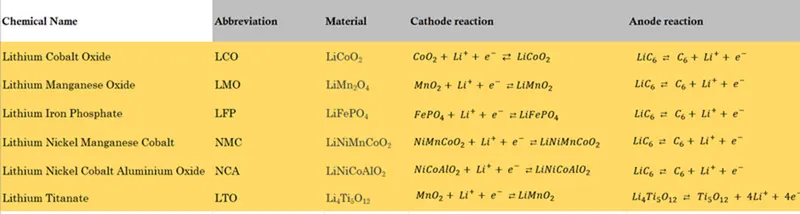
1.Prepare a table which includes materials & chemical reactions occurring at the anode and cathode of LCO, LMO, NCA, NMC, LFP and LTO type of lithium ion cells. Give your detailed explanation on it
2.Compare the differences between each type of Li+ion batteries based on their characteristics
Answer: -
Introduction:
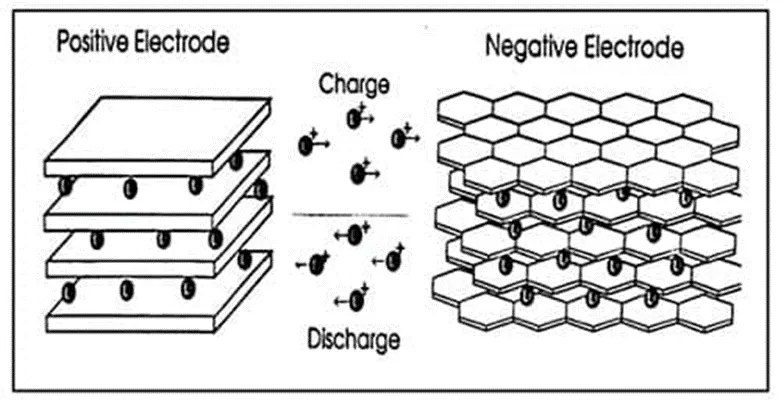
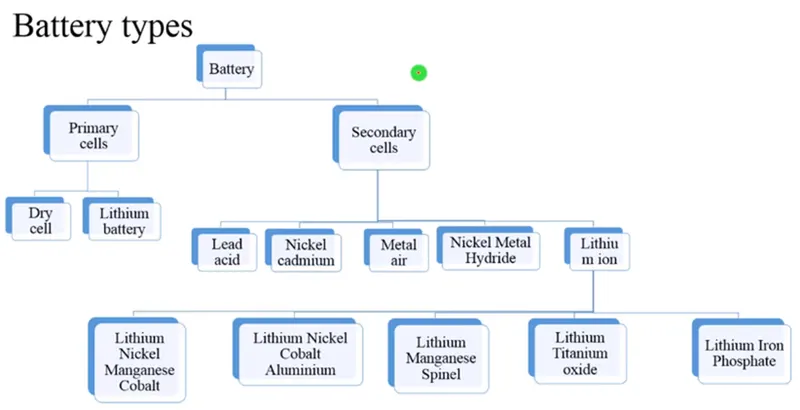
Lithium-ion Cells are a secondary type of battery cell that is they are rechargeable and also, they are reusable which makes them ideally suited for automotive applications and certain consumer electronics When two or more cells connected, they are referred to as batteries Like other batteries Lithium-ion batteries also rely on the chemical energy stored in the bonds and atoms of elements and compounds and utilize this energy in a chemical reaction occurring inside the cell. The chemical energy from this reaction is converted to electrical energy and it is used. Since the Lithium-ion cells are rechargeable, they can perform the reverse reaction using electricity as well
Electrolyte: -
The electrolyte is an ionic conductor that provides the medium for internal ionic charge transfer between the electrodes
The electrolyte must often comprise a liquid solvent containing dissolved chemicals the solution that provides the ionic conductivity
The Lithium-ion cels use non-aqueous electrolytes
Cathode and Anode: -
The Cathode ad Anoide is the two electrodes that are connected by a wire in an external circuit The electrons are passing through the external wire and so an electric current is perorated
The Anode refers to the Electrode through which the conventional current enters into a polarized electrical device.
The Cathode refers to the electrode through which conventional current leaves an electrical device.
Separator: -
The Separator physically isolates the positive and negative electrodes. The separator is an ionic conductor but an electronic insulator
It prevents the internal short-circuiting between the two electrodes
Advantage of Li-iron Battery: -
-As mentioned it has a high energy density which is two times compare to Ni-Cd.
-The Lithium-Ion battery is rechargeable.
-There is no memory effect. Hence it is not needed to discharge them completely before recharging.
-The battery can handle many charge/discharge cycles.
Disadvantage of Li-iron Battery: -
-It lasts only two to three years after the manufacturer.
-It is sensitive to high temperatures.
-If the battery is completely discharged, it can no longer be recharged again.
-If the "separator" gets damaged, it can burst into flames
Ii-iron Battery table
2.Compare the differences between each type of Li+ion batteries based on their characteristics
Answer:-
Type of Battery: -
Compare the li-iron battery
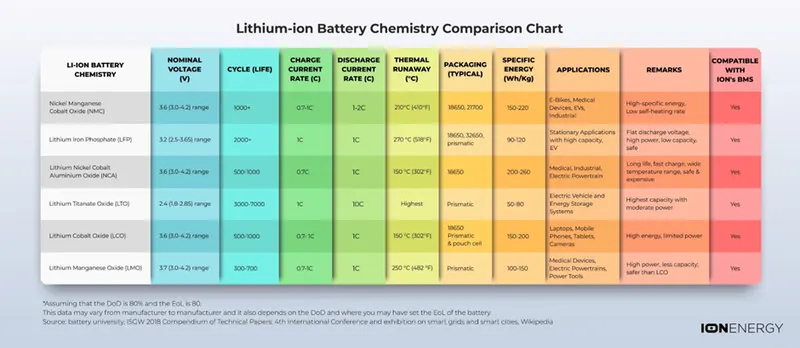
lithium Cobalt Oxide has high specific energy compared to the other batteries, making it the preferred choice for laptops and mobile phones. It also has a low cost and a moderate performance. However, it is highly unfavourable in all the other aspects when compared to the other lithium-ion batteries. It has low specific power, low safety, and a low lifespan.
Lithium Manganese Oxide has moderate specific power, moderate specific energy, and a moderate level of safety when compared to the other types of lithium-ion batteries. It has the added advantage of a low cost. The downsides are its low performance and low lifespan. It is usually used in medical devices and power tools.
Lithium Nickel Manganese Cobalt Oxide has two major advantages as compared to the other batteries. The first one is its high specific energy, which makes it desirable in electric powertrains, electric vehicles, and electric bikes. The other is its low cost. It is moderate in terms of specific power, safety, lifespan, and performance when compared to the other lithium-ion batteries. It can be optimized to either have high specific power or high specific energy.
Lithium Iron Phosphate only has one major disadvantage when compared to other types of lithium-ion batteries, and that is its low specific energy. Other than that, it has moderate to high ratings in all the other characteristics. It has high specific power, offers a high level of safety, has a high lifespan, and comes at a low cost. The performance of this battery is also moderate. It is often employed in electric motorcycles and other applications that require a long lifespan and a high level of safety.
Lithium Nickel Cobalt Aluminium Oxide offers one strong advantage compared to the five other batteries: high specific energy. It is pretty moderate in the rest of the characteristics like performance, cost, specific power, and lifespan. The only downside to this battery type is its low level of safety. Its high specific energy and moderate lifespan make it a good candidate for electric powertrains.
Lithium Titanate offers high safety, high performance, and a high lifespan which are very important features every battery should have. Its specific energy is low compared to the five other lithium-ion batteries, but it compensates for this with moderate specific power. The only major disadvantage of lithium titanate as compared to the other lithium-ion batteries is its extremely high cost. Another important feature of this battery worthy of mention is its remarkably fast recharge time. It can be used for storing solar energy and creating smart grids.