Week 1 Understanding Different Battery Chemistry
1.Prepare a table which includes materials & chemical reactions occurring at the anode and cathode of LCO, LMO, NCA, NMC, LFP and LTO type of lithium ion cells. Give your detailed explanation on it
Lithium-ion (Li-ion) cells are a type of rechargeable battery that have become the standard for many portable and high-power applications due to their high energy density, long cycle life, and relatively low self-discharge rate. These cells work by moving lithium ions between the anode and cathode during charging and discharging cycles. There are several types of lithium-ion cells, classified by the materials used in the cathode and anode. Each type has different characteristics, making it suitable for specific applications.
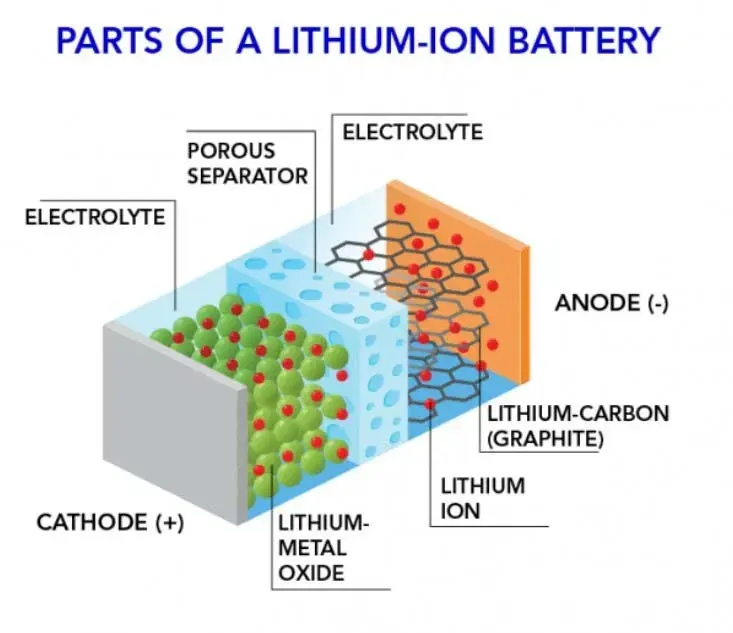
General Components of Lithium-Ion Cells
1. Anode: Usually made from graphite, but some chemistries (like LTO) use lithium titanate. During charging, lithium ions are stored in the anode.
2. Cathode: Made from different materials depending on the type of cell, such as lithium cobalt oxide (LCO), lithium iron phosphate (LFP), etc.
3. Electrolyte: Facilitates the movement of lithium ions between the anode and cathode.
Separator: A thin layer that separates the anode and cathode, preventing short circuits while allowing ion flow.
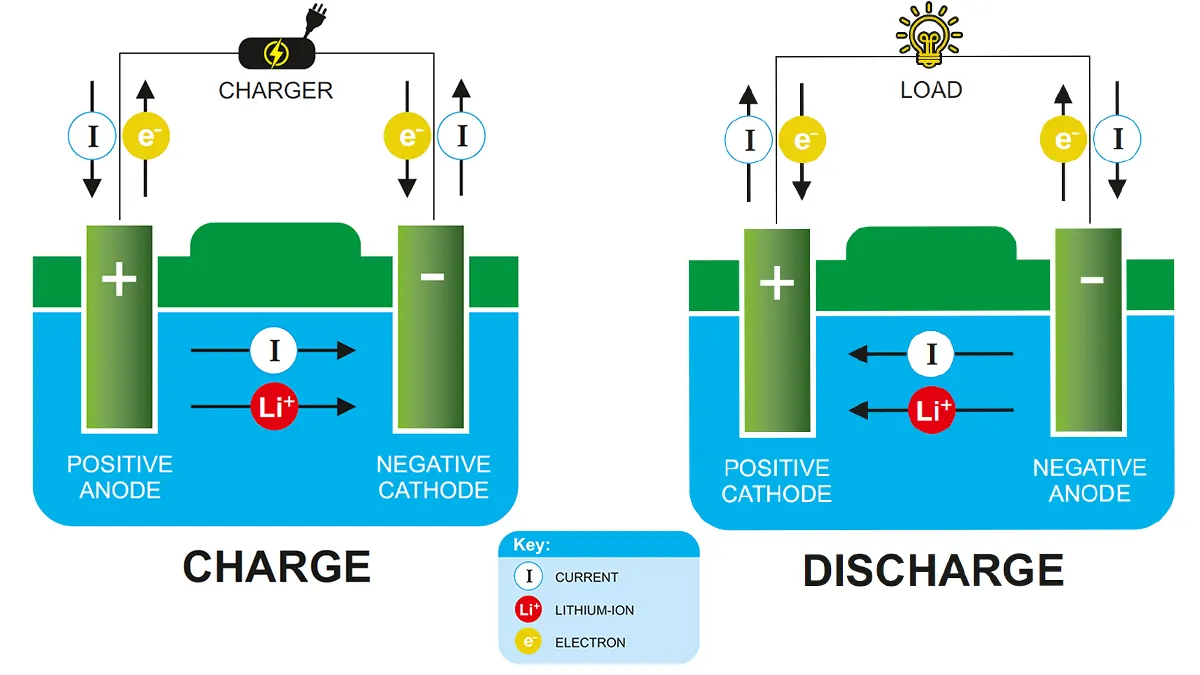
Battery Charging and Discharging reactions
here the movement of electrons are visible during charging and Discharging.
| Battery Type | Cathode Material | Anode Material | Cathode Reaction (Discharge) | Anode Reaction (Discharge) |
|---|---|---|---|---|
| LCO | Lithium Cobalt Oxide (LiCoO₂) | Graphite | LiCoO₂ → Li₁₋ₓCoO₂ + xLi⁺ + xe⁻ | xLi⁺ + xe⁻ + C₆ → LixC₆ |
| LMO | Lithium Manganese Oxide (LiMn₂O₄) | Graphite | LiMn₂O₄ → Li₁₋ₓMn₂O₄ + xLi⁺ + xe⁻ | xLi⁺ + xe⁻ + C₆ → LixC₆ |
| NCA | Nickel Cobalt Aluminum Oxide (LiNi₀.₈Co₀.₁₅Al₀.₀₅O₂) | Graphite | LiNi₀.₈Co₀.₁₅Al₀.₀₅O₂ → Li₁₋ₓNi₀.₈Co₀.₁₅Al₀.₀₅O₂ + xLi⁺ + xe⁻ | xLi⁺ + xe⁻ + C₆ → LixC₆ |
| NMC | Nickel Manganese Cobalt Oxide (LiNi₁/₃Mn₁/₃Co₁/₃O₂) | Graphite | LiNi₁/₃Mn₁/₃Co₁/₃O₂ → Li₁₋ₓNi₁/₃Mn₁/₃Co₁/₃O₂ + xLi⁺ + xe⁻ | xLi⁺ + xe⁻ + C₆ → LixC₆ |
| LFP | Lithium Iron Phosphate (LiFePO₄) | Graphite | LiFePO₄ → FePO₄ + Li⁺ + e⁻ | xLi⁺ + xe⁻ + C₆ → LixC₆ |
| LTO | Lithium Titanate Oxide (Li₄Ti₅O₁₂) | Lithium Titanate Oxide | Li4Ti5O12 + 4Li+ + 4e- -> 4Li + Ti5O12 | Li₄Ti₅O₁₂ + xLi⁺ + xe⁻ → Li₄₊ₓTi₅O₁₂ |
Lithium Cobalt Oxide(LiCoO2) — LCO
The battery consists of a cobalt oxide cathode and a graphite carbon anode. The cathode has a layered structure and during discharge, lithium ions move from the anode to the cathode. The flow reverses on charge. The drawback of Li-cobalt is a relatively short life span, low thermal stability and limited load capabilities (specific power).
Lithium Manganese Oxide (LiMn2O4) — LMO
Li-manganese has a capacity that is roughly one-third lower than Li-cobalt. Design flexibility allows engineers to maximize the battery for either optimal longevity (life span), maximum load current (specific power) or high capacity (specific energy).
Lithium Nickel Cobalt Aluminum Oxide (LiNiCoAlO2) — NCA
Lithium nickel cobalt aluminum oxide (NCA) batteries offer high specific energy with decent specific power and a long lifecycle. This means they can deliver a relatively high amount of current for extended periods.
Lithium Nickel Manganese Cobalt Oxide (LiNiMnCoO2) —NMC
NMCLithium nickel manganese cobalt oxide (NMC) batteries combine the benefits of the three main elements used in the cathode: nickel, manganese, and cobalt. Nickel on its own has high specific energy but is not stable. Manganese is exceptionally stable but has a low specific energy. Combining them yields a stable chemistry with a high specific energy.
Lithium Iron Phosphate(LiFePO4) — LFP
Lithium iron phosphate (LFP) batteries use phosphate as the cathode material and a graphitic carbon electrode as the anode. LFP batteries have a long life cycle with good thermal stability and electrochemical performance.
Lithium Titanate (Li2TiO3) — LTO
Li-titanate replaces the graphite in the anode of a typical lithium-ion battery and the material forms into a spinel structure. The cathode can be lithium manganese oxide or NMC. Li-titanate has a nominal cell voltage of 2.40V, can be fast charged and delivers a high discharge current of 10C, or 10 times the rated capacity.
2.Compare the differences between each type of Li+ion batteries based on their characteristics
| Battery Type | Nominal Voltage (V) | Energy Density (Wh/kg) | Cycle Life | Operating Temperature (°C) | Applications |
|---|---|---|---|---|---|
| LCO (Lithium Cobalt Oxide) | 3.7 | 150-200 | 500-1000 | 0 to 45 | Consumer electronics (smartphones, laptops) |
| LMO (Lithium Manganese Oxide) | 3.7 | 100-150 | 300-700 | -20 to 55 | Power tools, EVs, medical devices |
| NCA (Nickel Cobalt Aluminum Oxide) | 3.6-3.7 | 200-250 | 500-1000 | -20 to 55 | Electric vehicles, industrial equipment, medical devices |
| NMC (Nickel Manganese Cobalt Oxide) | 3.6-3.7 | 150-220 | 1000-2000 | -20 to 55 | Electric vehicles, energy storage systems |
| LFP (Lithium Iron Phosphate) | 3.2-3.4 | 90-160 | 2000-4000 | -20 to 60 | Electric buses, energy storage, power tools |
| LTO (Lithium Titanate Oxide) | 2.3-2.4 | 70-100 | 70000-10000 | -30 to 55 | Grid storage, fast-charging EVs, military applications |
References:
https://batteryuniversity.com/article/bu-205-types-of-lithium-ion
https://dragonflyenergy.com/types-of-lithium-batteries-guide/