Week 1 Understanding Different Battery Chemistry
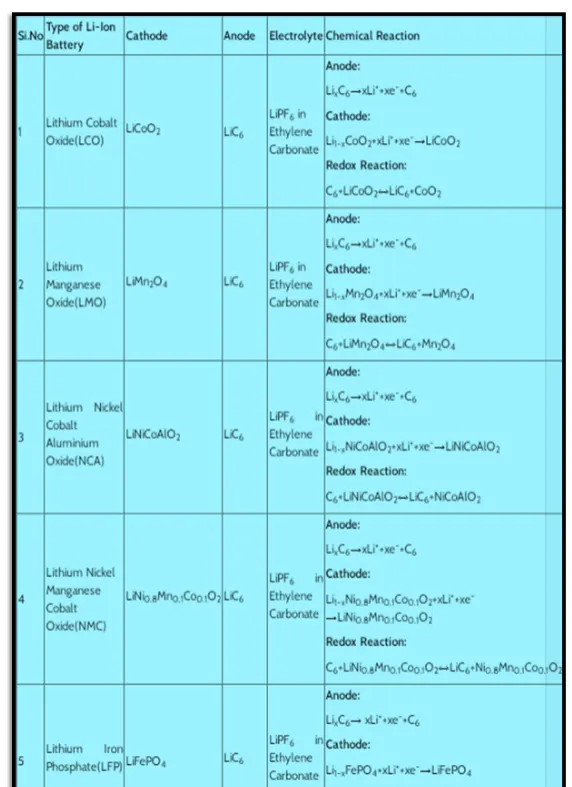
1.Prepare a table that includes materials & chemical reactions occurring at the
anode and cathode of LCO, LMO, NCA, NMC, LFP and LTO type of lithium-ion
cells. Give your detailed explanation on it
Introduction:
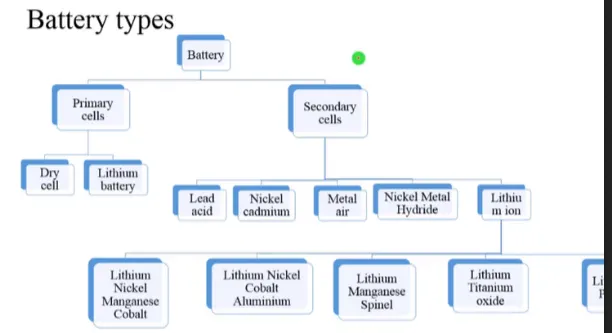
Lithium-ion Cells are a secondary type of battery cell that is they are rechargeable and
also they are reusable which makes them ideally suited for automotive applications and
certain consumer electronics When two or more cells connected they are referred to as
batteries Like other batteries Lithium-ion batteries also rely on the chemical energy
stored in the bonds and atoms of elements and compounds and utilize this energy in a
chemical reaction occurring inside the cell. The chemical energy from this reaction is
converted to electrical energy and it is used. Since the Lithium-ion cells are
rechargeable, they can perform the reverse reaction using electricity as well
Construction:
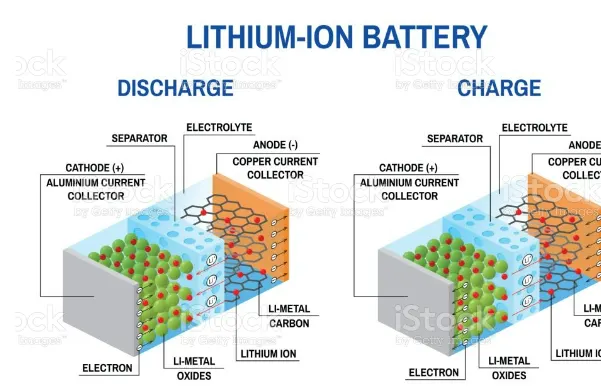
Electrolyte
The electrolyte is an ionic conductor that provides the medium for internal ionic
charge transfer between the electrodes
The electrolyte must often comprise a liquid solvent containing dissolved
chemicals the solution that provides the ionic conductivity
The Lithium-ion cels use non-aqueous electrolytes
Cathode and Anode
The Cathode ad Anoide is the two electrodes that are connected by a wire in an
external circuit The electrons are passing through the external wire and so an
electric current is perorated
The Anode refers to the Electrode through which the conventional current enters
into a polarized electrical device.
The Cathode refers to the electrode through which conventional current leaves
an electrical device.
Separator
a. The Separator physically isolates the positive and negative electrodes. The
separator is an ionic conductor but an electronic insulator
b. It prevents the internal short-circuiting between the two electrodes
Current Collectors:
• The current collectors are the electronic conductors with which the electrodes are
mixed It does not take part in chemical reactions of the cell but instead, it either allows
simple electronic connection to reduce the electronic resistance of an electrode
advantages of Lithium-Ion Battery
Following are the benefits or advantages of Lithium-Ion batteries:
➨As mentioned it has a high energy density which is two times compare to Ni-Cd.
➨The Lithium-Ion battery is rechargeable.
➨There is no memory effect. Hence it is not needed to discharge them completely
before recharging.
➨The battery can handle many charge/discharge cycles.
➨The battery can hold the charge and it can lose only 5% of its charge every month.
disadvantages of Lithium-Ion Battery
Following are the disadvantages of Lithium-Ion Battery:
➨It lasts only two to three years after the manufacturer.
➨It is sensitive to high temperatures.
➨If the battery is completely discharged, it can no longer be recharged again.
➨It is relatively expensive.
➨If the "separator" gets damaged, it can burst into flames.
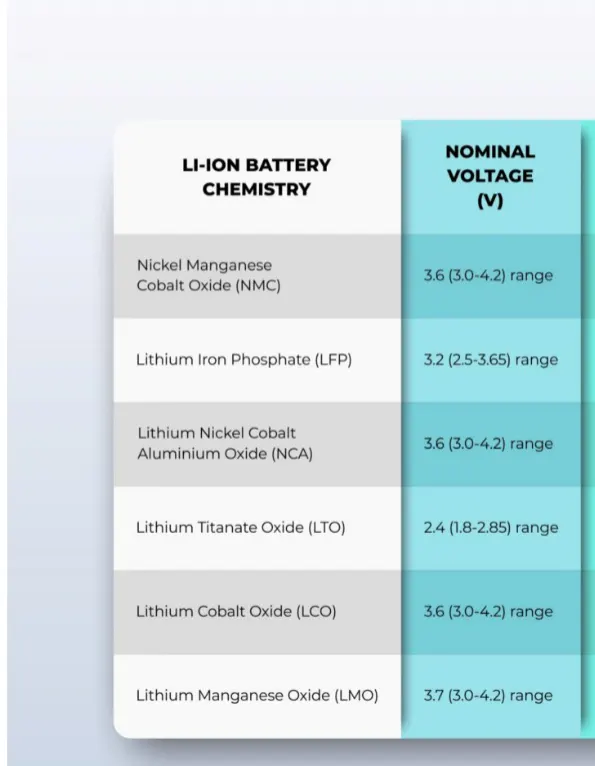
2.Compare the differences between each type of Li-ion battery based on their
characteristics
2 DIFFERENT TYPES OF LITHIUM-ION BATTERIES
2.1 LITHIUM COBALT OXIDE (LCO)
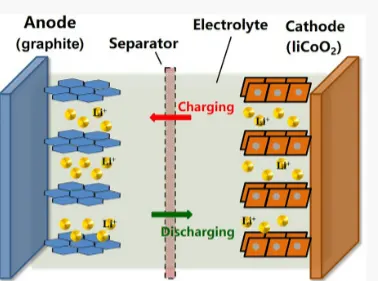
Also known as lithium cobaltate or lithium-ion cobalt batteries, lithium cobalt oxide
batteries are made from t lithium carbonate and cobalt. Due to their very high specific
energy, these batteries are used for cell phones. laptops and electronic cameras. They
have a cobalt oxide cathode and use graphite carbon as their anode material: during
discharge, lithium ions move from anode to cathode with the flow reversing when the
battery is charging
This type of battery has some drawbacks, including relatively short battery life and
limited specific power. Additionally. Battery University notes that these batteries are not
as safe as other types, Even so, their characteristics make them the popular choice for
coll phones and other portable electronic devices
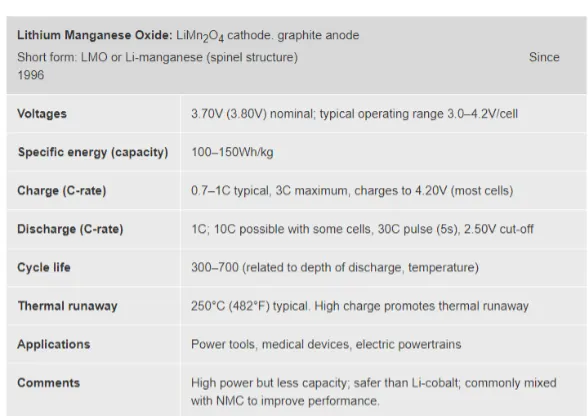
2.2 LITHIUM MANGANESE OXIDE (LMO)
Lithium manganese oxide batteries are also commonly called lithium manganate or
lithium-ion manganese batteries and are sometimes referred to as l-manganese or
manganese spinel The technology for this type of battery was discovered in the 1980s
with the first publication on the subject appearing in the Materials Research Bulletin in
1983. The first commercial lithium-ion cells made with lithium manganese oxide as a
cathode material were produced in 1996 by Mol Energy.
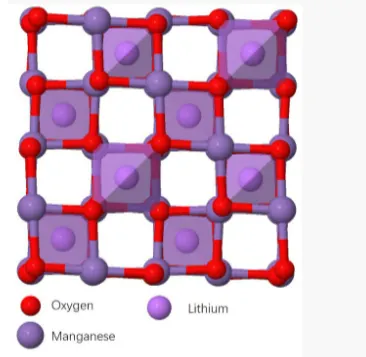
Lithium manganese oxide batteries are notable for their high-temperature stability and
are also safer than other lithium-ion battery types. For this reason, they are often used
in medical equipment and devices, but they may also be lithium-ion battery types. For
this reason, they are often used in medical equipment and devices, but they may also
be used for power tools, electric bikes and more. It is also possible to use lithium
manganese oxide batteries to power laptops and electric powertrain cars
The architecture forms a three-dimensional spinel structure that improves ion flow on
the electrode, which results in lower internal resistance and improved current handling.
A further advantage of spinel is high thermal stability and enhanced safety, but the cycle
and calendar life is limited.
Low internal cell resistance enables fast charging and high current discharging in a
18650 package. L manganese can be discharged at currents of 20-30A with moderate
heat buildup. It is also possible to apply one-second load pulses of up to 50A. A
continuous high lead at this current would cause heat buildup and the cell temperature
cannot exceed 80 C 1176 -manganese is used for power tools medical instruments, as
well as hybrid and electric vehicles.
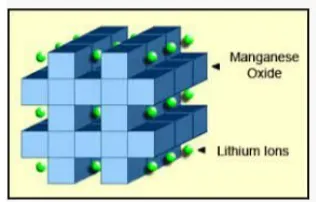
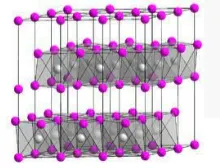
The figure illustrates the formation of a three-dimensional crystalline framework on the
cathode of a Li-manganese battery. This spinel structure, which is usually composed of
diamond shapes connected into a lattice appears after the initial information
The cathode crystalline formation of lithium manganese oxide has a three-dimensional
framework structure that appears after initial formation Spinel provides low resistance
but has a more moderate specific energy than cobalt.
U-manganese has a capacity that is roughly one-third lower than Li-cobalt. Design
flexibility allows engineers to maximize the battery for either optimal longevity (life
span), maximum load current (specific power) or high capacity (specific energy). For
example, the long-le version in the 18650 cells has a moderate capacity of only
1100mAh: the high-capacity version is 1500mAh
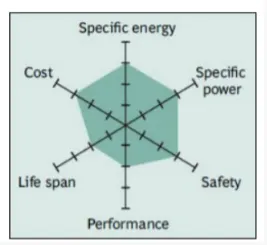
The figure shows the spider web of a typical Li-manganese battery. The characteristics
appear marginal but newer designs have improved in terms of specific power, safety
and life span. Pure Li-manganese batteries are no longer common today, they may only
be used for special applications.
Although moderate in overall performance, newer designs of Li-manganese offer
improvements in specific power, safety and life span
Most U-manganese batteries blend with lithium nickel manganese cobalt oxide (NMC)
to improve the specific energy and prolong the life span. This combination brings out the
best in each system, and the LMO (NMC) is chosen for most electric vehicles, such as
the Nissan Leaf. Chevy Volt and BMW 3. The LMO part of the battery which can be
about 30 per cent, provides a high current boost on acceleration the NMC part gives the
Li-ion research gravitates heavily towards combining Li-manganese with cobalt-nickel
manganese and aluminium as active cathode material in some architecture, a small
amount of silicon is added to the anode This provides a 25 per cent capacity boost,
however, the gain is commonly connected with a shorter cycle life as scan grows and
shrinks with charge and discharge causing mechanical stress
These three active metals, as well as the Alcon enhancement, can conveniently be
chosen to enhance the specific energy capacity), specific power load capability or
longevity While consumer batteries go for high capacity industrial applications prepare
battery systems that have good loading capable der a long life and provide sale and
dependable service
2.3 LITHIUM IRON PHOSPHATE (LIPO)
Lithium on phosphate batteries also known as li-phosphate batteries use phosphate as
a cathode They benefit from low resistance properties, which enhance their safety and
thermal stability
Other benefits include durability and a long Mecycle-fully charged batteries can be
stored with little change to the total Mespan of the battery's charge L-phosphate
batteries are often the most cost-effective option as well when their long battery life is
taken into consideration.
However, the lower voltage of the hi-phosphate battery means that it has less energy
than other types of lithium batteries Accordingly these batteries are often used in
electric motorcycles as well as other applications that need a long lifecycle and
significant safety Electric vehicles often use these batteries as well
Li-phosphate is more tolerant to full charge conditions and is less stressed than other
lithium-ion systems of kept at high voltage for a prolonged time As a trade-off, its lower
nominal voltage of 3. Zell reduces the species energy below that of cobalt blended
thumb With most batteries, the cold temperature reduces performance and elevated
storage temperature shorts the service life and Li-phosphate is no exception Li-
phosphate has a higher self-discharge than other Lon batteries which can cause
balancing ones with ageing Tho can be emitted by buying high-quality cells and/or using
sophisticated control electronics, both of which increase the cost of the pack
Cleanliness in manufacturing of importance for long every There is no tolerance for
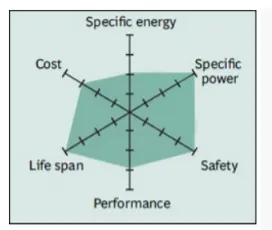
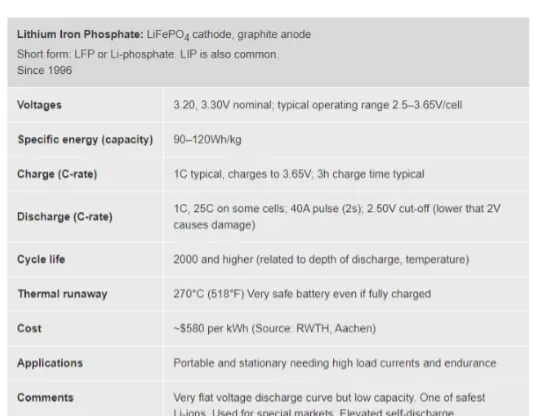
moisture et the battery will only deliver 50 cycles Figa summarizes the attributes of
phosphate.
Li-phosphate is often used to replace the lead-acid starter battery Four cells in series
produce 12.80V, a similar voltage to six 2V lead-acid cells in series Vehicles charge
lead-acid to 14.40V (2:40V/cell) and maintain a toppings charge. Topping charge is
applied to maintain full charge level and prevent sulfation on lead-acid batteries
With four Li-phosphate cells in series each cell tops at 3.60V which is the correct full-
charge voltage. At this point, the charge should be disconnected but the topping charge
continues while driving Li-phosphate is tolerant to some overcharge however, keeping
the voltage at 14.40V for a prolonged time, as most vehicles do on a long road trip could
stress L-phosphate Time will tell how durable Li-Phosphate will be as a lead and
replacement with a regular vehicle charging system Cold temperature also reduces the
performance of Li-ion and this could affect the cranking ability in extreme cases
2.4 LITHIUM MANGANESE COBALT OXIDE (NMC)
Also known as lithium manganese cobalt oxide or NMC batteries, lithium nickel
manganese cobalt oxide batteries are made of several materials common in lithium-ion
battery types. They include a cathode made of a combination of nickel, manganese and
cobalt
Like other lithium-ion battery varieties. NMC batteries can have either a high specific
energy density or a high specific power. They cannot, however, have both properties.
This battery type is most common in power tools and powertrains for vehicles
The cathode combination ratio is usually 60 per cent nickel, 20 per cent manganese and
20 per cent cobalt This means that the raw material cost is lower than it is for other
lithium-ion battery options, as cobalt can be quite expensive. These batteries may come
down in price further in the future, as some battery makers are planning to switch their
battery chemistry to a higher percentage of nickel so that they can use less cobalt. This
battery type is commonly preferred for electric vehicles due to its very low self-heating
rate
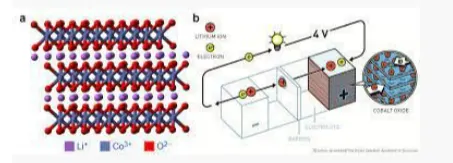
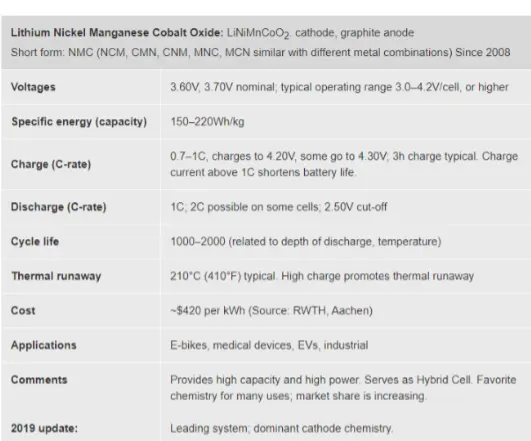
One of the most successful Li-ion systems is a cathode combination of nickel-
manganese-cobalt INMC Similar to L-manganese, these systems can be tailored to
serve as Energy Cells or Power Cells For example. NMC in a 18650 cell for moderate
load condition has a capacity of about 2800mAh and can deliver 4A to 5A: NMC in the
same cell optimized for specific power has a capacity of only about 2.000mAh but
delivers a continuous discharge current of 20A A silicon-based anode will go to
4.000mAh and higher but at reduced loading capability and shorter cycle life Silicon
added to graphite has the drawback that the anode grows and shrinks with charge and
discharge, making the cell mechanically unstable
The secret of NMC lies in combining nickel and manganese. An analogy of this is table
salt in which the main ingredients, sodium and chloride, are toxic on their own but
mixing them serves as seasoning salt and food preserver. Nickel is known for its high
specific energy but poor stability manganese has the benefit of forming a spinel
structure to achieve low internal resistance but offers low specific energy. Combining
the metals enhances each other strengths
NMC is the battery of choice for power tools, e-bikes and other electric powertrains. The
cathode combination is typically one-third nickel, one-third manganese and one-third
cobalt, also known as 1-1-1. Cobalt is expensive and in limited supply. Battery
manufacturers are reducing the cobalt content with some compromise in performance
The figure demonstrates the characteristics of the NMC
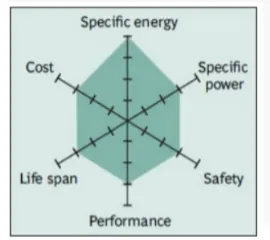
NMC has good overall performance and excels on specific energy. This battery is the
preferred candidate for the electric vehicle and has the lowest self-heating rate
2.5 LITHIUM NICKEL COBALT ALUMINIUM OXIDE (NCA)
Lithium nickel cobalt aluminium oxide batteries are also called NCA batteries and are
becoming increasingly important in electric powertrains and in grid storage.
NCA batteries are not common in the consumer industry but are promising for the
automotive industry NCA batteries provide a high-energy option with a good lifespan,
but they are not as safe as they could be compared to other lithium-ion battery types
and are quite costly. The Boston Consulting Group notes that NCA batteries must be
accompanied in cars by safety measures that monitor their performance and behaviour
to keep drivers secure
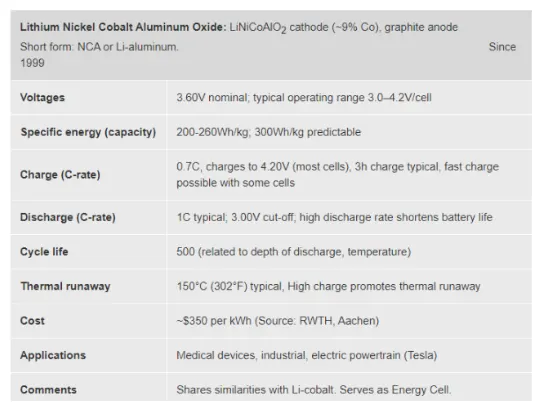
Return nickel cobalt aluminium oxide battery, or NCA, has been around since 1999 for
special applications. It shares similarities with NMC by offering high specific energy,
reasonably good specific power and a long life span Len flattering are safety and cost.
Figure 11 summarizes the six key characteristics NCA is a further development of
lithium nickel oxide adding aluminium gives the chemistry greater stability
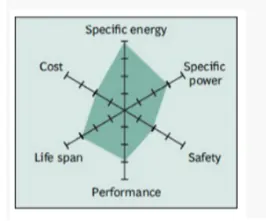
High energy and power densities, as well as good life san male NCA a candidate for EV
powers High and marginal safety, are negatives
2.6 LITHIUM TITANATE OXIDE (LTO)
The advantages of Lithium Titanate Oxide (lithium titanium oxide battery technology are
significant and the whole LTO technology is a game-changer for the entire battery
industry. The LTO is bringing a new dimension of possibilities for energy storage with a
number of economic as well as ecological aspects
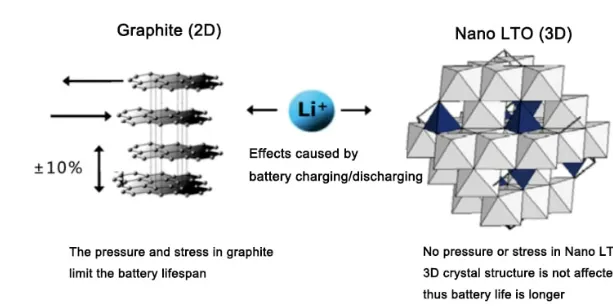
the LTO is a rechargeable battery based on or modified from the Lithium-Ion (Li-ion)
battery technology: titanate oxide (LTO) replaces the graphite in the anode of the typical
Li-ion battery and form the materials into a spinel 3D crystal structure. Having a nominal
cell voltage of 2.40V. it releases high current discharge arent which is 10 times the
capacity of the other types of lithium batteries. Instead of using carbon particles on its
surface as other Lithium batteries do, Lithilan Titanate utilizes lithium-titanate
nanocrystals
Lithium Titanate batteries benefits range from a long lifetime to enhanced safety, low-
temperature performance
and large potential for integration with energy storage solutions L-titanate replaces the
graphite in the anode of a typical lithium-ion battery and the material forms into a spinel
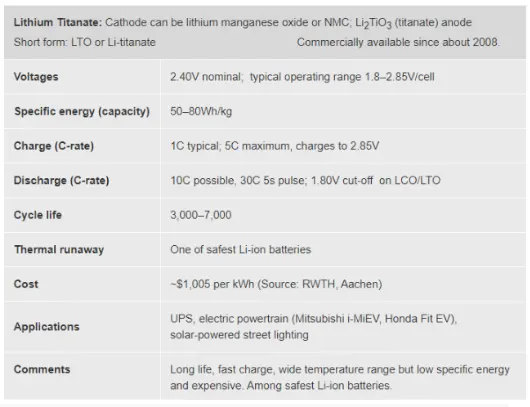
structure. The cathode can be lithium manganese oxide or NMC L-titanate has a normal
cell voltage of 2.40V can be fast-charged and delivers a high discharge current of 10C
or 10 times the rated capacity. The cycle said to be higher than that of a regular on L-
titanate w safe has excellent love temperature discharge characteristics and obtains a
capacity of 80 percentat-30° C(-22° F)
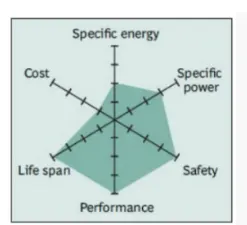
LTO (commonly L4TijOu) has advantages over the conventional cobalt-blended Li-ion
with graphite anode by attaining zero-strain property, no SEI film formation and no
lithium plating when fast charging and charging at low temperature. Thermal stability
under high temperature is also better than other Li-ion systems however, the battery is
expensive. At only 65While the specific energy is low, rivalling that of NiCd Li-titanate
changes to 180V/cell and the end of discharge is 180V/cell Figure illustrates the
characteristics of the U-titanate battery Typical uses are electric powertrains UPS and
solar-powered street lighting.
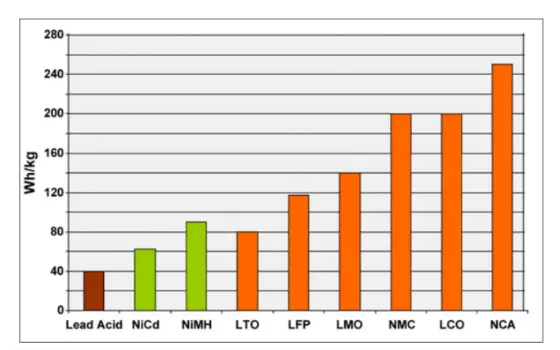
The figure compares the specific energy of lead-, nickel- and lithium-based systems.
While Li-aluminum (NCA) is the clear winner by storing more capacity than other
systems, this only applies to specific energy in terms of specific power and thermal
stability, Li-manganese (LMO) and Li-phosphate (LFP) are superior, Li-titanate (LTO)
may have low capacity but this chemistry outlives most other batteries in terms of de
span and also has the best cold temperature performance. Moving towards the electric
powertrain safety and the cycle life will gain dominance overcapacity (LCO stands for Li-
cobalt, the original Li-ion)
CONCLUSION :
In this way, we study the different types of Lithium-ion batteries