Week 1 Understanding Different Battery Chemistry
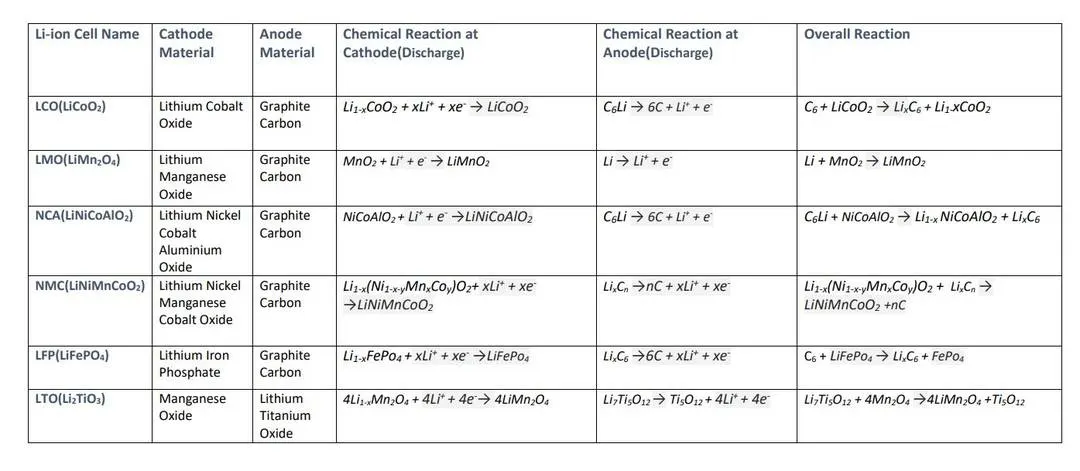
1.Prepare a table which includes materials & chemical reactions occurring at the anode and cathode of LCO, LMO, NCA, NMC, LFP and LTO type of lithium ion cells.Give your detailed explanation on it
What is a lithium-ion battery? What features does it have?
A lithium-ion battery is a type of rechargeable battery that is charged and discharged by lithium ions moving between the negative (anode) and positive (cathode) electrodes. (Generally, batteries that can be charged and discharged repeatedly are called secondary batteries, whereas disposable batteries are called primary batteries.)
Because lithium-ion batteries are suitable for storing high-capacity power, they are used in a wide range of applications, including consumer electronics such as smartphones and PCs, industrial robots, production equipment and automobiles.How do lithium-ion batteries store energy?
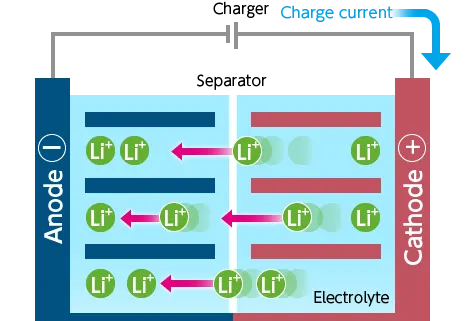
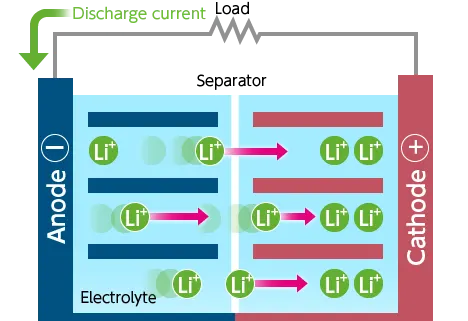
lithium-ion battery is composed of 1) the anode and the cathode; 2) a separator between the two electrodes; and 3) an electrolyte that fills the remaining space of the battery. The anode and cathode are capable of storing lithium ions. Energy is stored and released as lithium ions travel between these electrodes through the electrolyte.
When storing energy (i.e., during charging)
- The charger passes current to the battery.
- Lithium ions move from the cathode to the anode through the electrolyte.
- The battery is charged by a potential difference between the two electrodes.
When using energy (i.e., during discharging)
- A discharge circuit is formed between the anode and the cathode.
- Lithium ions stored in the anode move to the cathode.
- Energy is used.
2.Compare the differences between each type of Li+ion batteries based on their characteristics
It is important to note that the six types of lithium-ion batteries are compared relative to one another.
| Lithium-ion battery Types | SP | SE | SF | LS | CS | PF |
|---|---|---|---|---|---|---|
|
Lithium Cobalt Oxide |
Low |
High |
Low |
Low |
Low |
Moderate |
|
Lithium Manganese Oxide |
moderate |
moderate |
moderate |
Low |
Low |
Low |
|
Lithium Nickel Manganese Cobalt Oxide |
moderate |
H |
moderate |
moderate |
Low |
Moderate |
|
Lithium Iron Phosphate |
High |
Low |
High |
High |
Low |
moderate |
|
Lithium Nickel Cobalt Aluminum Oxide |
moderate |
High |
Low |
moderate |
moderate |
moderate |
|
Lithium Titanate |
moderate |
Low |
High |
High |
High |
High |
- SP stands for specific power
- SE stands for specific energy
- SF stands for safety
- LS stands for lifespan
- CS stands for cost
- PF stands for performance
Summary of the Table
Lithium Cobalt Oxide has high specific energy as compared to the other batteries which make it the preferred choice for laptops and mobile phones. It also has a low cost and a moderate performance. However, it is highly unfavorable in all the other aspects when compared to the other lithium-ion batteries. It has low specific power, low safety, and a low lifespan.
Lithium Manganese Oxide has moderate specific power, moderate specific energy, and a moderate level of safety when compared to the other types of lithium-ion batteries. It has the added advantage of a low cost. The downsides are its low performance and low lifespan. It is usually used in medical devices and power tools.
Lithium Nickel Manganese Cobalt Oxide has two major advantages as compared to the other batteries. The first one is its high specific energy which makes it desirable in electric powertrains, electric vehicles, and electric bikes. The other is its low cost. It is moderate in terms of specific power, safety, lifespan, and performance when compared to the other lithium-ion batteries. It can be optimized to either have high specific power or high specific energy.
Lithium Iron Phosphate only has one major disadvantage when compared to other types of lithium-ion batteries and that is its low specific energy. Other than that, it has moderate to high ratings in all the other characteristics. It has high specific power, offers a high level of safety, has a high lifespan, and comes at a low cost. The performance of this battery is also moderate. It is often employed in electric motorcycles and other applications that require a long lifespan and a high level of safety.
Lithium Nickel Cobalt Aluminum Oxide offers one strong advantage as compared to the five other batteries and that is high specific energy. It is pretty moderate in the rest of the characteristics like performance, cost, specific power, and lifespan. The only downside to this battery type is its low level of safety. Its high specific energy and moderate lifespan make it a good candidate for electric powertrains.
Lithium Titanate offers high safety, high performance, and a high lifespan which are very important features every battery should have. Its specific energy is low compared to the five other lithium-ion batteries but it compensates for this with moderate specific power. The only major disadvantage of lithium titanate as compared to the other lithium-ion batteries is its extremely high cost. Another important feature of this battery worthy of mention is its remarkably fast recharge time. It can be used for storing solar energy and creating smart grids.
Much work is still being done on lithium ion batteries in various laboratories. Lithium vanadium phosphate (LVP) battery is a proposed type of lithium-ion battery that uses a vanadium phosphate in the cathode. It has already made its way into the Subaru prototype G4e, doubling energy density.