Week 1 Understanding Different Battery Chemistry
WEEK 1-UNDERSTANDING BATTERY CHEMISTRY CHALLENGE
AIM: -
- To prepare a table which includes materials and chemical reactions occurring at the anode and cathode of LCO, LMO, NCA, NMC, LFP and LTO type of lithium-ion cells. And to give a detailed explanation of it.
- Compare the differences between each type of LI+ ion batteries based on. their characteristics.
GENERAL DESCRIPTION: -
Batteries: -
An electric battery is a source of electric power consisting of one or more electrochemical cells with external connections for powering electrical devices. When battery is supplying power, its positive terminal is the cathode and its negative terminal is the anode. The terminal marked negative is the source of electrons that will flow through an external electric circuit to the positive terminal. When a battery is connected to an external electric load, a redox reaction converts high-energy reactants to lower-energy products, and the free-energy difference is delivered to an external circuit as electrical energy. Historically the term battery specifically referred to a device composed of multiple cells. However, the usage has evolved to include devices composed of a single cell.
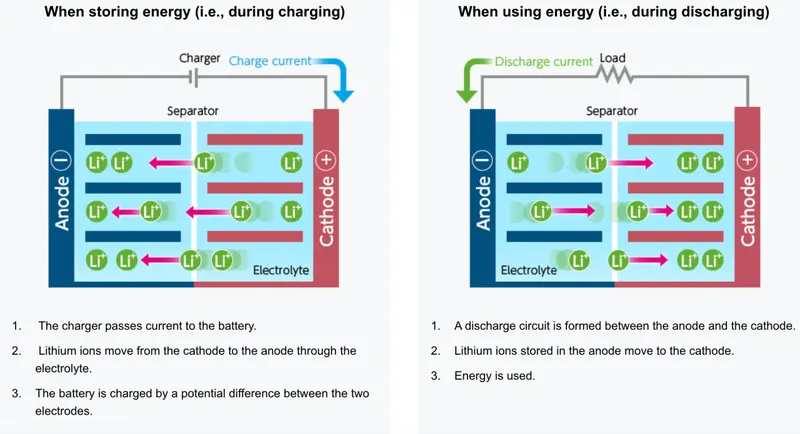
Lithium-ion battery is composed of 1) anode and the cathode 2) a Seperator between the two electrodes & 3) an electrolyte that fills the remaining space of the battery. The anode and cathode of storing lithium ions. Energy is stored and released as lithium ions travel between these electrodes through the electrolyte
TYPES OF LITHIUM-ION BATTERIES.
- LITHIUM cobalt oxide (LiCoO2)
- Lithium manganese oxide (LiMn204)
- Lithium nickel cobalt aluminum oxide (LiNiCoAlO2)
- Lithium nickel manganese cobalt oxide (LiNiMnCoO2)
- Lithium iron phosphate (LiFePO4)
- Lithium titanate (Li2TiO3)
|
BATTERY |
CATHODE MATERIAL |
ANODE MATERIAL |
CATHODE REACTION |
ANODE REACTION |
|
Lithium Cobalt Oxide (LCO) |
Lithium Cobalt Oxide |
Graphite Carbon |
CoO2+xLi++xe- = LiCoO2 |
LiC6 = Li++e-+C6 |
|
Lithium Manganese Oxide (LMO) |
Lithium Manganese Oxide |
Graphite Carbon |
Mn2O4+xLi++xe-= LiMn204 |
LiC6 = Li++e-+C6 |
|
Lithium Nickel Cobalt Aluminum Oxide (NCA) |
Lithium Nickel Cobalt Aluminum Oxide |
Graphite Carbon |
NiCoAlO2+Li++e-=LiNiCoAlO2 |
LiC6 = Li++e-+C6 |
|
Lithium Nickel Manganese Cobalt Oxide (NMC) |
Lithium Nickel Manganese Cobalt Oxide |
Graphite Carbon |
NiMnCoO2+Li++e- =LiNiMnCoO2 |
LiC6 = Li++e-+C6 |
|
Lithium Iron phosphate (LFP) |
Lithium Iron phosphate |
Graphite Carbon |
FePO4+Li++e-= LiFePO4 |
LiC6 = Li++e-+C6 |
|
Lithium Titanate (LTO) |
Lithium Titanate |
Graphite Carbon |
Mno2+Li++e-= LiMnO2 |
Li4Ti5O12 = Ti5O12+4Li++4e-
|
- LCO-LITHIUM COBALT OXIDE (LiCoO2)
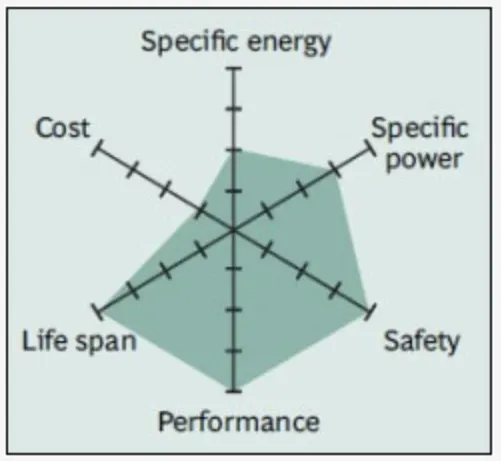
LCO batteries are manufactured from lithium carbonate and cobalt and are also known as lithium cobaltite or lithium-ion cobalt batteries. These batteries are used in cell phones, laptops and electronic cameras because of their high specific energy. They have a cobalt oxide cathode and a graphite carbon anode, and lithium ions migrate from the anode to the cathode during discharge, with the flow reversing when the battery is charged. The drawback of this battery is its short life span, low thermal stability and limited load capabilities.
Voltages 3.60V nominal; typical operating range 3.0–4.2V/cell.
Specific energy 150–200Wh/kg. Specialty cells provide up to 240Wh/kg.
Charge (C-rate) 0.7–1C, charges to 4.20V (most cells); 3h charge typical. Charge current above 1C shortens battery life.
Discharge (C-rate) 1C; 2.50V cut off. Discharge current above 1C shortens battery life.
Cycle life 500–1000, related to depth of discharge, load, temperature.
Thermal runaway 150°C (302°F). Full charge promotes thermal runaway.
Applications Mobile phones, tablets, laptops, cameras
- LMO-lithium manganese oxide (LiMn204)
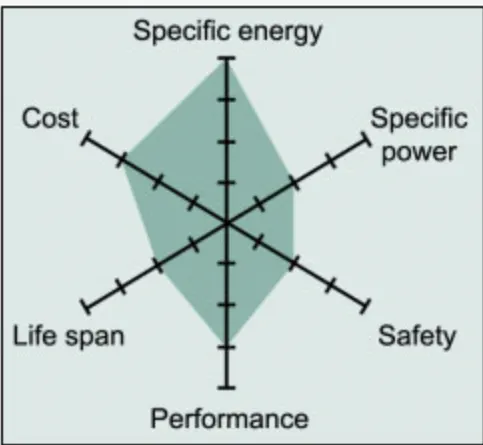
Manganese oxide batteries are sometimes known as lithium manganate or lithium manganese batteries, or li-manganese or manganese spinal batteries. The technology for this sort of battery was initially discovered in 1980s, with the first publication in the materials research bulletin in 1983. This battery is referred to as LMO, has a higher nominal voltage than LCO-based battery cells, rated between 3.8 and 4V. On the other hand, the energy density of LMO batteries is approximately 20% less than the ones of LCO batteries. Other important attributes are high thermal stability, lower cost, and improved safety. However, due to its relatively short cycle life and high-capacity losses, the LMO battery cell is not suitable for electric vehicles, plug-in electric vehicles nor hybrid plug in electric vehicle applications. LMO batteries do not have power nor energy density.
Voltages 3.70V (3.80V) nominal; typical operating range 3.0–4.2V/cell.
Specific energy 100–150Wh/kg
Charge (C-rate) 0.7–1C typical, 3C maximum, charges to 4.20V (most cells).
Discharge (C-rate) 1C;10C possible with some cells, 30C pulse (5s), 2.50V cut-off
Cycle life 300–700 (related to depth of discharge, temperature).
Thermal runaway 250°C (482°F) typical. High charge promotes thermal runaway
Applications Power tools, medical devices, electric powertrains
- NCA-lithium nickel cobalt aluminum oxide (LiNiCoAlO2)
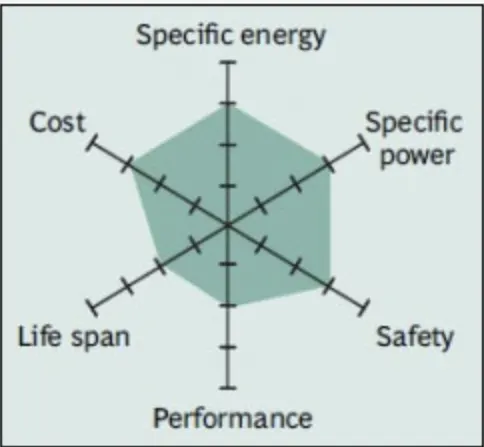
NCA batteries are making their way in electric vehicles and grid storage. Although NCA batteries are not widely used in consumer electronics, they have great potential in the automobile industry. NCA batteries offer a high-energy choice with a long lifespan, but they are less safe than other lithium-ion battery types and are rather expensive. To ensure driver safety NCA batteries must be accompanied by monitoring systems. Given the widespread use of NCA batteries in electric vehicles, demand for these batteries may increase as the number of electric vehicles grows.
Voltages 3.60V nominal; typical operating range 3.0–4.2V/cell
Specific energy 200-260Wh/kg; 300Wh/kg predictable
Charge (C-rate) 0.7C, charges to 4.20V (most cells), 3h charge typical, fast charge possible with some cells.
Discharge (C-rate) 1C typical; 3.00V cut-off; high discharge rate shortens battery life.
Cycle life 500 (related to depth of discharge, temperature)
Thermal runaway 150°C (302°F) typical, High charge promotes thermal runaway
Applications Medical devices, industrial, electric powertrain (Tesla)
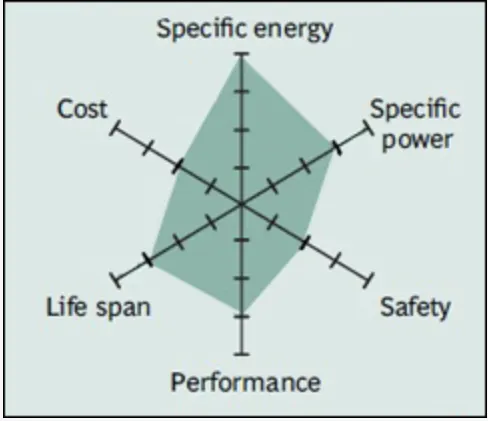
- NMC-lithium nickel manganese cobalt oxide (LiNiMnCoO2)
NMC batteries are constructed of a variety of materials that are universal in lithium-ion batteries. A cathode constructed of a mix of nickel, manganese, and cobalt is included. NMC batteries, like other lithium-ion battery types, can have a high specific energy density or a high specific power. They can’t have both features and these batteries are most commonly seen in power tools and automobile powertrains. 60% nickel, 20% manganese, and 20% cobalt are commonly the cathode combination ratios. This means that the cost of raw material is lower than for other lithium-ion battery solutions, as cobalt may be fairly costly. Because some battery manufacturers plan to convert their battery chemistry to a larger percentage of nickel to utilize less cobalt, the price of these batteries may drop even more in future. Because of its low self-heating rate, this battery type is often used in electric vehicles.
Voltages 3.60V, 3.70V nominal; typical operating range 3.0–4.2V/cell, or higher
Specific energy 150–220Wh/kg
Charge(C-rate) 0.7–1C, charges to 4.20V, some go to 4.30V; 3h charge typical. Charge current above 1C shortens battery life.
Discharge (C-rate) 1C; 2C possible on some cells; 2.50V cut-off
Cycle life 1000–2000 (related to depth of discharge, temperature)
Thermal runaway 210°C (410°F) typical. High charge promotes thermal runaway
Cost ~$420 per kWh [1]
Applications E-bikes, medical devices, EVs, industrial
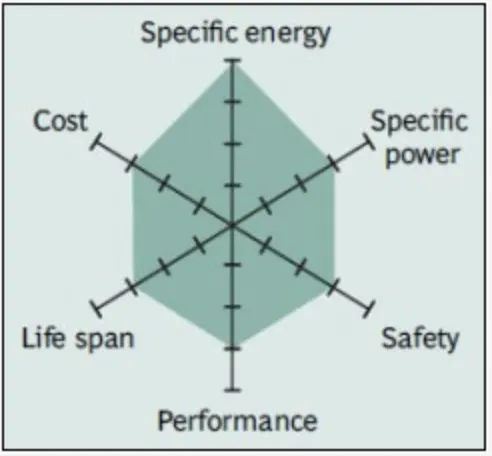
- LFP-lithium iron phosphate (LiFePO4)
Phosphate is used as cathode in lithium iron phosphate batteries, often known as li-phosphate batteries. They have low resistance qualities, which improve their thermal stability and safety. Durability and a long lifecycle are other advantages - fully charged batteries can be kept with no effect on the battery’s overall charge life. When the lengthy battery life of Li-phosphate batteries is considered, they are frequently the most cost-effective option. The lower voltage of the lithium-phosphate battery, on the other hand, means that it has less energy than other lithium batteries. As a result, these batteries are frequently used in electric bikes and other applications requiring a long lifecycle and high levels of safety. These batteries are also commonly used in electric vehicles.
Voltages 3.20, 3.30V nominal; typical operating range 2.5–3.65V/cell
Specific energy (capacity) 90–120Wh/kg
Charge (C-rate) 1C typical, charges to 3.65V; 3h charge time typical
Discharge (C-rate) 1C, 25C on some cells; 40A pulse (2s); 2.50V cut-off (lower that 2V causes damage)
Cycle life 2000 and higher (related to depth of discharge, temperature)
Thermal runaway 270°C (518°F) Very safe battery even if fully charged
Cost ~$580 per kWh [1]
Applications Portable and stationary needing high load currents and endurance
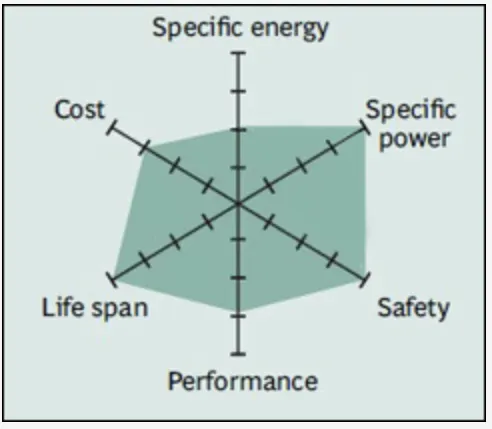
- LTO-lithium titanate (Li2TiO3)
Batteries with lithium titanate anodes have been known since the 1980’s. LI-titanate replaces the graphite in the anode of a typical lithium-ion battery and the material forms into a spinel structure. Because of the superior nanotechnology, the LI-titanate battery has an extremely rapid recharge time. LI-titanate batteries are being employed by makers of electric vehicles and bicycles, and this type of battery has the potential to be used in electric buses for public transit. However, these batteries have a lower intrinsic voltage or energy density than other lithium-ion battery types, which might cause problems when it comes to efficiently power automobiles. Despite this, lithium titanate batteries have a higher density than non-lithium batteries, which is a benefit. These batteries could be used for military and aerospace applications, as well as storing wind and solar energy and constructing smart grids. Furthermore, according to battery space these could be used in power system-critical backups.
Voltages 2.40V nominal; typical operating range 1.8–2.85V/cell
Specific energy (capacity) 50–80Wh/kg
Charge (C-rate) 1C typical; 5C maximum, charges to 2.85V
Discharge (C-rate) 10C possible, 30C 5s pulse; 1.80V cut-off on LCO/LTO
Cycle life 3,000–7,000
Thermal runaway One of safest Li-ion batteries
Cost $1,005 per kWh [1]
Applications UPS, electric powertrain (Mitsubishi i-MiEV, Honda Fit EV), solar-powered street lighting