Week 1 Understanding Different Battery Chemistry
EV BATCH - 16
Week 1: Understanding Different Battery Chemistry
Task 1:
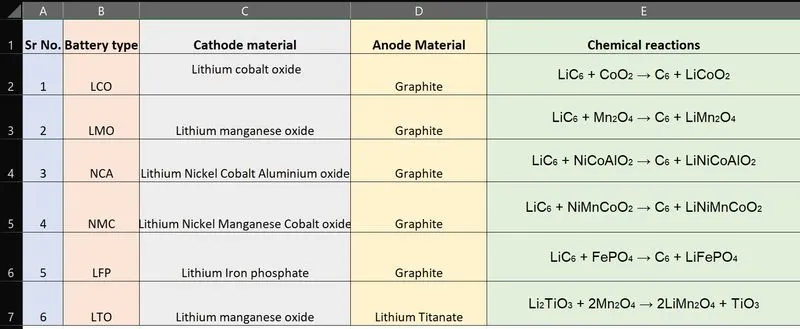
Prepare a table that includes materials & chemical reactions occurring at the anode and cathode of LCO, LMO, NCA, NMC, LFP, and LTO types of lithium-ion cells. Give your detailed explanation of it.
Battery: Battery is a collection of one or more cells whose chemical reactions create a flow of electrons in a circuit. All batteries are made up of three basic components: an anode '-' ve, cathode '+' ve, an electrolyte, and current collectors at each electrode.
Working: When the anode and cathode of a battery are connected to a circuit, a chemical reaction takes place between the anode and the electrolyte. This reaction causes electrons to flow through the circuit and back into the cathode where another chemical reaction takes place. When the material in the cathode or anode is consumed or no longer able to be used in the reaction, the battery is unable to produce electricity.
Types of battery: Batteries that must be thrown away after use are known as primary batteries. Batteries that can be recharged are called secondary batteries.
Lithium-Ion batteries: Lithium-ion cells are rechargeable cells, they use lithium as one of the key components in the construction of the cell. These are rechargeable cells commonly used in portable electronics to something as large as Discoms for storing energy produced from renewable energy. The Li-ion cell has 4 main components that are Cathode, Anode, Electrolyte, and Separator.
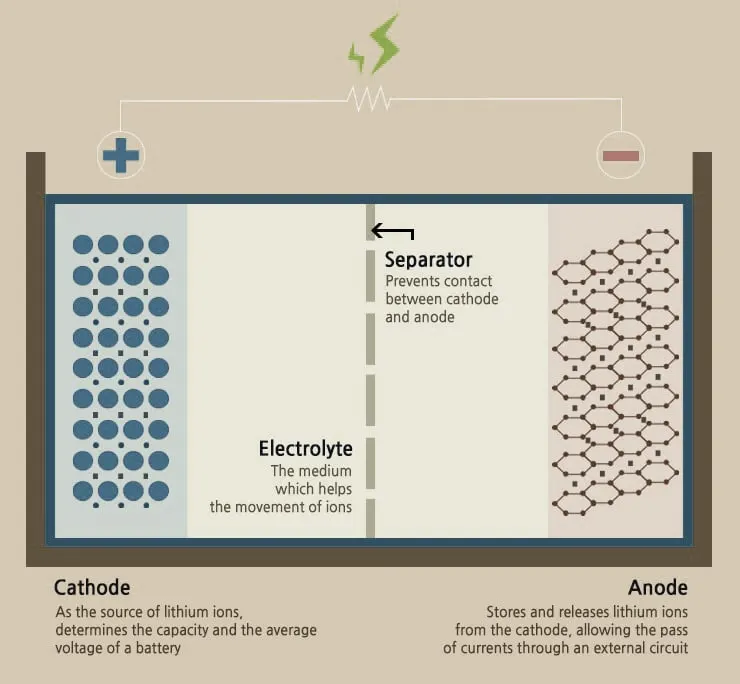
Cathode: The material used in the cathode determines the capacity and voltage of the Li-ion battery. This material is called the active material. The active material plays a crucial role in the chemical reaction in the battery which causes the flow of current. The capacity of a cell depends on the size of the active material at the cathode. For higher capacity of the cell, we need to have bigger cathodes.
Anode: Anode is the negative electrode and its property decides the rate of charge and discharge of the battery. We try to maximize the surface area of the anode which affects the rate of flow of electric current through the external circuit, resulting in a higher rate of absorption or emission of lithium ions released from the cathode. Anode stores the lithium ions during the charge cycle of the battery.
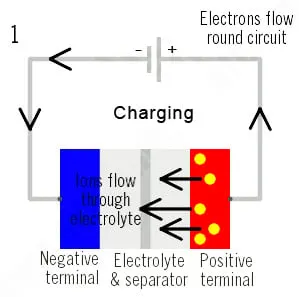
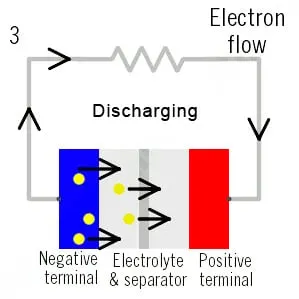
Electrolyte: An electrolyte solution is an electrically neutral solution. Both the electrodes are submerged in the electrolyte solution. During the charge cycle, the lithium ions move from cathode to anode, while in the discharge cycle the reverse happens. Electrolyte plays a major role in the movement of ions thus making the flow of current possible. The movement of anions and cations in opposite directions in the electrolyte causes the flow of current. For a Li-ion cell, the electrolyte needs to be a lithium salts
Separator: The separator is placed between the electrodes to isolate them from each other so that no electron flows through them while allowing the ions to flow between them. It forms a catalyst when covered with the electrolyte thus facilitating the movement of ions between anode and cathode while stopping the electrons.
There are six categories of lithium-ion batteries readily available in the market, these are Lithium Cobalt Oxide (LCO), Lithium Manganese Oxide (LMO), Lithium Nickel Manganese Cobalt Oxide (NMO), Lithium Iron Phosphate (LFP), Lithium Nickel Cobalt Aluminum Oxide (NCA), and Lithium Titanate (LTO).
Lithium-ion battery chemistries:
Task 2:
Compare the differences between each type of Li+ion battery based on their characteristics
Li-ion batteries are classified based on the combination of anode and cathodes used. There are currently 6 types of lithium-ion batteries. The properties of each type differ and we need to know their properties and their operating conditions to select the best battery for a particular application. The basic properties of Lithium-ion batteries are grouped here.
In this table, Li-ion batteries are compared on the basis of SPecific energy, Specific power, Safety, Performance, Life span, and Cost.
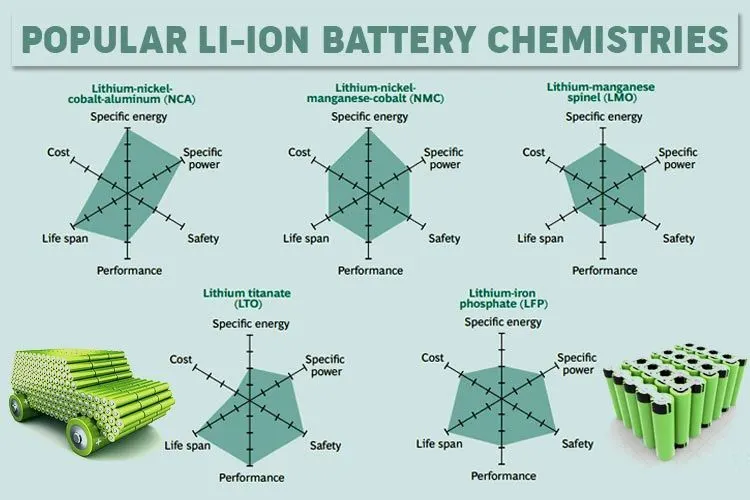
1. Lithium cobalt oxide battery (LCO)
- Exhibits a high energy density of 150-200 Wh/kg
- Not used extensively because of the inadequate and depleting supply of Cobalt
- Costlier compared to other Li-ion chemistries
- Cobalt is a highly volatile metal and has lower thermal stability hence there is a risk of overheating and sensitivity to higher operating temperatures and overcharging
- They are mainly used in phones, cameras, laptops, and also electric vehicles.
2. Lithium manganese oxide battery (LMO)
- They have low internal resistance and high-temperature stability.
- They are safer than other lithium-ion battery types.
- They are capable of delivering current up to 20-30 Amps due to their low internal resistance.
- They exhibit the properties of fast charging and discharging.
- They have a lower capacity and low cycle life of 300-700 cycles.
- Mainly used in power tools, electric vehicles, and in medical applications.
3. Lithium iron phosphate battery (LFP)
- They have a high energy density of 90-160 Wh/kg.
- They have low internal resistance and higher thermal stability.
- They are more durable and have a long lifecycle and have low self-discharge rates.
- They are very cost-effective due to their longer life cycle.
- They can withstand a lot of mechanical and thermal abuse.
- Mainly used in industrial equipment, heavy machinery, and electric vehicles,
4. Lithium Nickel Manganese Cobalt Oxide (NMC)
- They have high specific energy density and high specific power.
- They have a very low self-heating rate and a nominal voltage of 3.7V.
- They have a high energy density of 150-220 Wh/kg.
- They are cheaper than other Li-ion batteries
- They are used in medical equipment, power tools, and electric vehicles.
5. Lithium Nickle Cobalt battery (NCA)
- They have a high energy density as high as 260Wh/kg and a nominal voltage of 3.6V.
- They have longer life cycles.
- They have lower thermal stability.
- They have high-cost making hence not used in consumer applications.
- They are used in cars and grid storage.
6. Lithium titanate oxide battery (LTO)
- They exhibit a very high rate of charging and discharging.
- They have low nominal voltage and low energy density of 2.4V and 50-80Wh/kg.
- They have a special ability to provide a discharge rate exceeding 30 C.
- This is the safest battery chemistry available in Li-ion batteries.
- They are used in electric cars, electric buses, aerospace applications, military energy storage, and smart grids.