Week 1 Understanding Different Battery Chemistry
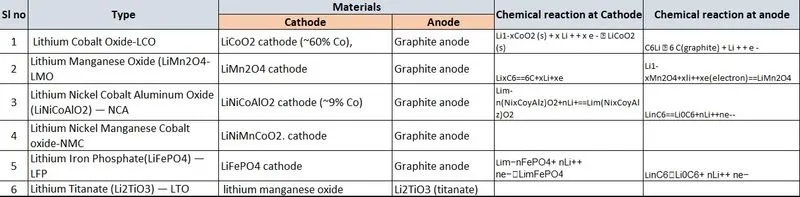
1.Prepare a table which includes materials & chemical reactions occurring at the anode and cathode of LCO, LMO, NCA, NMC, LFP and LTO type of lithium ion cells.Give your detailed explanation on it
2.Compare the differences between each type of Li+ion batteries based on their characteristics
LCO batteries: properties and usage
LCO stands for Lithium cobalt battery. Lithium cobalt oxide is one of the most common Lithium-ions, it has a chemical symbol which is LiCoO2 and is abbreviated as LCO. For simplification, Li-cobalt –which is the short term- can also be used for this type battery. Cobalt is the core active material which defines the character of the battery.
Lithium-ion batteries and concept
The most popular technology of the battery sector currently is the lithium ion battery. Relative to other types of batteries, lithium ion batteries have better energy, power density and higher cycling ability. These qualities are extremely important in the use in modern applications like electrical and hybrid vehicles and most importantly energy storage systems which are used in the renewable energy applications.The lithium ion batteries chemistry is the same across the different lithium-ion battery types; during discharge, Lithium-ions are moved to the positive cathode from the negative anode through the organic electrolyte. The anodes in all various technologies of lithium ion are all made from graphite. The differences are the cathode which contains changing cobalt, nickel or manganese concentrations. All various cathode types allow high lithium insertion and intercalation levels which result in large energy storage quantities.
LCO batteries technology and applications
LCO (Lithium cobalt oxide) was invented in the year 1991. Its anode material is LiaC6, the cathode material is LibCoO2 and the carrier is Li+.It is used in various applications ranging from electronic devices to all laptops and phone batteries.The majority of lithium-ion batteries for the portable devices are cobalt based. The system contains a cobalt oxide cathode (positive electrode) and graphite carbon anode (negative electrode).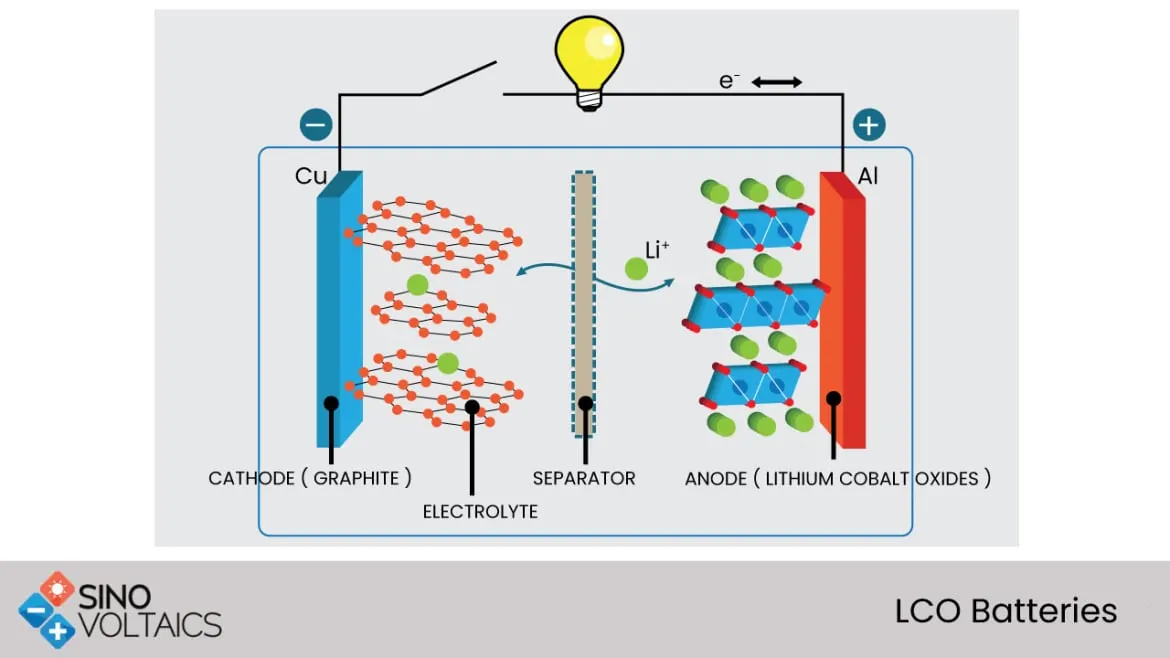
Advantages and disadvantages of LCO batteries
The main advantages of the LCO batteries are:
- High energy density.
- Long runtime making it optimum for new technologies
The main disadvantages of the LCO batteries are:
- It has a relatively low discharge current so high load can lead to pack overheat
- The safety circuit of the LCO battery is typically limited to a 1C for charging and discharging.
- The internal resistance increases with cycling and aging. This high internal resistance can cause the battery to become unserviceable due to a large voltage drop under the load after a couple of years of use.
LMO Batteries: properties and usage
LMO stands for Lithium manganese oxide batteries, which are commonly referred to as lithium-ion manganese batteries or manganese spinel. This battery was discovered in the 1980s, yet the first commercial lithium-ion battery made with a cathode material made from lithium manganese was produced in 1996.
Lithium-ion batteries and concept
The most popular technology of the battery sector currently is the of the lithium ion battery. Relative to other types of batteries, lithium ion batteries have better energy, power density and higher cycling ability. These qualities are extremely important in the use in modern applications like electrical and hybrid vehicles and most importantly energy storage systems which are used in the renewable energy applications.The lithium ion batteries chemistry is the same across the different lithium-ion battery types; during discharge, Lithium-ions are moved to the positive cathode from the negative anode through the organic electrolyte. The anodes in all various technologies of lithium ion are all made from graphite. The differences are the cathode which contains changing cobalt, nickel or manganese concentrations. All various cathode types allow high lithium insertion and intercalation levels which result in large energy storage quantities.
LMO batteries technology and applications
LMO (Lithium magnesium oxide) was invented in the year 1996. Its anode material is LiaC6, the cathode material is LibMn2O4 and the carrier is Li+. It is used in different applications like power tools and electric cars.LMO batteries have the ability to deliver a lot of energy in a short period of time, which makes them extremely useful for use in power tools like drills.In 1996, lithium manganese oxide was first used as a cathode material. A three dimensional spinel structure was formed by this structure, this improves the flow of ions between the electrodes. The high flow decreases the internal resistance and increases loading capability.LMO batteries are usually used in medical devices and equipment, power tools, electric bikes and more. Because of their thermal resistance and higher safety. LMO batteries can also be used for laptops and electrical cars.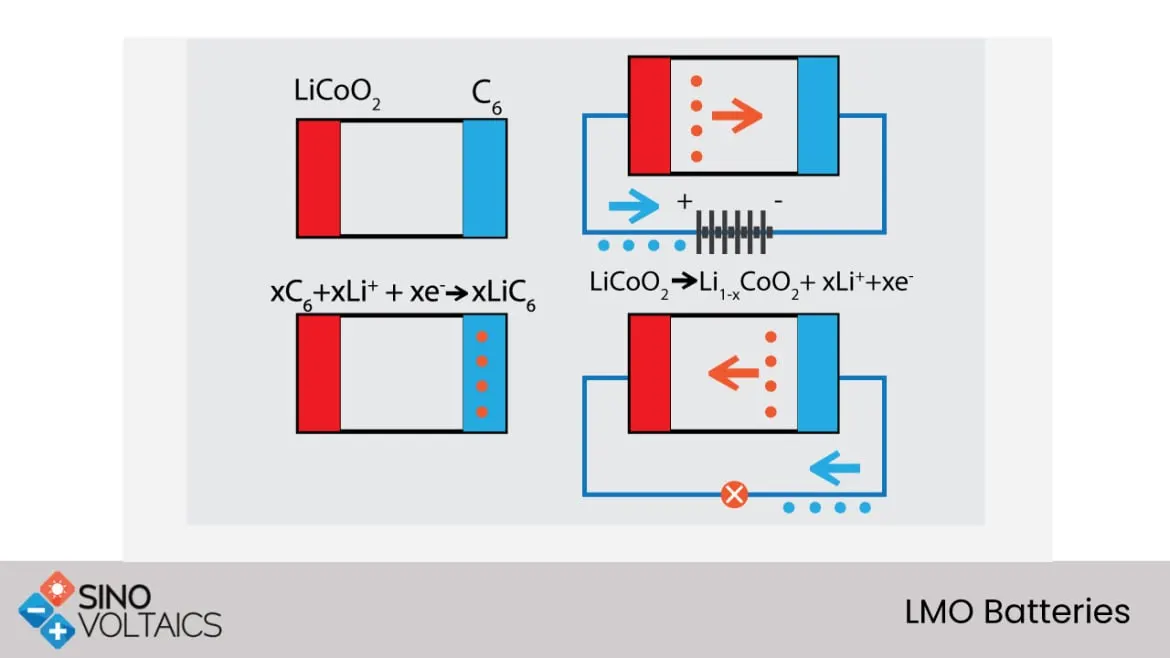
Advantages and disadvantages of LMO batteries
The main advantages of the LMO batteries are:
- High temperature stability and safety relative to other Li-ion types as it has integrally high thermal stability thus needs less safety circuitry than cobalt system.
- High rate capability due to low internal cell resistance which benefits fast charging and high current discharging.
The main disadvantage of the LMO batteries is:
- Lower capacity relative to cobalt-based system,yet it still has an energy density which is nearly 50% higher than the nickel based system.
NCA batteries: properties and usage
NCA battery stands for Lithium nickel cobalt aluminum oxide based battery (LiNiCoAlO2). Also, NCA batteries are becoming more and more important in in-grid storage and electrical power terrain applications.
Lithium-ion batteries and concept
The most popular technology of the battery sector currently is the of the lithium ion battery. Relative to other types of batteries, lithium ion batteries have better energy, power density and higher cycling ability. These qualities are extremely important in the use in modern applications like electrical and hybrid vehicles and most importantly energy storage systems which are used in the renewable energy applications.The lithium ion batteries chemistry is the same across the different lithium-ion battery types; during discharge, Lithium-ions move to the positive cathode from the negative anode through the organic electrolyte. The anodes in all various technologies of lithium ion are all made from graphite. The differences are the cathode which contains changing cobalt, nickel or manganese concentrations. All various cathode types allow high lithium insertion and intercalation levels which result in large energy storage quantities.
NCA battery technology and applications
NCA (Lithium nickel cobalt aluminum oxide) battery was invented in the year 1999. Its anode material is LiaC6, the cathode material is LibNi0.8Co0.15Al0.05O2 and the carrier is Li+. It is used in different applications like power grid applications, medical devices and electric cars. Most notably Tesla deploys NCA batteries in their electric vehicles system. NCA batteries can store the same amount of energy as NMC.NCA batteries are not widely common in the consumer industry, but are quite promising in the electric car industry.
Advantages and disadvantages of NCA batteries
The main advantages of the NCA batteries are:
- High specific energy
- Reasonably good specific power
- Long life span
- NCA cathodes contain the most energy amount by weight and volume (as NMC).
The main disadvantages of the NCA batteries are:
- Less safety than other Li-ion battery types (they require extra safety features and circuits for use in electric cars for example)
- Higher cost in comparison to other Li-ion battery types
Lithium Nickel Manganese Cobalt oxide (NMC):
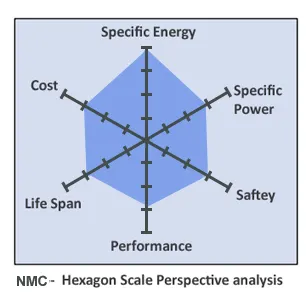
Lithium Nickel Cobalt Manganese (Li(NiCoMn)O2) batteries are made of cathode materials which is combination of nickel, manganese and cobalt, typically one-third nickel, one-third manganese and one-third cobalt, also known as 1-1-1. Similar to Li-manganese, NMC can be tailored to serve as Energy Cells or Power Cells, like other lithium-ion battery varieties, NMC batteries can have either a high specific energy density or a high specific power. They however cannot have both properties in the same pack. For example, NMC in an 18650 cell for moderate load condition has a capacity of about 2,800mAh andcan deliver 4A to 5A. NMC in the same cell size can be optimized for specific power with capacity of about 2000mAh, but capable of delivering a continuous discharge current of 20A.
Typical Specifications of NMC with Graphite anode
- Voltages: 3.60V, 3.70V nominal; typical operating range 3.0–4.2V/cell, or higher
- Specific Energy: 150–220Wh/kg
- Charge (C-rate): 0.7–1C, charges to 4.20V, some go to 4.30V; 3h charge typical.
- Discharge (C-rate): 1C; 2C possible on some cells; 2.50V cut-off
- Cycle life: 1000–2000 (related to depth of discharge, temperature)
- Thermal runaway: 210°C typical. High charge promotes thermal runaway
- Applications: power tools, e-bikes and other electric powertrains
- Note: Charge current above 1C shortens life of NMC.
Lihium Ion Phosphate (LFP)
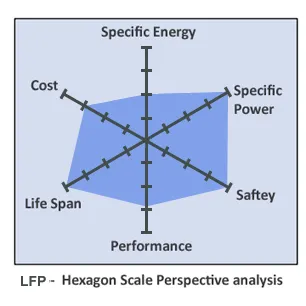
In Lithium Iron Phosphate (LiFePO4) Batteries phosphate is used as cathode material, Li-phosphate offers good electrochemical performance with low resistance. This nano-scale phosphate material for cathode in Lithium Ion batteries is most viable option because of its low cost,environmental friendliness, long cycle and calendar lives (chemical stability) and good capacity (170 mAh/g). Doping with transition metals results in reduction of internal impedance. LiFePO4 batteries are incombustible in case of misuse during charging or discharging, they are more stable during overcharge or short circuit conditions and they can withstand high temperatures without decomposing. LFP is more tolerant to full charge conditions and is compartively less vunerable to stress even if kept at high voltage for a prolonged time.
Typical Specifications of LFP with Graphite anode
- Voltages: 3.20, 3.30V nominal; typical operating range 2.5–3.65V/cell
- Specific Energy: 90–120Wh/kg
- Charge (C-rate): 1C typical, charges to 3.65V; 3h charge time typical
- Discharge (C-rate): 1C, 25C on some cells; 40A pulse (2s); 2.50V cut-off
- Cycle life: 2000 and higher (related to depth of discharge, temperature)
- Thermal runaway: 270°C Very safe battery even if fully charged
- Applications: For high load currents & endurance, and electric powertrains
- Note: LFP if discharged lower than 2V can causes damage
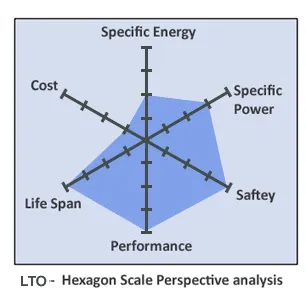
Lithium Titanate (LTO): Lithium Titanate ((Li2TiO3)) battery is a modified Li Ion battery in which the graphite in the anode is replaced by Li-titanate which forms a spinel structure. The cathode can be lithium manganese oxide orNMC or LFP, or other lithium battery Chemistry. LTO has a nominal cell voltage of 2.40V, can be fast charged and can deliver a high discharge current of 10C. Even the cycle life is higher than regular Li-ion batteries. LTO exhibits excellent low-temperature discharge characteristics (capacity of 80 percent at –30°C). Thermal stability under high temperature is comparitively better, highly tolerant to operational abuses and can comfortably perform up to 55 °C and can go up to 65 °C.
Typical Specifications of LTO (Li2TiO3) as Anode and LMO or NMC as Cathode
- Voltages: 2.40V nominal; typical operating range 1.8–2.85V/cell
- Specific Energy: 50–80Wh/kg
- Charge (C-rate): 1C typical; 5C maximum, charges to 2.85V
- Discharge (C-rate): 10C possible, 30C 5s pulse.
- Cycle life: 3000 to 7000
- Thermal runaway: One of safest Li-ion batteries
- Applications: UPS, electric powertrain, solar-powered street lighting
- Note: LTO- Long life, fast charge, safest, wide temperature range but low specific energy