Week 1 Understanding Different Battery Chemistry
AIM :
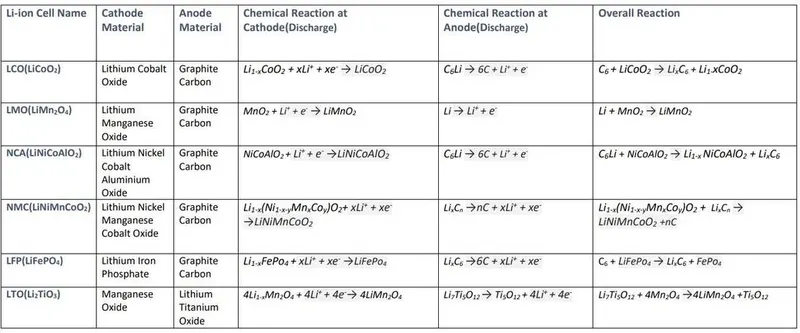
1.Prepare a table which includes materials & chemical reactions occurring at the anode and cathode of LCO, LMO, NCA, NMC, LFP and LTO type of lithium ion cells.Give your detailed explanation on it
2.Compare the differences between each type of Li+ion batteries based on their characteristics
ANSWER :
A rechargeable lithium-ion battery, like any other battery, is made up of one or more power-generating compartments known as cells. Each cell consists of three parts: a positive electrode (connected to the battery’s positive or + terminal), a negative electrode (attached to the battery’s negative or – terminal), and an electrolyte in the middle. The positive electrode is commonly composed of lithium-cobalt oxide (LiCoO2) or, in modern batteries, lithium iron phosphate (LiFePO4).
The negative electrode is usually composed of carbon (graphite), and the electrolyte varies depending on the type of battery—but this isn’t critical to understanding how the battery operates.
Overview of Lithium Cobalt Oxide Batteries
Cobalt acid lithium battery has high discharge platform, high specific capacity, stable product performance, and good cycle performance, but its safety performance is poor. The cost is very high, it is mainly used for medium and small type batteries, which is widely used in mobile phones, portable computers, cameras, camera, electric cars, solar energy storage, UPS power supply, medical equipment, space and other fields.
Lithium cobalt oxide, LiCoO2 (LCO), is an inorganic compound commonly used as a anode material for lithium ion batteries.
LiCoO2 basically uses liquid phase synthesis process of lithium ion secondary battery cathode material with layered structure in the current commercial lithium ion battery (cobalt acid lithium). It adopts polyvinyl alcohol (PVA) or polyethylene glycol (PEG) aqueous solution as solvent. Lithium and cobalt salt dissolve in PVA or PEG solution, mixing the solution after heating, then they will concentrate into gel formation. After heating and decomposition, calcine the gel formation at high temperature, sinter, grind and sieve, then you can get the cobalt acid lithium powder.
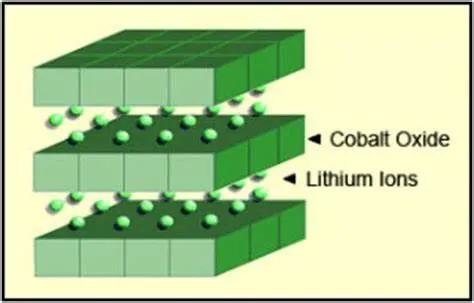
Lithium Cobalt Oxide (LCO) Battery - LiCoO2
Lithium cobalt oxide battery mainly relies on the intercalation and disintercalation of lithium ions between anode and cathode to realize the storage and release of energy.
While charging, at the external electric field, lithium elements in the LiCoO2 molecules of the anode material become lithium ion with positive charge, which moves from the anode to cathode. After chemical reaction with the carbon atoms of the cathode, LiC6 is formed, which is stably embedded into the layered graphite cathode.
Lithium manganese oxide battery (LiMn 2O 4) - LMO
Lithium manganate oxide battery refers to the battery that uses lithium manganate oxide as an anode material. Its nominal voltage is 3.7V. It is the mainstream power battery at present. This kind of battery has ordinary energy density and cycling life. It has environmental protection and no patent limitation. But lithium manganate oxide is not very stable, easy to decompose gas, may lead to swell, and its high-temperature performance is poor.
Lithium manganate oxide, whose chemical formula is LiMn2O4 (LCM), is one of the promising lithium ion anode materials. Compared with traditional anode materials such as lithium cobalt oxides, lithium manganate oxide has rich resources, low cost, no pollution, good safety and nice rate capability. It is an ideal anode material for power battery.
Lithium manganate oxide tends to be spinel type. LiMn2O4 spinel manganese acid lithium is the first anode material with 3D Li ion channel that made by Hunter in 1981. So far, it has been attracted attention from many scholars and researchers both at home and abroad. As an electrode material, it has low price and high potential, environment friendly and good safety performance, and is the most promising anode materials of new generation of lithium ion battery to replace LiCoO2.
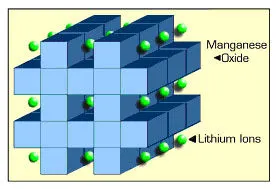
LMO Battery Cathode
The main components of lithium manganate oxide are spinel lithium manganate oxide and layered structure lithium manganate oxide. The model of spinel structure lithium manganate oxide belongs to cubic system, which is a kind of Fd3m space group. At present, the high-capacity lithium manganate oxide anode material has a reasonable structure. Lithium ions can be easily and reversibly detached from the spinel lattice, because the structure is relatively secure, there is no risk of structural collapse, and the safety of the product is guaranteed.
Lithium Nickel Manganese Cobalt Oxides (LiNiMnCoO2)- NMC
Ternary lithium battery refers to lithium battery that uses ternary materials of lithium nickel cobalt manganese oxide (LiNiMnCoO2, NMC) or lithium nickel cobalt aluminate (NCA) as anode material. Ternary means different proportions for different adjustments of nickel salt, cobalt salt and manganese salt as three different components. Lots of batteries have many different proportions of ternary materials.
In terms of shape, ternary lithium batteries can be divided into soft-pack batteries, cylindrical batteries and square hard-shell batteries. Its nominal voltage can reach 3.6-3.8V. It has high energy density, high voltage platform, high tap density, long endurance range, large output power, excellent performance at low temperature, but poor stability at high temperature, and has high cost.
Lithium iron phosphate battery (FeLiO4P)-LFP
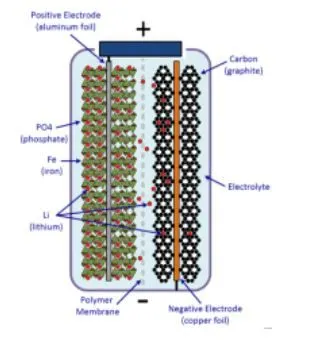
Lithium iron phosphate battery is a kind of lithium-ion battery that uses lithium iron phosphate (LiFePO4) as the positive electrode material and carbon as the negative electrode material. The rated voltage of the single unit is 3.2V, and the charge cut-off voltage is 3.6V~3.65V. Lithium iron phosphate battery has the advantages of high working voltage, high energy density, long cycle life, good safety performance, low self-discharge rate and no memory effect.
Composition of lithium iron phosphate battery
On the top is LiFePO4 with olivine structure as the positive electrode of the battery, which is connected to the positive electrode of the battery by aluminum foil. On the left is a polymer diaphragm, which separates the positive electrode from the negative electrode, but lithium-ion Li can pass but electron e- cannot pass. On the right is the negative electrode of the battery composed of carbon (graphite), which is connected to the negative electrode of the battery by copper foil. Between the upper and lower ends of the battery is the electrolyte of the battery, and the battery is hermetically sealed by a metal casing.
The working principle of lithium iron phosphate battery
When a lithium iron phosphate battery is charged, the lithium-ion Li in the positive electrode migrates to the negative electrode through the polymer separator; during the discharge process, the lithium-ion Li in the negative electrode migrates to the positive electrode through the separator. Lithium-ion batteries are named after lithium ions move back and forth during charging and discharging.
1. When the battery is charged, Li migrates from the 010 face of the lithium iron phosphate crystal to the crystal surface. Under the action of the electric field force, it enters the electrolyte, passes through the diaphragm, and then migrates to the surface of the graphite crystal through the electrolyte, and then embeds the graphite crystal. Grid. At the same time, electrons flow to the aluminum foil collector of the positive electrode through the conductor, flow to the copper foil collector of the negative electrode through the tab, battery pole, external circuit, negative pole, and negative lug, and then flow to the graphite negative electrode through the conductor. The charge on the negative electrode is balanced. After the lithium ions are deintercalated from the lithium iron phosphate, the lithium iron phosphate is converted into iron phosphate.
2. When the battery is discharged, Li is released from the graphite crystal, enters the electrolyte, passes through the diaphragm, and then migrates to the surface of the lithium iron phosphate crystal through the electrolyte, and then re-embeds into the lithium iron phosphate crystal lattice through the 010 plane. At the same time, the battery flows to the copper foil collector of the negative electrode through the conductor, flows to the aluminum foil collector of the battery positive electrode through the tab, battery negative pole, external circuit, positive pole, and positive tab, and then flows to the iron phosphate through the conductor. Lithium positive electrode balances the charge of the positive electrode.
From the working principle of the lithium iron phosphate battery, it can be known that the charging and discharging process of the lithium iron phosphate battery requires the participation of lithium ions and electrons, and the migration speed of lithium ions and the migration speed of electrons must reach a balance. This requires that the positive and negative electrodes of lithium-ion batteries must be a mixed conductor of ions and electrons, and their ionic conductivity and electronic conductivity must be consistent. However, the conductivity of lithium iron phosphate is very poor. Although the conductivity of the graphite negative electrode is better, it is still necessary to improve the conductivity of the negative electrode in order to achieve a high-rate discharge, so that its electronic conductivity and the ability of lithium ions to be deintercalated from the graphite are balanced.
About Lithium Nickel Cobalt Aluminum Oxide - (LiNiCoAlO2 ) - NCA
Lithium Nickel Cobalt Aluminum Oxide (NCA) is a highly thermally stable cathode material used lithium-ion batteries. Doping the lithium nickel cobalt oxide with aluminum both stabilizes its thermal and charge transfer resistance. Lithium Nickel Cobalt Aluminum Oxide is generally immediately available in most volumes. American Elements produces to many standard grades when applicable, including Mil Spec (military grade).
lithium titanate oxide - LTO
Lithium titanate oxide batteries are a class of lithium ion batteries that are built using nanotechnology. The process of material particle nanoization is difficult, so the cost is high, and it is currently difficult to achieve large-scale industrial processing. They are rechargeable lithium ion batteries that use titanate oxide as their anode and make use of lithium iron phosphate as the cathode in their chemical reaction.
This type of lithium ion battery has a long lifecycle and is exceedingly safe to use. Also, this battery charges faster than others because it uses an anode with a bigger surface area.
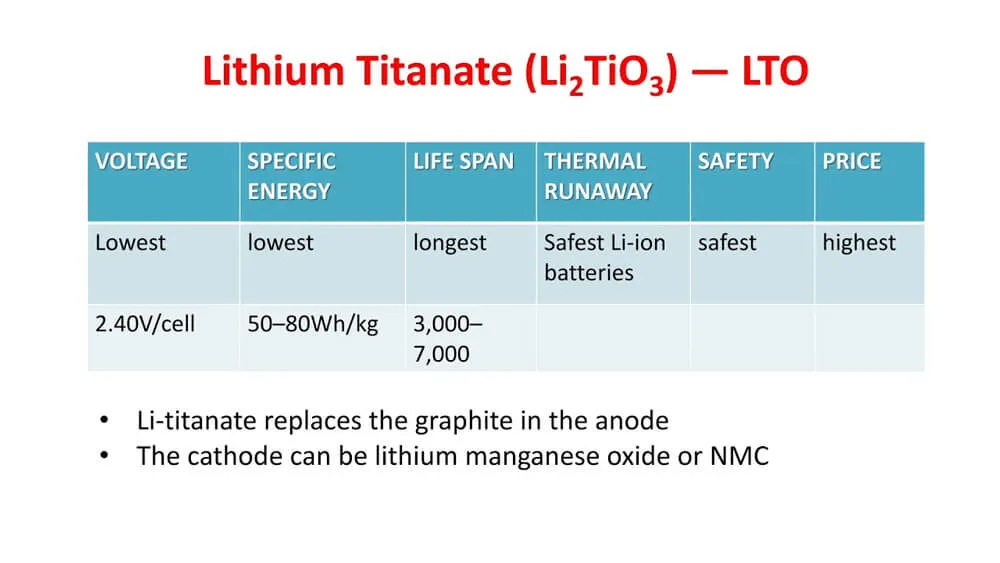
The lithium titanate oxide battery has some properties that make them unique from other lithium-ion batteries. These advantages are the result of the nanotechnology used to create them. Of these benefits include:
Longer Functionality Period
The lithium titanate battery is capable of charging fast and storing energy for a longer period. They do not easily degrade because they are built using nanocrystals that enhance fast charging.
Speedy charging and discharging
The nanocrystals are used in place of traditional carbon elements as the anode during the chemical reaction. This anode’s surface area is about 100 square meters/g.
As a result, the mobility of electrons is enhanced, causing them to travel faster, resulting in faster charging and discharging of the battery,and can supply high current when needed. The lithium titanate oxide battery recharges faster than its other lithium battery counterparts thanks to its 30 times larger surface area.
Low-Temperature while storing energy
With their nanotechnology operating system, the lithium titanate oxide battery operates with a low temperature, storing up 80% energy at just -30°C. It has the ability to fully charge and discharge in the ultra-wide temperature range of -50℃~60℃.
2.Compare the differences between each type of Li+ion batteries based on their characteristics
ANSWER :
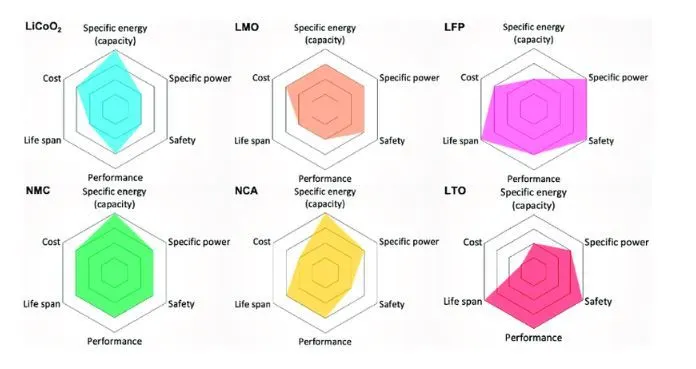
It is important to note that the six types of lithium-ion batteries are compared relative to one another.
| Lithium-ion battery Types | SP | SE | SF | LS | CS | PF |
|---|---|---|---|---|---|---|
|
Lithium Cobalt Oxide |
L |
H |
L |
L |
L |
M |
|
Lithium Manganese Oxide |
M |
M |
M |
L |
L |
L |
|
Lithium Nickel Manganese Cobalt Oxide |
M |
H |
M |
M |
L |
M |
|
Lithium Iron Phosphate |
H |
L |
H |
H |
L |
M |
|
Lithium Nickel Cobalt Aluminum Oxide |
M |
H |
L |
M |
M |
M |
|
Lithium Titanate |
M |
L |
H |
H |
H |
H |
- SP stands for specific power
- SE stands for specific energy
- SF stands for safety
- LS stands for lifespan
- CS stands for cost
- PF stands for performance
- L stands for low
- M stands for moderate
- H stands for high
Summary of the Table
Lithium Cobalt Oxide has high specific energy as compared to the other batteries which make it the preferred choice for laptops and mobile phones. It also has a low cost and a moderate performance. However, it is highly unfavorable in all the other aspects when compared to the other lithium-ion batteries. It has low specific power, low safety, and a low lifespan.
Lithium Manganese Oxide has moderate specific power, moderate specific energy, and a moderate level of safety when compared to the other types of lithium-ion batteries. It has the added advantage of a low cost. The downsides are its low performance and low lifespan. It is usually used in medical devices and power tools.
Lithium Nickel Manganese Cobalt Oxide has two major advantages as compared to the other batteries. The first one is its high specific energy which makes it desirable in electric powertrains, electric vehicles, and electric bikes. The other is its low cost. It is moderate in terms of specific power, safety, lifespan, and performance when compared to the other lithium-ion batteries. It can be optimized to either have high specific power or high specific energy.
Lithium Iron Phosphate only has one major disadvantage when compared to other types of lithium-ion batteries and that is its low specific energy. Other than that, it has moderate to high ratings in all the other characteristics. It has high specific power, offers a high level of safety, has a high lifespan, and comes at a low cost. The performance of this battery is also moderate. It is often employed in electric motorcycles and other applications that require a long lifespan and a high level of safety.
Lithium Nickel Cobalt Aluminum Oxide offers one strong advantage as compared to the five other batteries and that is high specific energy. It is pretty moderate in the rest of the characteristics like performance, cost, specific power, and lifespan. The only downside to this battery type is its low level of safety. Its high specific energy and moderate lifespan make it a good candidate for electric powertrains.
Lithium Titanate offers high safety, high performance, and a high lifespan which are very important features every battery should have. Its specific energy is low compared to the five other lithium-ion batteries but it compensates for this with moderate specific power. The only major disadvantage of lithium titanate as compared to the other lithium-ion batteries is its extremely high cost. Another important feature of this battery worthy of mention is its remarkably fast recharge time. It can be used for storing solar energy and creating smart grids.