Week 1 Understanding Different Battery Chemistry
Q1.Prepare a table which includes materials & chemical reactions occurring at the anode and cathode of LCO, LMO, NCA, NMC, LFP and LTO type of lithium ion cells.Give your detailed explanation on it.
Introduction:
A lithium-ion battery or Li-ion battery is a type of rechargable battery composed of cells in which lithium ions move from the negative electrode through an electrolyte to the positive electrode during discharge and back when charging. Li-ion cells use an intercalated lithium compound as the material at the positive electrode and typically graphite at the negative electrode. Li-ion batteries have a high energy density, no memory effect (other than LFP cells) and low self-discharge. Cells can be manufactured to either prioritize energy or power density.They can however be a safety hazard since they contain flammable electrolytes and if damaged or incorrectly charged can lead to explosions and fires.
A prototype Li-ion battery was developed by Akira Yoshino in 1985, based on earlier research by John Goodenough, M. stanley,Whittingham,Rachid yazami and Koichi mizushima during the 1970s–1980s, and then a commercial Li-ion battery was developed by a sony and Asahi kasel team led by Yoshio Nishi in 1991.Lithium-ion batteries are commonly used for portable electronics and electric vehicles and are growing in popularity for military and aerospace applications.
Chemistry, performance, cost and safety characteristics vary across types of lithium-ion batteries. Handheld electronics mostly use lithium polymer batteries (with a polymer gel as electrolyte), a Lithium cobalt oxide(LiCoO2) cathode material, and a graphite anode, which together offer a high energy density. Lithium iron phosphate (LiFePO4), Lithium magnese oxide (LiMn2O4 spinel, or Li2MnO3-based lithium rich layered materials, LMR-NMC), and Lithium nickel magnese cobalt oxide (LiNiMnCoO2 or NMC) may offer longer lives and may have better rate capability. Such batteries are widely used for electric tools, medical equipment, and other roles.
NMC and its derivatives are widely used in the electrification of transport, one of the main technologies (combined with renewable energy) for reducing greenhouse gas emmisions from vehicles.Improperly recycled batteries can create toxic waste, especially from toxic metals and are at risk of fire. Moreover, both lithium and other key strategic minerals used in batteries have significant issues at extraction, with Lithium being water intensive in often arid regions and other minerals often being conflict minerals such as cobalt. Both environmental issues have encouraged some researchers to improve mineral efficiency and alternatives such as iron-air batteries.
Research areas for lithium-ion batteries include extending lifetime, increasing energy density, improving safety, reducing cost, and increasing charging speed, among others. Research has been under way in the area of non-flammable electrolytes as a pathway to increased safety based on the flammability and volatility of the organic solvents used in the typical electrolyte. Strategies include aqueous lithium-ion batteries, ceramic solid electrolytes, polymer electrolytes, ionic liquids, and heavily fluorinated systems.
Lithium-ion cells (Fig.1), in their most common form, consist of a graphite anode, a lithium metal oxide cathode and an electrolyte of a lithium salt and an organic solvent. Lithium is a good choice for an electrochemical cell due to its large standard electrode potential (–3.04 V) resulting in a high operating voltage (which helps both power and energy) and the fact that it is the metal with the lowest density (which reduces weight).
The construction of a typical cylindrical cell is shown in Fig2, while Fig3 shows a typical pouch cell. Such cells provide a relatively light and small source of energy and are now manufactured in very large quantities (>1 billion cells per year). In an automotive application a lithium-ion battery consists of tens to thousands of individual cells packaged together to provide the required voltage, power and energy. Individual cells are normally mounted into a number of modules, which are then assembled into the complete battery pack as shown in Fig4.
Many countries have now put in place binding carbon dioxide emissions targets for cars, for example in Europe the requirements are for fleet average CO2 emissions of 130 g km–1 by 2015 and 95 g km–1 by 2021. It will be shown in Section 2 of this paper that by using a (lithium-ion) battery it is possible to significantly reduce a car's CO2 emissions. More lithium-ion batteries are now being used in automotive applications for this reason.
The structure of this paper is as follows. In section a number of automotive passenger car applications for lithium-ion batteries are presented and their key requirements listed. section3 will give a brief overview of the capabilities of a number of lithium-ion chemistries currently in use for automotive applications and section4 will compare the requirements (from section2) with the capabilities listed in section3. section5 will look at future developments, while section6 will offer some conclusions.
2. Automotive Applications for Lithium-ion Batteries
There are a range of applications for batteries in passenger cars . The ones that will be considered here were selected either because they already use lithium-ion batteries or because they could potentially do so in the future. Note that there are a number of standard automotive requirements that all lithium-ion batteries used in cars need to meet: these include life (8–15 years are typical requirements), temperature range (–40°C to at least +60°C, ideally 80°C) and vibration resistance (at least 4.5 root-mean-square-acceleration (grms)) . Each application will now be briefly described.
Cathode:
Cathode materials are generally constructed from LiCoO2 or LiMn2O4. The cobalt-based material develops a pseudo tetrahedral structure that allows for two-dimensional lithium-ion diffusion. The cobalt-based cathodes are ideal due to their high theoretical specific heat capacity, high volumetric capacity, low self-discharge, high discharge voltage, and good cycling performance. Limitations include the high cost of the material, and low thermal stability.The manganese-based materials adopt a cubic crystal lattice system, which allows for three-dimensional lithium-ion diffusion. Manganese cathodes are attractive because manganese is cheaper and because it could theoretically be used to make a more efficient, longer-lasting battery if its limitations could be overcome. Limitations include the tendency for manganese to dissolve into the electrolyte during cycling leading to poor cycling stability for the cathode.Cobalt-based cathodes are the most common, however other materials are being researched with the goal of lowering costs and improving cell life.
As of 2017, LiFePO4 is a candidate for large-scale production of lithium-ion batteries such as electric vehicle applications due to its low cost, excellent safety, and high cycle durability. For example, Sony Fortelion batteries have retained 74% of their capacity after 8000 cycles with 100% discharge. A carbon conductive agent is required to overcome its low electrical conductivity.
| Technology | Company | Target application | Benefit |
|---|---|---|---|
| Lithium Nickel Manganese cobalt oxide NMC, LiNixMnyCozO2 |
Imara Corporation, Nissan Motor, Microvast In LG Chem,Northvolt | Electric vehicles,Power tools,Grid energy stoage. | good specific energy and specific power density |
| Lithium Nickel Cobalt Aluminium Oxide NCA, LiNiCoAlO2 |
Panasonic,saft Groupe S.A.Samsung | Electric Vehicles | High specific energy, good life span |
| Lithium Mangnese Oxide LMO, LiMn2O4 |
LG chem,NEC,Samsung,Hitachi,Nissan/AESC,EnerDel | Hybride electrcic vehicle,Cell phone,laptop | |
| Lithium Iron Phosphate LFP, LiFePO4 |
Phostech Lithium Inc., Valence Technology,A123system/MIT | power tools, aviation products, automotive hybrid systems, PHEV conversions | moderate density (2 A·h outputs 70 amperes) High safety compared to Cobalt / Manganese systems. Operating temperature >60 °C (140 °F) |
| Lithium Cobalt Oxide LCO, LiCoO2 |
Sonyfirst commercial production | broad use, laptop | High specific energy |
Anode:
Negative electrode materials are traditionally constructed from graphite and other carbon materials, although newer silicon-based materials are being increasingly used (see Nanowire Battery). These materials are used because they are abundant and are electrically conducting and can intercalate lithium ions to store electrical charge with modest volume expansion (~10%).Graphite is the dominant material because of its low voltage and excellent performance. Various materials have been introduced, but their higher voltage reduces low energy density. Low voltage is the key requirement; otherwise, the excess capacity is useless in terms of energy density.
| Technology | Density | Durability | Company | Target application | |
|---|---|---|---|---|---|
| Graphite | Weight: 260 wh/kg | Tesla | The dominant negative electrode material used in lithium ion batteries, limited to a capacity of 372 mAh/g | . | |
| Lithium Titanate LTO, Li4Ti5O12 |
Toshiba, Altairnano | Automotive,electrical grid (PJM Interconnection Regional Transmission Organization control area, United States Deparment Of Defense), bus (Proterra) | |||
| Hard Carbon | Energ2 | Home electronics | |||
| Tin/Cobalt Alloy | Sony | Consumer electronics (Sony Nexelion battery) | |||
| Silicon/Carbon | Volumetric: 730 W·h/l Weight: 450 W-h/kg |
Amprius | Smartphones, providing 5000 mA·h capacity |
As graphite is limited to a maximum capacity of 372 mAh/g much research has been dedicated to the development of materials that exhibit higher theoretical capacities, and overcoming the technical challenges that presently encumber their implementation. The extensive 2007 Review Article by Kasavajjula et al. summarizes early research on silicon-based anodes for lithium-ion secondary cells. In particular, Hong Li et al. showed in 2000 that the electrochemical insertion of lithium ions in silicon nanoparticles and silicon nanowires leads to the formation of an amorphous Li-Si alloy. The same year, Bo Gao and his doctoral advisor, Professor Otto Zhou described the cycling of electrochemical cells with anodes comprising silicon nanowires, with a reversible capacity ranging from at least approximately 900 to 1500 mAh/g.
To improve stability of the lithium anode, several approaches of installing a protective layer have been suggested.Silicon is beginning to be looked at as an anode material because it can accommodate significantly more lithium ions, storing up to 10 times the electric charge, however this alloying between lithium and silicon results in significant volume expansion (ca. 400%), which causes catastrophic failure for the cell.Silicon has been used as an anode material but the insertion and extraction of {\displaystyle {\ce {\scriptstyle Li+}}} can create cracks in the material. These cracks expose the Si surface to an electrolyte, causing decomposition and the formation of a solid electrolyte interphase (SEI) on the new Si surface (crumpled graphene encapsulated Si nanoparticles). This SEI will continue to grow thicker, deplete the available {\displaystyle {\ce {\scriptstyle Li+}}}, and degrade the capacity and cycling stability of the anode.
Electrochemistry:
The reactants in the electrochemical reactions in a lithium-ion cell are materials of anode and cathode, both of which are compounds containing lithium atoms. During discharge, an oxidation half-rection at the anode produces positively charged lithium ions and negatively charged electrons. The oxidation half-reaction may also produce uncharged material that remains at the anode. Lithium ions move through the electrolyte, electrons move through the external circuit, and then they recombine at the cathode (together with the cathode material) in a reduction half-reaction. The electrolyte and external circuit provide conductive media for lithium ions and electrons, respectively, but do not partake in the electrochemical reaction. During discharge, electrons flow from the negative electrode (anode) towards the positive electrode (cathode) through the external circuit. The reactions during discharge lower the chemical potential of the cell, so discharging transfers energy from the cell to wherever the electric current dissipates its energy, mostly in the external circuit. During charging these reactions and transports go in the opposite direction: electrons move from the positive electrode to the negative electrode through the external circuit. To charge the cell the external circuit has to provide electric energy. This energy is then stored as chemical energy in the cell (with some loss, e. g. due to coulombic efficiency lower than 1).
Both electrodes allow lithium ions to move in and out of their structures with a process called insertion or extrction respectively.
As the lithium ions "rock" back and forth between the two electrodes, these batteries are also known as "rocking-chair batteries" or "swing batteries" (a term given by some European industries).
The following equations exemplify the chemistry.
The positive electrode (cathode) half-reaction in the lithium-doped cobalt oxide substrate is
- {\displaystyle {\ce {CoO2 + Li+ + e- <=> LiCoO2}}}

The negative electrode (anode) half-reaction for the graphite is
- {\displaystyle {\ce {LiC6 <=> C6 + Li+ + e^-}}}

The full reaction (left to right: discharging, right to left: charging) being
- {\displaystyle {\ce {LiC6 + CoO2 <=> C6 + LiCoO2}}}

The overall reaction has its limits. Overdischarging supersaturates lithium cobalt oxide, leading to the production of lithium oxide, possibly by the following irreversible reaction:
- {\displaystyle {\ce {Li+ + e^- + LiCoO2 -> Li2O + CoO}}}

- Overcharging up to 5.2 volts leads to the synthesis of cobalt (IV) oxide, as evidenced by x-ray differaction.
- {\displaystyle {\ce {LiCoO2 -> Li+ + CoO2 + e^-}}}

In a lithium-ion cell, the lithium ions are transported to and from the positive or negative electrodes by oxidizing the transition metal, cobalt (Co), in Li1-xCoO2 from Co3+ to Co4+ during charge, and reducing from Co4+ to Co3+ during discharge. The cobalt electrode reaction is only reversible for x < 0.5 (x in mole units), limiting the depth of discharge allowable. This chemistry was used in the Li-ion cells developed by Sony in 1990.
The cell's energy is equal to the voltage times the charge. Each gram of lithium represents Faraday's Constant/6.941, or 13,901 coulombs. At 3 V, this gives 41.7 kJ per gram of lithium, or 11.6 kWh per kilogram of lithium. This is a bit more than the heat of combustion of gasoline but does not consider the other materials that go into a lithium battery and that make lithium batteries many times heavier per unit of energy.
The cell voltages given in the Electrochemistry section are larger than the potential at which aqueous solutions will electrolyze.
1)Lithium cobalt oxide barrey:
Lithium cobalt oxide (LiCoO2) is a common cathode material in lithium ion (Li-ion) batteries whose cathode is composed of lithium cobalt oxide (LiCoO2). They are widely used for powering mobile phones, laptops, video cameras, and other modern day electronic gadgets.Lithium ion batteries commonly use graphite and cobalt oxide as additional electrode materials. Lithium ion batteries work by using the transfer of lithium ions and electrons from the anode to the cathode. At the anode, neutral lithium is oxidized and converted to Li+.
2)Lithium-ion mangnese oxide battery:
A lithium ion manganese oxide battery (LMO) is a lithium-ion cell that uses manganese dioxide, Mno2, as the cathode material. They function through the same intercalation/de-intercalation mechanism as other commercialized secondary battery technologies, such as LoCoO2. Cathodes based on manganese-oxide components are earth-abundant, inexpensive, non-toxic, and provide better thermal stability.
3)Lithium Nickel Cobalt Aluminium Oxide battery:
The lithium nickel cobalt aluminium oxides (NCAs) are a group of mixed metal oxides. Some of them are important due to their application in lithium ion batteries. NCAs are used as active material on the positive pole (which is the cathode when the battery is discharged).
4)Lithium Nickel Mangnese Cobalt oxide battery:
Nickel manganese cobalt batteries. This is one of the most famous lithium ion systems which have a cathode combination of nickel-manganese-cobalt. This system can be used to operate as power cells or energy cells. The components of NMC are combined and made with nickel and manganese.
5)Lithium Iron Phosphate Batteries:
Lithium iron phosphate batteries (LiFePO4 or LFP) offer lots of benefits compared to lead-acid batteries and other lithium batteries. Longer life span, no maintenance, extremely safe, lightweight, improved discharge and charge efficiency, just to name a few. LiFePO4 batteries are not the cheapest in the market, but due to a long life span and zero maintenance, it’s the best investment you can make over time.
6)Lithium-Titanate-oxide battery:
The lithium-titanate or lithium-titanium-oxide (LTO) battery is a type of rechargeable battery which has the advantage of being faster to charge than other lithium-ion batteries, but the disadvantage of having a much lower energy density.
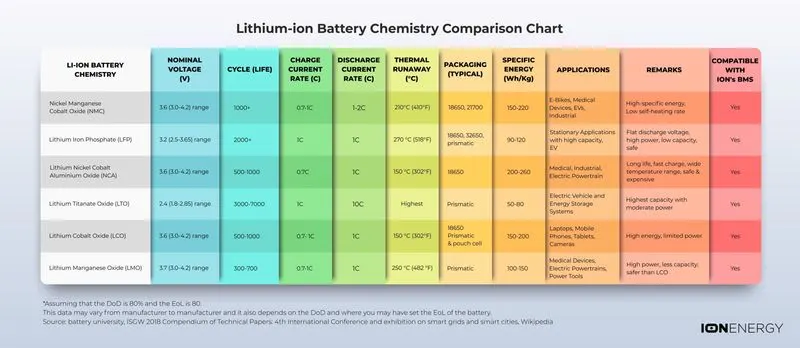
Q2.Compare the differences between each type of Li+ion batteries based on their characteristics.
Conclusion:Future of lithium cells.
Overall most analysts agree there will be a more balanced market for lithium in 2021.We except the market to be largly balanced in 2021 Jeary of CRU said,with mine supply to largly track demand growth.
Reference:
1)https://batteryuniversity.com/article/bu-205-types-of-lithium-ion
3)https://www.sciencedirect.com/science/article/pii/S1369702114004118